| 📊 Alain’s Holdings — September 16, 2026 | ||||
|---|---|---|---|---|
| Symbol | Name | Price | Change | Change % |
| VOO | Vanguard S&P 500 ETF | 693.24 | -2.96 | -0.43% |
| QQQ | Invesco QQQ Trust | 704.72 | +0.18 | +0.03% |
| XIU.TO | iShares S&P/TSX 60 ETF | 52.80 | -0.11 | -0.21% |
The Federal Reserve finally did what Wall Street had been expecting.
It raised interest rates.
For the first time in more than three years, the Fed increased its benchmark rate by 25 basis points Wednesday, bringing the federal funds target range to 3.75%–4.00%.
The decision itself wasn’t much of a surprise.
What came afterward was.
Federal Reserve officials signaled that today’s hike probably won’t be the last one this year.
And Wall Street didn’t particularly like that message.
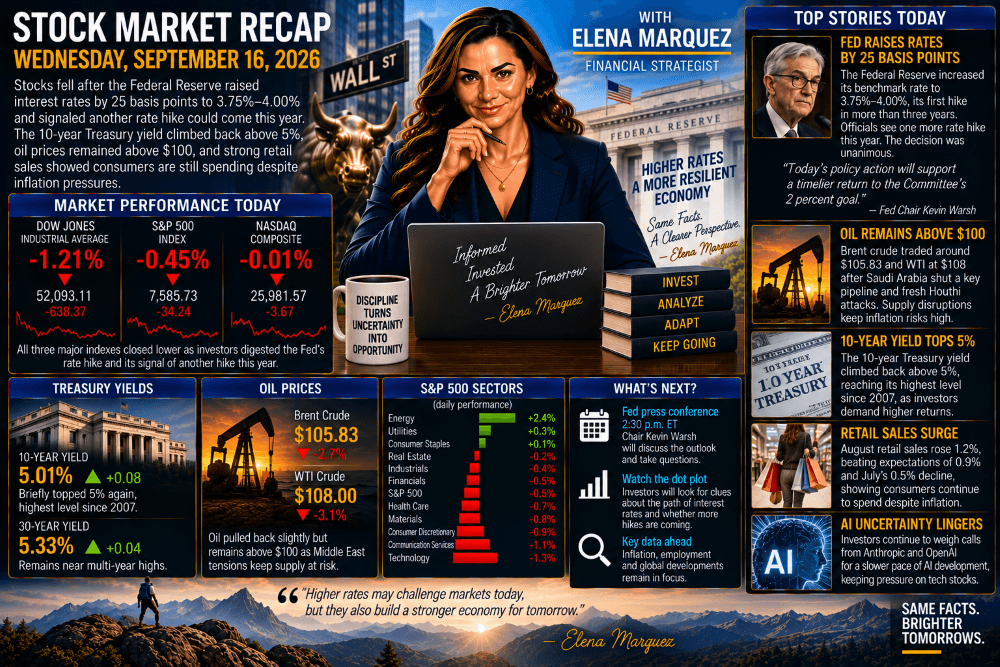
Market Performance
📉 Dow Jones: -1.21%
📉 S&P 500: -0.45%
➖ Nasdaq Composite: -0.01%
Stocks initially searched for direction after the announcement before selling accelerated in the afternoon.
The Dow took the biggest hit, while the Nasdaq managed to finish essentially unchanged.
The message from investors was fairly clear:
One rate hike was already priced in. Another one wasn’t quite as comfortable.
The Fed Raises Rates for the First Time Since 2023
The Federal Open Market Committee voted unanimously to raise rates by a quarter percentage point.
That brings the target range to:
3.75%–4.00%.
The Fed said economic activity continues to expand at a solid pace, domestic spending remains resilient and capital investment is robust.
But one problem hasn’t gone away:
Inflation.
The Fed’s statement was unusually straightforward:
“Today’s policy action will support a timelier return to the Committee’s 2 percent goal.”
In other words, policymakers don’t want to wait and hope inflation eventually disappears.
They’re tightening monetary policy to push it down.
One More Rate Hike Could Be Coming
Today’s rate hike wasn’t the biggest surprise.
The Fed’s new economic projections were.
Sixteen of the 18 policymakers submitting 2026 rate projections expect at least one additional increase before the end of the year.
That makes today’s move look less like an isolated adjustment and more like the beginning of a renewed tightening phase.
That’s a major change in the market narrative.
Not long ago, investors were debating when the Fed might start cutting rates.
Now the question is:
How many times will it raise them?
Kevin Warsh Isn’t Promising Anything
Fed Chairman Kevin Warsh reinforced the central bank’s focus on inflation during his press conference.
But he stopped short of promising another hike.
That’s consistent with the approach Warsh has been signaling since taking over the Fed.
He doesn’t want to give markets explicit forward guidance months in advance.
Instead, future decisions will depend on incoming economic data.
That means investors may have to get used to considerably more uncertainty surrounding each Fed meeting.
For Wall Street, that’s not necessarily comfortable.
But it also means every inflation report, jobs report and oil-price move becomes even more important.
The 10-Year Treasury Is Back Above 5%
The bond market delivered another warning.
The yield on the 10-year Treasury climbed back to approximately 5% following the Fed announcement.
That’s significant for stocks.
When investors can earn around 5% from U.S. government debt, equities face much tougher competition for capital.
Higher yields also increase borrowing costs throughout the economy.
Mortgages.
Corporate bonds.
Commercial real estate.
Auto loans.
And increasingly important:
AI infrastructure.
Building the enormous data centers behind the artificial-intelligence boom requires tremendous amounts of borrowed capital.
The more expensive that capital becomes, the harder companies have to work to justify those investments.
Why Is the Fed Hiking When the 10-Year Is Already at 5%?
This is one of the most interesting questions facing investors.
Financial conditions have already tightened substantially.
Long-term Treasury yields have surged.
Mortgage rates have climbed.
Corporate borrowing has become more expensive.
Yet the Fed is tightening further.
Why?
Because inflation remains stubbornly above the central bank’s 2% target.
And the energy shock has complicated the situation considerably.
Oil Is Still Above $100
Oil finally took a breather Wednesday.
Brent crude fell about 2.7% to roughly $105.83 per barrel.
That’s welcome news.
But let’s keep some perspective.
$106 oil is still expensive oil.
The war in the Middle East and disruptions around the Strait of Hormuz have pushed energy prices dramatically higher in recent months.
And energy eventually finds its way into almost everything.
Transportation.
Food.
Manufacturing.
Air travel.
Construction.
Delivery services.
If businesses pay more to move products, many eventually pass at least some of those costs to consumers.
That’s one reason the Fed isn’t willing to declare victory over inflation.
Strong Retail Sales Complicate the Story
The Fed also received another sign Wednesday that the American consumer remains surprisingly resilient.
August retail sales rose 1.2%.
Economists had expected approximately 0.9%.
That came after a 0.5% decline in July.
Consumers therefore appear to be absorbing higher gasoline prices, higher borrowing costs and persistent inflation without dramatically reducing spending.
That’s good news for the economy.
But it creates a strange problem for the Fed.
A strong consumer makes a recession less likely.
It also makes inflation harder to eliminate.
If households continue spending aggressively, businesses have more ability to raise prices.
So one of the economy’s biggest strengths may also be one reason interest rates remain high.
The Fed Raised Its Growth Forecast
There’s another interesting detail buried inside the Fed’s projections.
Policymakers actually became more optimistic about economic growth.
The Fed now projects real GDP growth of approximately 2.3% in 2026, while unemployment is projected around 4.1%.
That’s hardly a recessionary forecast.
The Fed is essentially saying:
The economy is strong.
Consumers are spending.
Businesses are investing.
The labor market remains stable.
And because the economy can withstand tighter monetary policy, the Fed has room to continue fighting inflation.
That’s very different from a rate hike caused by an overheating economy on the verge of collapse.
Inflation Could Remain Above Target for Years
Perhaps the most sobering part of today’s projections concerns inflation.
Fed policymakers don’t expect inflation to return sustainably to the central bank’s 2% target immediately.
The projections suggest inflation could remain above target through 2029.
That’s a long time.
It also helps explain why the Fed is willing to risk tighter financial conditions today.
Central bankers worry that if inflation remains elevated for too long, businesses and consumers begin expecting it.
Those expectations can become self-reinforcing.
Workers demand larger wage increases.
Companies raise prices in anticipation of higher costs.
Consumers accelerate purchases because they expect prices to rise.
At that point, inflation becomes much harder to eliminate.
The Fed is trying to prevent that cycle.
Why Did the Dow Fall So Much More Than the Nasdaq?
Wednesday produced an interesting divergence.
The Dow fell more than 1.2%.
The Nasdaq barely moved.
That’s notable because higher interest rates have traditionally been especially difficult for technology stocks.
But the current market is more complicated.
Large technology companies continue benefiting from extraordinary AI-related spending and strong earnings expectations.
Meanwhile, higher borrowing costs and energy prices can weigh heavily on industrial, financial and consumer businesses.
The result is that the old relationship between rising yields and falling technology stocks isn’t always playing out as cleanly as investors might expect.
The Fed’s Message Wasn’t Necessarily Bearish
It’s tempting to interpret today’s rate hike as simply bad news.
But there’s another way to look at it.
The Fed believes the economy is strong enough to handle higher rates.
Consumer spending remains resilient.
Business investment is robust.
Employment remains relatively healthy.
And economic growth is running at a respectable pace.
Those aren’t signs of an economy in crisis.
The Fed isn’t raising rates because the economy is collapsing.
It’s raising rates because inflation remains too high and the economy is strong enough to withstand tighter policy.
That’s an important distinction for long-term investors.
The Investment Environment Has Changed
For much of the past decade, investors became accustomed to extraordinarily cheap money.
That environment encouraged:
High stock valuations.
Aggressive corporate borrowing.
Speculative investments.
Expensive real estate.
And enormous technology investments.
Now the environment looks very different.
The Fed funds rate is approaching 4%.
The 10-year Treasury is around 5%.
Oil remains above $100.
And another Fed hike could arrive before the year is over.
Capital has a meaningful cost again.
Companies that generate real cash flow may increasingly have an advantage over businesses whose valuations depend primarily on distant future profits.
The Bottom Line
September 16, 2026 may turn out to be an important date for this market cycle.
The Federal Reserve officially restarted the rate-hiking process.
Fed funds target: 3.75%–4.00%
📉 Dow: -1.21%
📉 S&P 500: -0.45%
➖ Nasdaq: -0.01%
📈 10-year Treasury: ~5%
🛢️ Brent crude: ~$105.83
And Fed officials are signaling that another hike could come before year-end.
For months, Wall Street’s favorite question was:
When will the Fed cut rates?
That question has officially become obsolete.
The new question is:
How high will rates have to go before inflation finally returns to 2%?
The answer could determine what happens next to stocks, bonds, housing, AI investment—and the broader economy.
Other Stock Market blog posts
Leave a Reply