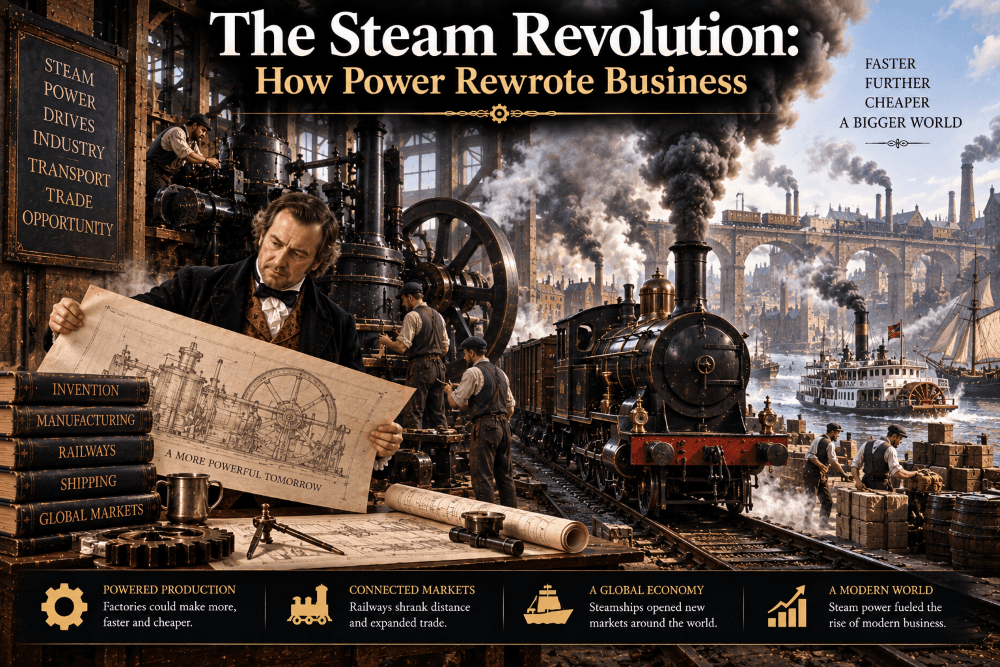
The Steam Revolution was less a single invention than a chain reaction. Once reliable steam power became commercially available in the late 18th century, it didn’t just make existing work faster — it changed where factories could be built, how far goods could travel, how quickly information moved, and which industries were even possible. For entrepreneurs, it represents one of history’s clearest examples of a general-purpose technology reshaping the entire landscape of business opportunity.
What Made the Steam Revolution Different
Earlier power sources placed hard limits on what businesses could do and where they could operate.
- Water wheels required factories to sit beside fast-moving rivers, regardless of whether that location made commercial sense.
- Wind was unreliable and seasonal, making it unsuitable for consistent industrial production.
- Animal and human muscle simply couldn’t scale to the output that growing markets demanded.
Steam removed the geographic constraint entirely. A factory could now be built near coal, near labor, near customers, or near a port, based on business logic rather than the location of a suitable river.
How the Steam Revolution Transformed Manufacturing
Freeing Factories From Geography
The relocation of industry may be the most underappreciated consequence of the Steam Revolution.
- Factories clustered near coalfields, since coal was the fuel that made steam engines run.
- Industrial cities grew rapidly around these clusters, drawing enormous populations from rural areas.
- Manufacturing concentrated in regions like the English Midlands and northern England, creating industrial hubs that shaped national economies for a century.
This concentration created dense networks of suppliers, skilled workers, and specialized knowledge — the industrial equivalent of what modern economists call clustering effects.
Scaling Output Beyond Previous Limits
Steam power allowed individual businesses to reach production volumes that earlier methods couldn’t approach.
- A single engine could drive dozens of machines simultaneously through belts and shafts.
- Production could run continuously rather than depending on seasonal water flow or daylight.
- This consistency made it possible to plan output, commit to large orders, and serve distant markets reliably.
Steam Transport and the Collapse of Distance
Railways Rewrite the Map
Railways transformed steam from a factory technology into an economy-wide one.
- Goods that once took days to move overland could travel in hours, dramatically lowering transport costs.
- Perishable products, including fresh food and dairy, could reach urban markets for the first time.
- Entire new industries emerged around railways themselves: locomotive manufacturing, rail construction, signaling, and station commerce.
Railways also demanded unprecedented amounts of capital, driving the growth of investment markets and corporate finance structures explored elsewhere in this series.
Steamships and Global Trade
At sea, steam power broke sailing’s dependence on wind and seasonal patterns.
- Steamships could maintain predictable schedules regardless of prevailing winds, making international shipping far more reliable.
- Journey times across the Atlantic and to Asia dropped substantially, accelerating trade and migration alike.
- Reliable schedules made it possible to plan international business around known delivery dates rather than rough estimates.
The Business Consequences of the Steam Revolution
New Industries, New Fortunes
The Steam Revolution created entire categories of business that hadn’t previously existed.
- Coal mining expanded enormously to feed industrial demand for fuel.
- Iron and steel production grew to supply engines, rails, ships, and machinery.
- Engineering firms, machine tool makers, and specialized component suppliers emerged to serve industrial customers.
Standardized Time and Coordination
One overlooked consequence: railways forced societies to standardize how they measured time.
- Before railways, towns kept their own local time based on the sun, making coordinated schedules impossible.
- Rail networks required synchronized timetables across regions, driving the adoption of standard time zones.
- This standardization became essential infrastructure for coordinating business activity at scale.
Human and Environmental Costs
The Steam Revolution’s benefits came with significant costs that shouldn’t be minimized.
- Rapid urbanization created overcrowded, unsanitary industrial cities with serious public health consequences.
- Coal mining and factory work involved genuinely dangerous conditions, with high injury and mortality rates.
- Coal-driven industrialization marked the beginning of large-scale fossil fuel use and its long-term environmental consequences.
Lessons from the Steam Revolution
- General-purpose technologies reshape everything. Steam’s impact extended far beyond the machines themselves into geography, finance, and time itself.
- Removing constraints creates opportunity. Freeing factories from riverside locations opened business possibilities no one had planned for.
- Infrastructure enables the next wave. Railways and steamships became the foundation on which later commercial expansion was built.
Frequently Asked Questions
What was the Steam Revolution? It refers to the period when commercially viable steam power transformed manufacturing, transport, and trade, beginning in the late 18th century and reshaping economies throughout the 19th century.
How did steam power change where factories were built? Steam freed factories from needing riverside locations for water power, allowing them to be built near coal supplies, labor pools, ports, or customers based on business considerations instead.
Why were railways so important to the Steam Revolution? Railways dramatically cut transport costs and times, opened distant markets, enabled perishable goods trade, created entire new industries, and drove the growth of large-scale investment markets.
What were the downsides of the Steam Revolution? Rapid industrialization brought overcrowded and unsanitary cities, dangerous working conditions in mines and factories, and the beginning of large-scale fossil fuel consumption.
Related Articles
- The Rothschilds: How Information Built a Banking Empire
- Robert Owen: The Factory Owner Who Chose Workers
- Josiah Wedgwood: The Man Who Invented Branding
- Matthew Boulton: The Industrialist Who Scaled Genius
- James Watt: The Steam Engine That Powered Industry
- Richard Arkwright: The Father of the Factory System
- The Industrial Revolution: How Machines Multiplied Human Productivity
About The History of Entrepreneurship
This article is part of The History of Entrepreneurship, an ongoing series exploring how civilizations, technologies, entrepreneurs, investors, institutions, and markets gradually created the foundations of modern business.
Leave a Reply