| 📊 Alain’s Holdings — September 17, 2026 | ||||
|---|---|---|---|---|
| Symbol | Name | Price | Change | Change % |
| VOO | Vanguard S&P 500 ETF | 701.03 | +7.79 | +1.12% |
| QQQ | Invesco QQQ Trust | 716.92 | +12.20 | +1.73% |
| XIU.TO | iShares S&P/TSX 60 ETF | 53.23 | +0.43 | +0.81% |
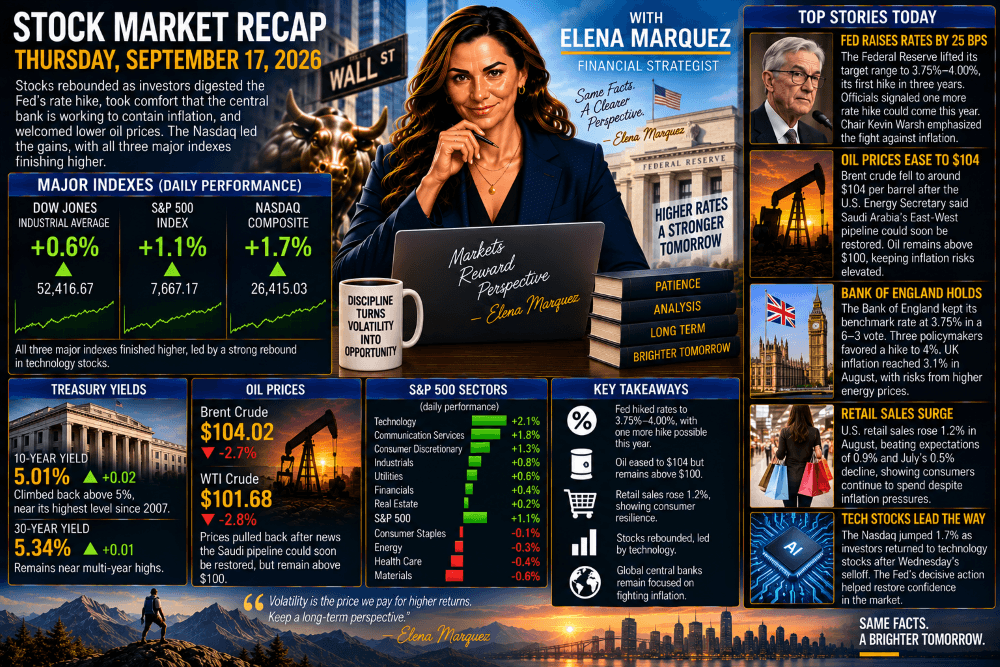
Wall Street rebounded sharply Thursday, recovering from Wednesday’s post-Fed selloff as investors grew more comfortable with the Federal Reserve’s decision to raise interest rates and oil prices eased.
📈 Major Indexes
| Index | Daily Move |
|---|---|
| Nasdaq Composite | +1.7% |
| S&P 500 | +1.1% |
| Dow Jones | +0.6% |
The Nasdaq led the recovery, as investors returned to technology stocks following Wednesday’s cautious reaction to the Fed.
The Nasdaq led the recovery, as investors returned to technology stocks following Wednesday’s cautious reaction to the Fed.
🏦 Markets Digest the Fed Rate Hike
Wednesday’s 25-basis-point Federal Reserve rate hike initially rattled markets. But sentiment improved Thursday as investors interpreted Chair Kevin Warsh’s inflation-focused message as evidence that the central bank is determined to prevent elevated inflation from becoming entrenched.
The Fed raised its target range to 3.75%–4.00%, its first increase in three years, while policymakers’ projections indicated another hike could come before year-end.
The shift in sentiment is important: investors appear to be weighing the near-term cost of higher interest rates against the possibility that decisive Fed action could ultimately bring inflation under better control.
🛢️ Oil Retreats to $104
Another source of relief came from the energy market.
Brent crude slipped to around $104 per barrel, after weeks of soaring energy prices fueled by disruptions associated with the Middle East conflict.
According to the information you provided, US Energy Secretary Chris Wright said Saudi Arabia’s East-West pipeline could soon be restored. If additional capacity becomes available, it could provide an alternative route for crude affected by disruptions around the Strait of Hormuz.
Oil remains extremely elevated, however, meaning energy prices continue to represent one of the biggest inflation risks facing the Fed.
🇬🇧 Bank of England Holds Rates
Across the Atlantic, the Bank of England kept its benchmark rate at 3.75% in a 6–3 vote. Three policymakers favored raising it to 4%.
The Bank said UK inflation reached 3.1% in August and warned that persistent Middle East-related energy disruptions could push inflation higher.
That highlights the increasingly global nature of the problem: central banks are confronting renewed inflation pressure largely driven by energy prices at the same time that they are trying to avoid unnecessarily damaging economic growth.
🔎 Bottom Line
Thursday brought a convincing rebound after Wednesday’s Fed-driven decline.
The Nasdaq’s 1.7% surge suggests investors were willing to move back into growth and technology stocks despite higher interest rates. Meanwhile, falling oil prices offered some breathing room on the inflation front.
But the underlying tension hasn’t disappeared. The Fed has begun tightening again, oil remains above $100, and another US rate hike could arrive before the end of 2026.
For now, investors appear to be taking the view that a Fed willing to confront inflation may ultimately be better for markets than allowing inflation expectations to become entrenched.
Other Stock Market blog posts
Leave a Reply