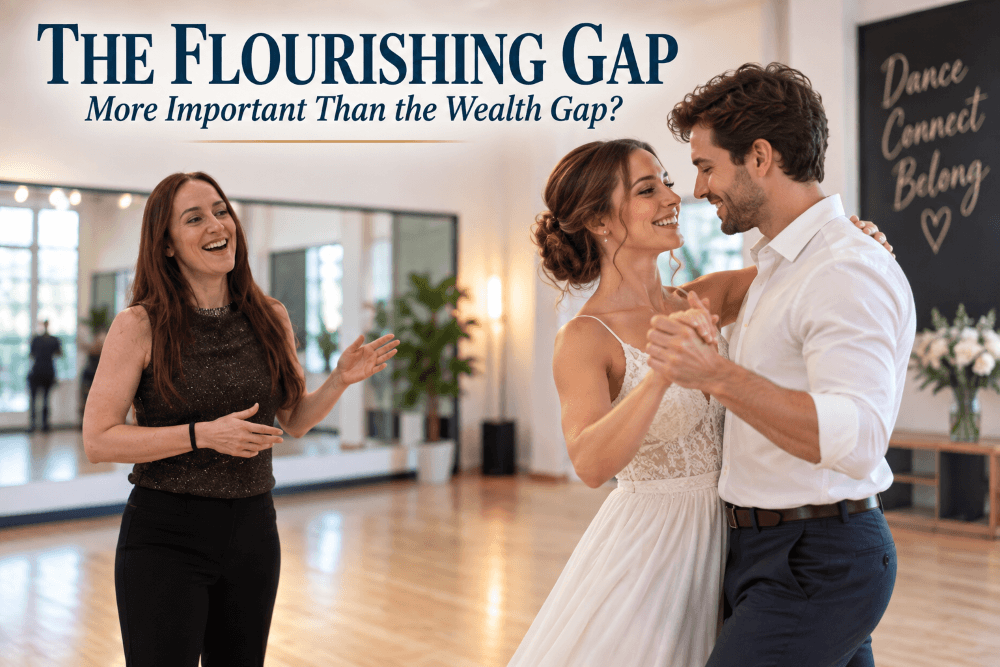
My dance partner Cheryl is teaching dance to a young engaged couple who is preparing for their first dance at their wedding. I saw some photos of them, and they look gorgeous.
They are young. They are beautiful. They both have good, rewarding jobs. They have parents who love them. They are in love with each other, preparing to get married, and apparently have their whole lives ahead of them.
Looking at their photos, I had a simple thought: I wish I were them.
Of course, I don’t really know their lives. Photographs don’t show us people’s worries, insecurities, family problems, or private struggles. Perhaps their lives are far less perfect than they appear.
But seeing them made me think about something I will call the flourishing gap: the enormous inequality between people not simply in how much money they have, but in how many of life’s good things they possess at the same time.
And I wonder whether the flourishing gap deserves at least as much attention as the wealth gap.
We Talk Constantly About the Wealth Gap
We hear a great deal about economic inequality.
Someone struggling to pay the rent is compared with Elon Musk or another billionaire. We calculate income inequality, wealth inequality, CEO compensation, home ownership, and the percentage of wealth controlled by the richest 1%.
Those are legitimate subjects.
Money matters enormously. Poverty creates stress, limits choices, damages health, and can make almost every other problem in life more difficult.
But money is only one component of a good life.
Imagine someone who has a reasonable income but is suffering from a serious illness. Or someone with plenty of money who is desperately lonely.
Imagine someone who has no partner, few friends, a job they hate, poor health, and no close family.
Now compare that person with someone who has enough money, excellent health, a loving spouse, supportive parents, close friends, an enjoyable career, and an optimistic future.
The difference between those two lives cannot adequately be described by looking at their bank accounts.
That is the flourishing gap.
What Is the Flourishing Gap?
The flourishing gap is the inequality between people in their access to the ingredients of a good life.
Those ingredients might include:
- Physical and mental health
- Love and romantic companionship
- Family support
- Friendship and community
- Financial security
- Meaningful and rewarding work
- Education and useful skills
- Personal freedom and autonomy
- A sense of purpose
- Safety and stable housing
- Social belonging
- Hope for the future
None of these guarantees happiness.
But having several of them certainly makes life easier. More importantly, these advantages often reinforce one another.
Advantages—and Disadvantages—Compound
This is what makes the flourishing gap particularly interesting to me.
A young person who grows up with loving parents may develop greater confidence. That confidence may help them make friends, perform better at school, take reasonable risks, and pursue better employment opportunities.
A good job provides financial security. Financial security reduces certain forms of stress. Better health makes it easier to exercise, socialize, date, work, travel, and participate in the community.
Then perhaps that person meets a loving partner.
The advantages begin to compound.
Unfortunately, disadvantages can compound too.
A person with poor health may have difficulty maintaining employment. Financial difficulties create stress. Stress can damage relationships. Loneliness can make it harder to remain optimistic and motivated.
Losing a job can eventually mean losing a home. Losing a spouse can mean losing part of a social network. Poor mental health can make it more difficult to build the relationships that might improve one’s mental health.
Life isn’t a spreadsheet in which every disadvantage remains neatly in its own column.
Everything interacts.
The Flourishing Gap Can Be Bigger Than the Wealth Gap
Suppose Person A earns $50,000 a year and Person B earns $100,000.
We can easily see the income difference.
But imagine that Person A is healthy, happily married, surrounded by friends, enjoys their work, and has parents and siblings who would immediately help during a crisis.
Person B earns twice as much but suffers from chronic illness, hates their job, lives alone, has no close friends, and hasn’t spoken to their family in years.
Who is richer?
Financially, the answer is obvious.
In terms of life, it isn’t obvious at all.
This is why I think our conversations about inequality are incomplete. We have become very good at measuring money because dollars are easy to count.
Love isn’t.
Neither are friendship, health, purpose, belonging, beauty, youth, optimism, or having someone who is delighted to see you when you come home.
Yet these things can matter more than another zero on a bank statement.
We Shouldn’t Resent People Who Are Flourishing
There is an important danger in talking about this kind of inequality.
The goal should not be to make fortunate people feel guilty.
When I look at Cheryl’s young engaged couple, I don’t want them to have less. I want them to have everything they appear to have and more.
I hope they have a wonderful wedding. I hope their marriage lasts for decades. I hope they remain healthy, have successful careers, maintain strong relationships with their families, and dance together when they are 80.
The same principle applies to billionaires and other wealthy people. We shouldn’t resent them simply because they have more money than we do. We don’t know what price they may have paid to acquire that wealth—the years of work, sacrifices, risks, stress, or relationships neglected along the way. More importantly, we don’t know whether they are happy. A person can be extraordinarily rich financially while being poor in health, love, friendship, family relationships, peace of mind, or purpose. A bank account tells us how much money someone has; it tells us very little about how rich their life actually is.
The purpose of recognizing the flourishing gap should not be to pull flourishing people downward.
It should be to ask how we can help more people move upward.
How Can We Narrow the Flourishing Gap?
Governments can do income redistribution, taking away (thorugh taxation) from the rich to give to the poor. Government can no to take beauty from a beautiful person to give to a fat ugly person. Governments cannot manufacture love. No government program can guarantee friendship, good health, a happy marriage, or a sense of purpose.
Money cannot guarantee them either.
But that doesn’t mean we are powerless.
1. Fight Extreme Poverty
Money isn’t everything, but a minimum level of financial security matters enormously.
People have a much better chance of building satisfying lives when they aren’t constantly worried about food, housing, transportation, or an unexpected $500 expense.
Economic growth, employment, education, affordable housing, and sensible social safety nets can give people the foundation from which flourishing becomes more possible.
2. Take Loneliness Seriously
We often treat loneliness as a private problem when it is increasingly a social one.
People need places where relationships can form naturally: dance classes, sports clubs, churches, community organizations, volunteer groups, libraries, neighborhood events, hobby clubs, and public spaces.
I see this through dancing.
People may initially come to a dance class to learn salsa or bachata, but they also meet people. They talk. They laugh. They become part of a community.
Some make friends.
Some even fall in love. Many people have met, fallen in love, and gotten married after attending classes at our school Dance Conmigo.
That social value is difficult to measure, but it is real.
3. Make It Easier to Build Strong Families
Stable, loving families are an enormous source of human wealth.
Society should make it easier—not harder—for people to raise children, spend time together, care for elderly parents, and maintain family relationships.
We should also recognize that not everyone has a supportive biological family. Friends, mentors, neighbors, and community organizations can sometimes become a person’s chosen family.
4. Improve Access to Health
A million dollars means something very different to a healthy person than to someone whose entire life is dominated by illness.
Preventive healthcare, exercise, nutritious food, mental-health support, and opportunities for physical activity can have effects that go far beyond medical outcomes.
Health gives people the ability to participate in life.
5. Help People Develop Social Skills
We spend years teaching children mathematics, grammar, and history while sometimes giving surprisingly little attention to the skills they will use in almost every human interaction.
How do you make a friend?
How do you ask someone on a date?
How do you resolve a disagreement?
How do you listen?
How do you apologize?
How do you become comfortable talking to strangers?
These skills affect careers, marriages, friendships, and happiness. Perhaps we should treat them as seriously as many academic skills.
6. Create More Paths to Purpose
People need to feel useful.
Purpose can come from a profession, entrepreneurship, raising children, caring for someone, creating art, volunteering, teaching, religion, community service, or hundreds of other activities.
A flourishing society should offer people opportunities not merely to consume entertainment, but to contribute.
Some Inequality Can Never Be Eliminated
There is also an uncomfortable reality we should acknowledge.
Life will never be fair.
Some people are born healthy; others are born with disabilities. Some are naturally attractive, athletic, outgoing, or academically gifted. Some grow up with extraordinary parents. Others grow up surrounded by instability.
Some meet the love of their life at 25.
Others search for decades and never find that person.
No tax system can redistribute youth. No government program can guarantee romantic love. We cannot transfer ten years of good health from one person to another.
Recognizing those limits, however, doesn’t mean accepting every disadvantage as inevitable.
We can still create a society in which fewer people are isolated, fewer children grow up without support, fewer people live in desperate poverty, and more people have opportunities to form relationships, develop skills, find meaningful work, and participate in their communities.
The Goal Should Be More Human Flourishing
When we talk about inequality, perhaps we should ask a bigger question than “How much money does everyone have?”
We should ask: “How many people have a reasonable opportunity to build a good life?”
Wealth matters because it is one of the tools that makes a good life easier.
But it is a tool, not the final objective.
The young couple Cheryl is teaching may be wealthy or they may not be. I don’t know.
What struck me about them wasn’t their bank account.
It was the abundance surrounding them: youth, health, beauty, careers, family, love, and a future they are preparing to build together.
That is a form of wealth that doesn’t appear on a balance sheet.
Perhaps one of the great challenges of a prosperous society should be figuring out how to spread more of those opportunities—not by taking happiness away from people who have found it, but by giving more people a realistic chance to flourish.
If we could narrow that flourishing gap, we might reduce an inequality that matters even more than money.
Frequently Asked Questions
What is the flourishing gap?
The flourishing gap is the difference between people in their access to the conditions that help create a good life, including health, relationships, financial security, meaningful work, community, purpose, and hope for the future.
How is the flourishing gap different from the wealth gap?
The wealth gap measures differences in financial assets and economic resources. The flourishing gap is broader because it considers non-financial forms of well-being such as health, love, friendship, family support, purpose, and belonging.
Can governments reduce the flourishing gap?
Governments cannot guarantee happiness, love, or friendship. They can, however, improve the conditions that make flourishing more likely through education, healthcare, economic opportunity, public safety, social infrastructure, and support for people facing severe hardship.
Can the flourishing gap ever be eliminated?
Probably not. Luck, genetics, health, family circumstances, relationships, and unexpected events will always create differences between people’s lives. A realistic objective is not perfect equality but giving more people the opportunity and tools to build fulfilling lives.
Other Personal Development Posts
Leave a Reply