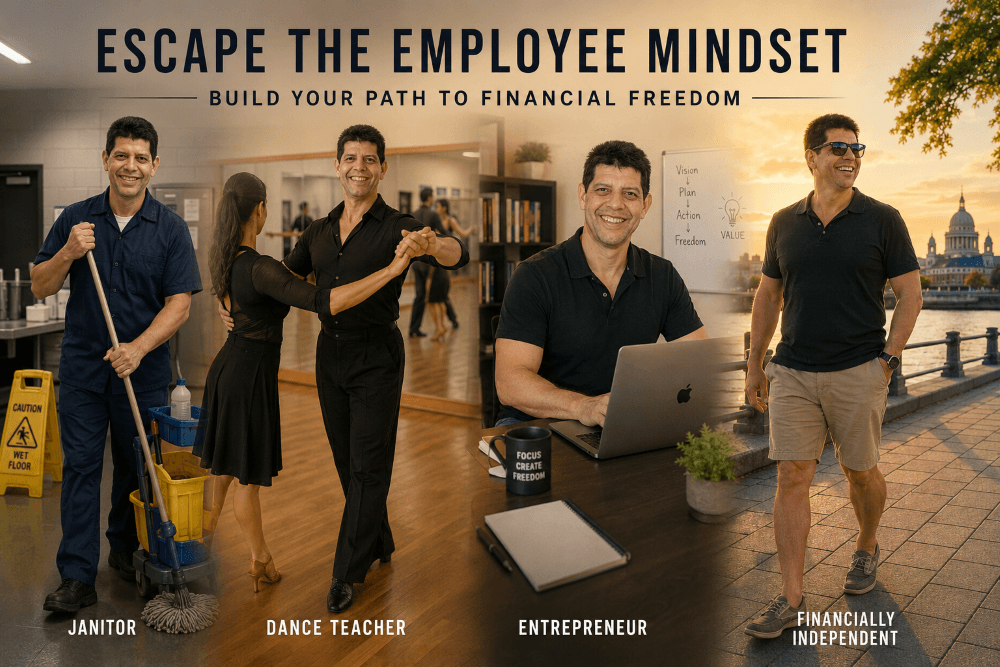
If you want to escape the employee mindset, you first have to recognize the bargain most employees make: they exchange a significant amount of freedom for the perceived security of a regular paycheck.
There is nothing inherently wrong with making that trade. I made it myself when I arrived in Canada. Sometimes employment is exactly what we need.
The mistake is believing that employment is the only way to live.
I believe every employee should eventually develop an escape plan.
The Hidden Price of Job Security
Employees are often told that having a job provides security.
But how secure is a job when someone else can take it away from you?
An employee depends heavily on his employer. The employer determines the employee’s responsibilities, schedule, workplace policies, compensation and often even when the employee can take vacation.
Of course, employees have legal rights and can negotiate certain conditions. Some employees also have considerable autonomy.
But ultimately, the employer owns the job.
If your boss decides that your performance is inadequate, your position is unnecessary or someone else could do the work better, your employment can end.
And losing a job can cost much more than a paycheck.
It can affect your:
- professional reputation
- career progression
- references
- future employment opportunities
- financial stability
- health insurance or other benefits
- sense of personal security
The longer someone depends on one employer, the greater that dependency can become.
Employees Have More to Lose
Compare an employee with an independent contractor.
Suppose I have ten clients and one client fires me.
That’s unfortunate.
But it’s business.
I still have nine clients, and tomorrow I can start looking for number ten.
Now imagine an employee with one employer.
That employer represents 100% of his employment income.
Losing that relationship can suddenly become a financial emergency.
Ironically, what we call “job security” can create enormous economic dependency.
The Provocative Comparison With Slavery
I sometimes think about employment using an intentionally uncomfortable historical analogy.
An employee can sometimes behave as though his time belongs to someone else.
For eight hours a day—or whatever schedule has been established—someone else largely determines where he should be and what he should be doing.
But an important distinction needs to be made.
Employment is not slavery.
Historical slavery involved people being legally treated as property, subjected to violence and coercion, separated from their families and denied the fundamental freedom to leave. Modern employees generally have legal rights, receive wages and can resign.
Those differences are enormous.
What interests me about the comparison is not ownership of the person. It is control over one’s time and economic dependence on another person or organization.
Freedom exists on a spectrum.
Someone can be legally free while still organizing almost his entire economic life around keeping one employer happy.
Escape the Employee Mindset: Who Owns Your Time?
Time is our most valuable possession because it is the one thing we can never replace.
Yet employees routinely sell large blocks of it.
Imagine arriving at work Monday morning and discovering that there isn’t much to do.
Can you simply say:
“There’s nothing important for me to do today, so I’m going home”?
Usually not.
You aren’t necessarily being paid for accomplishing a specific result. You are often being paid for making your time available to the employer.
That’s one of the biggest differences between employment and entrepreneurship.
An entrepreneur is generally focused on results.
A client doesn’t care whether I worked two hours or eight hours if I delivered what I promised.
That distinction changed the way I thought about work.
Your Employer Can Influence What You Say
Economic dependency can also influence behavior outside the workplace.
Employees increasingly have to think about whether something they say publicly could damage their careers.
A controversial social media post can potentially create problems with an employer. Public comments that embarrass a company or anger customers can have professional consequences.
During COVID, workplace disputes over masking, vaccination requirements and other policies also demonstrated how strongly employment can affect personal choices.
Regardless of which side of those debates you supported, the lesson was obvious:
The person who controls your paycheck has considerable influence over your behavior.
The easiest way to control someone doesn’t necessarily involve physical force.
Sometimes economic dependence is enough.
Why Contractors Think Differently
Being self-employed doesn’t guarantee security.
In fact, self-employment can be incredibly insecure.
Clients disappear. Businesses fail. Income fluctuates. Competitors emerge.
But there’s an important psychological difference.
Losing a client is expected.
If you are a freelancer with ten clients and one disappears, you don’t usually conclude that your career has ended.
You find another client.
The independent worker gradually learns an extremely valuable skill:
how to create income instead of waiting for someone to provide it.
That ability creates resilience.
Employment Can Be a Useful Stage of Life
I don’t believe everyone should quit their job tomorrow.
That would be foolish advice.
Most people need employment at some point in their lives. A job provides income, experience, contacts and an opportunity to learn.
The question is what you do while you have it.
You can use employment as your permanent destination.
Or you can use it as a platform from which to build something else.
Your job can finance your freedom.
Build Your Escape Plan While You’re Still Employed
Historically, some enslaved people obtained freedom through manumission, including cases where they accumulated money and purchased their freedom. Others escaped or were freed through different circumstances.
Obviously, modern employees don’t need to purchase their legal freedom.
But there is an interesting financial lesson here.
You can accumulate the resources necessary to purchase your economic independence.
Instead of consuming every dollar you earn, use some of your income to create alternatives.
Your escape plan might include:
- Learning a marketable skill. Develop something people will pay you to do independently.
- Starting a side business. Find your first customer before leaving your employer.
- Building multiple sources of income. Reduce your dependence on any single paycheck.
- Saving and investing aggressively. Capital gives you choices.
- Keeping your lifestyle under control. The more money you need every month, the harder it is to walk away.
- Learning how to sell. If you know how to find customers, you will always have more options.
The objective isn’t necessarily to become a millionaire.
The objective is to be able to say no.
That’s one of the greatest privileges money can buy.
My Escape Plan Started With a Mop
When I came to Canada, I didn’t understand the system.
I didn’t have money. I didn’t have a valuable skill I could sell. I didn’t have a business waiting for me.
So I did what I had to do.
I took low-paying jobs.
I worked as a janitor. I stacked food on supermarket shelves. I prepared sandwiches.
There is absolutely nothing shameful about doing those jobs. They allowed me to survive.
But I knew I didn’t want to spend the rest of my life doing them.
While I was working, I was crafting my escape plan.
Dance Became My First Door to Freedom
I learned how to dance.
More importantly, I learned a skill that other people were willing to pay me to teach.
Eventually, I started teaching dance independently and created my own dance school.
That was the beginning.
For the first time, I understood something that would shape the rest of my life:
I didn’t need an employer to give me money. I needed customers willing to pay me for creating value.
That’s a completely different way of looking at the world.
Once you understand how to create your own income, employment becomes an option rather than a necessity.
Then I Learned How to Stay Free
Becoming self-employed wasn’t the end of my escape plan.
It was the beginning.
I continued developing skills. I experimented with other businesses. I learned about investing, saving and creating income independently.
Some things worked.
Others didn’t.
That’s entrepreneurship.
But every new skill and every additional dollar of capital made me slightly less dependent on someone else.
Approximately 20 years after arriving in Canada, I became financially independent.
Nobody could fire me.
Nobody could threaten to take away my paycheck.
And perhaps most importantly, I had control over my time.
Financial Independence Is the Ultimate Escape Plan
Entrepreneurship creates one kind of freedom.
Financial independence creates another.
A self-employed person still needs customers.
An entrepreneur still needs revenue.
But once your accumulated investments can support your lifestyle, something fundamental changes.
Work becomes optional.
You can work because you enjoy it, because you want to create something, because you want intellectual stimulation or simply because you want more money.
But you don’t have to work because you’re afraid of missing next month’s rent.
That is my definition of financial freedom.
Don’t Quit Your Job—Use It
If you are currently an employee, I am not telling you to walk into your boss’s office tomorrow and resign.
Quite the opposite.
Use your job strategically.
Collect your paycheck.
Learn everything you can.
Build relationships.
Save money.
Invest.
Develop another skill.
Find your first customer.
Start something on weekends.
Create an income stream that doesn’t depend on your employer.
Then create another.
The goal is not to escape employment recklessly.
The goal is to reach the point where employment becomes a choice.
Freedom Is the Ability to Walk Away
Many people spend decades trying to become indispensable to their employers.
I think there is a better objective.
Become independent of them.
Do your job well. Be professional. Provide value. Build a good reputation.
But quietly build your own economic foundation at the same time.
Your employer should never be your entire financial plan.
The greatest career security doesn’t come from having a supposedly secure job.
It comes from knowing that if the job disappears tomorrow, you know how to survive without it.
That’s why I believe everyone should have an escape plan.
Not because employment is literally slavery.
But because your time belongs to you.
And the more economically independent you become, the more power you have to decide how to use it.
Frequently Asked Questions
Is being an employee the same as being a slave?
No. Historical slavery involved legal ownership, coercion and the denial of fundamental human freedom. The comparison in this article concerns the narrower issues of control over time and economic dependence. Employees have legal rights and can leave their jobs.
How can I escape the employee mindset without quitting my job?
Start while you are still employed. Learn a marketable skill, save money, invest, start a small side business and try to acquire your first independent customers. Build alternatives before giving up your paycheck.
Is self-employment more secure than having a job?
Not necessarily. Self-employment brings different risks, including fluctuating income and losing clients. Its advantage is that you can build multiple customer relationships rather than depending entirely on one employer.
What is the ultimate goal of an employee escape plan?
The goal isn’t simply to quit your job. It is to create enough skills, income sources and financial assets that employment becomes a choice rather than an economic necessity.
Other Personal Development Posts