| 📊 Alain’s Holdings — September 25, 2026 | ||||
|---|---|---|---|---|
| Symbol | Name | Price | Change | Change % |
| VOO | Vanguard S&P 500 ETF | 710.79 | +3.80 | +0.54% |
| QQQ | Invesco QQQ Trust | 744.50 | +3.40 | +0.46% |
| XIU.TO | iShares S&P/TSX 60 ETF | 53.08 | +0.13 | +0.25% |
Wall Street finished the week on a positive note Friday, despite a bond market that continues to send warning signals.
The biggest source of relief came from oil.
After weeks of surging energy prices, crude finally moved meaningfully lower, easing some of the inflation fears that have dominated markets throughout September.
Meanwhile, Treasury yields remained exceptionally high, consumer confidence weakened, and President Donald Trump and Chinese President Xi Jinping wrapped up a closely watched summit that produced few major breakthroughs.
Yet stocks climbed anyway.
Market Performance
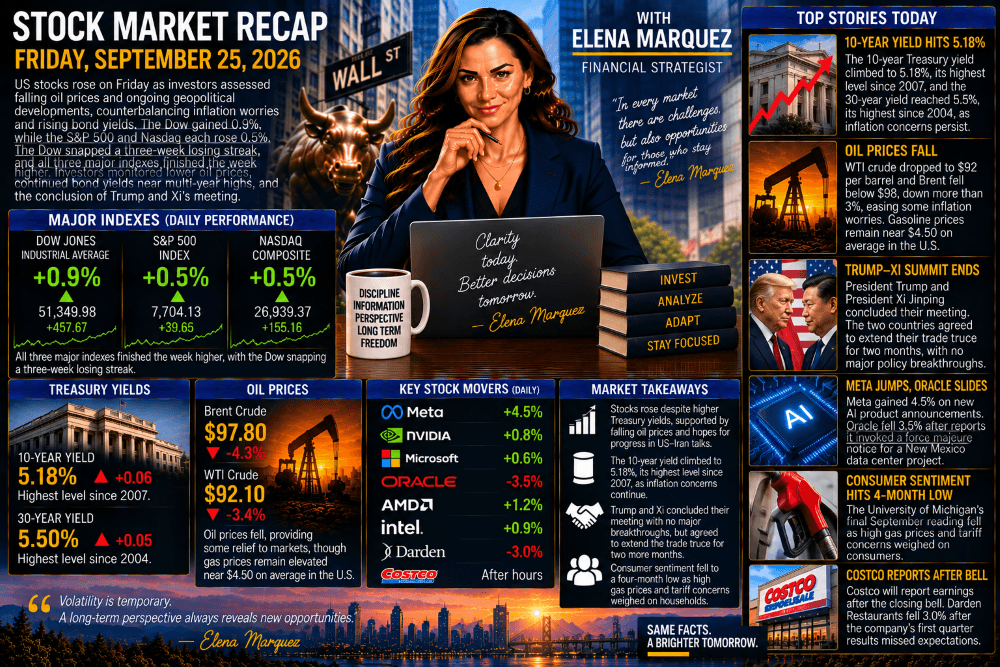
📈 Dow Jones: +0.9%
📈 S&P 500: +0.5%
📈 Nasdaq Composite: +0.5%
Friday’s gains were enough for the Dow to snap a three-week losing streak.
The S&P 500 and Nasdaq also finished the week higher.
Considering the turmoil we’ve seen recently in oil, bonds, inflation expectations and geopolitics, that’s a surprisingly resilient finish.
The Bond Market Still Isn’t Happy
The biggest warning signal continues to come from US Treasurys.
The 10-year Treasury yield climbed to roughly 5.18% Friday, hovering around levels not seen since the global financial crisis.
That’s important because Treasury yields influence borrowing costs throughout the economy.
Higher yields mean:
🏠 More expensive mortgages
🚗 More expensive auto loans
🏢 Higher corporate borrowing costs
🤖 More expensive AI infrastructure financing
💳 More expensive consumer credit
And there’s another problem for stocks.
When investors can earn around 5% from relatively safe US government bonds, expensive stocks suddenly have more competition.
That’s especially relevant for high-growth technology companies whose valuations depend heavily on profits expected years into the future.
“Not a Crisis, but an Eye-Opener”
BlackRock’s Rick Rieder offered an interesting description of the recent bond selloff:
“Not a crisis but an eye-opener.”
That’s probably a useful way to think about what’s happening.
The financial system isn’t breaking.
But investors are demanding considerably more compensation to lend money long-term.
Several forces are contributing:
Persistent inflation.
Heavy government borrowing.
Expensive energy.
Expectations for additional Federal Reserve tightening.
And enormous corporate borrowing requirements—including financing for the AI infrastructure boom.
For years, cheap capital helped support rising asset prices.
Today, money isn’t cheap anymore.
Finally, Some Relief From Oil
If bonds were Friday’s warning sign, oil was the good news.
🛢️ WTI crude fell toward $92 per barrel.
🛢️ Brent crude traded below $100.
That’s a significant retreat from the $100+ prices we’ve seen recently.
Oil has become one of the most important variables driving this market because of its direct connection to inflation.
We’ve repeatedly watched this chain reaction:
Oil ↑ → Inflation fears ↑ → Fed expectations ↑ → Treasury yields ↑ → Stocks pressured
Friday offered investors the possibility of the opposite:
Oil ↓ → Inflation pressure ↓ → Fed pressure ↓ → Stocks supported
One day doesn’t establish a trend.
But Wall Street clearly welcomed the relief.
Consumers Are Feeling the Pressure
Unfortunately, cheaper oil hasn’t reached consumers yet.
Average US gasoline prices are approaching $4.50 per gallon, putting additional pressure on household budgets already dealing with years of higher prices.
That showed up in Friday’s economic data.
The University of Michigan’s final September consumer sentiment reading fell to a four-month low.
Consumers remain worried about inflation, tariffs and everyday living costs.
This creates an interesting disconnect.
The labor market remains relatively strong.
Consumers are still spending.
But they’re increasingly unhappy about what their money buys.
We’ve seen this story repeatedly in corporate earnings.
People haven’t stopped spending.
They’re becoming much more selective.
Trump and Xi Wrap Up Their Summit
Another major event concluded Friday as Chinese President Xi Jinping finished his visit to Washington.
The summit produced plenty of symbolism.
There was a formal White House dinner.
A red carpet.
And some of America’s most powerful business leaders were in attendance.
But there were relatively few major policy breakthroughs.
The United States and China appear likely to maintain the existing trade relationship for at least the next several months.
For markets, that may actually be enough.
Investors weren’t necessarily expecting a grand agreement.
Avoiding a major escalation in tariffs or technology restrictions removes one potential source of immediate uncertainty.
AI Moves From Silicon Valley to Washington
Perhaps the most interesting aspect of Xi’s visit was the presence of America’s technology leaders.
AI has become much more than a business story.
It’s increasingly part of foreign policy.
The United States and China are competing across:
🤖 Artificial intelligence
💻 Semiconductors
⚡ Data-center infrastructure
🔋 Energy
🧲 Critical minerals
🏭 Advanced manufacturing
The executives running America’s biggest technology companies are therefore becoming increasingly important players in geopolitical discussions.
That tells us something about where economic power is moving.
In the 20th century, governments worried about oil, steel and industrial manufacturing.
In the 21st century, computing power may be just as strategically important.
The AI Boom Meets 5% Interest Rates
That brings us back to the bond market.
AI companies want to build hundreds of billions—and eventually perhaps trillions—of dollars worth of infrastructure.
Data centers.
Semiconductor fabs.
Power generation.
Networking equipment.
Cooling systems.
Transmission lines.
All of it requires capital.
When Treasury yields were 2%, financing enormous projects was relatively inexpensive.
When Treasurys yield more than 5%, the calculation changes.
The AI boom doesn’t necessarily stop.
But investors begin demanding something very important:
Returns.
The question is slowly shifting from:
“How much can companies spend on AI?”
to:
“How much money will those investments actually generate?”
That could become one of the defining questions for markets in 2027.
A Positive End to a Complicated Week
Despite all the uncertainty, stocks ended Friday higher.
And perhaps more importantly, all three major indexes finished the week with gains.
The Dow snapped its three-week losing streak.
The Nasdaq remained supported by enthusiasm surrounding artificial intelligence.
And the S&P 500 once again demonstrated its ability to absorb bad news.
Investors are dealing with an unusual combination:
📈 Treasury yields near two-decade highs
🛢️ Volatile energy prices
🔥 Persistent inflation
🏦 A hawkish Federal Reserve
🌎 Geopolitical uncertainty
🤖 Massive AI investment
🇺🇸🇨🇳 US-China competition
Yet stocks continue to hold up remarkably well.
The Bottom Line
Friday belonged to the bulls.
📈 Dow: +0.9%
📈 S&P 500: +0.5%
📈 Nasdaq: +0.5%
📈 10-year Treasury: ~5.18%
🛢️ WTI: ~$92
🛢️ Brent: below $100
⛽ US gasoline: approaching $4.50/gallon
😟 Consumer sentiment: four-month low
🇺🇸🇨🇳 Trump-Xi summit concludes without major breakthroughs
The most encouraging development was falling oil prices.
But the biggest risk hasn’t disappeared.
Treasury yields remain extraordinarily high.
That’s the tension defining today’s market.
Stocks want to rally.
Oil is finally providing some relief.
But the bond market keeps reminding investors that the era of cheap money is over.
For now, Wall Street is learning how to live with 5%.
Other Stock Market blog posts
Leave a Reply