| 📊 Alain’s Holdings — September 24, 2026 | ||||
|---|---|---|---|---|
| Symbol | Name | Price | Change | Change % |
| VOO | Vanguard S&P 500 ETF | 706.99 | -0.61 | -0.09% |
| QQQ | Invesco QQQ Trust | 741.10 | -0.11 | -0.01% |
| XIU.TO | iShares S&P/TSX 60 ETF | 52.95 | 0.00 | 0.00% |
Wall Street spent Thursday caught between two competing stories.
The bond market was flashing warning signs.
But hopes for progress toward ending the US-Iran war—and eventually reopening the Strait of Hormuz—gave investors a reason not to sell aggressively.
By the closing bell, stocks were almost exactly where they started.
Market Performance
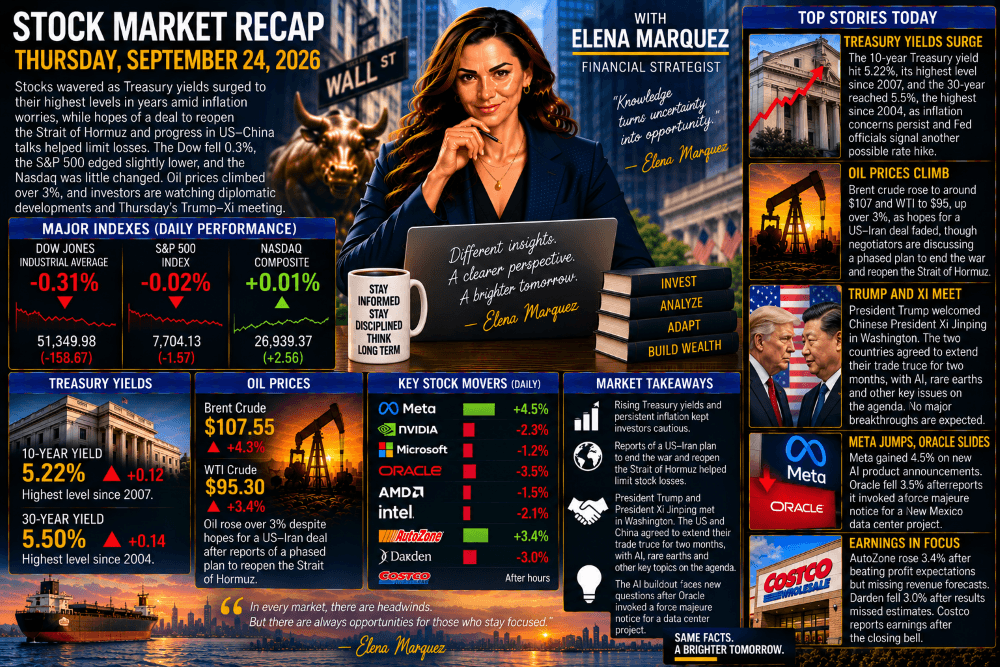
📉 Dow Jones: -0.31% to 51,349.98
➖ S&P 500: -0.02% to 7,704.13
➖ Nasdaq Composite: +0.01% to 26,939.37
The Dow has now fallen for three consecutive sessions.
But considering what happened in the bond and oil markets Thursday, the fact that the S&P 500 and Nasdaq finished essentially unchanged was notable.
The 10-Year Treasury Climbs Above 5.2%
Once again, the day’s biggest story came from the bond market.
The 10-year Treasury yield climbed to approximately 5.2%, reaching its highest level since 2007.
The 30-year Treasury yield reached roughly 5.5%—its highest level since 2004.
Those numbers matter.
A 5%+ Treasury yield provides investors with an increasingly attractive alternative to stocks while simultaneously increasing borrowing costs throughout the economy.
Mortgages become more expensive.
Corporate borrowing becomes more expensive.
Government borrowing becomes more expensive.
And financing the enormous AI infrastructure boom becomes more expensive.
The Fed Isn’t Finished Yet
Federal Reserve officials added to the pressure Thursday.
New York Fed President John Williams said it would be reasonable to expect another interest-rate increase this year.
Philadelphia Fed President Anna Paulson similarly said that some additional tightening may be necessary to bring inflation back toward the Fed’s 2% target.
Markets are listening.
Traders now see roughly a 71% probability of another 25-basis-point Fed hike in October.
Only a week ago, investors were wondering whether September’s rate increase might be enough.
That optimism is disappearing quickly.
The Economy Isn’t Cooperating With the Fed
Another interesting piece of Thursday’s economic picture came from the labor market.
Initial unemployment claims fell to approximately 197,000.
That’s good news if you’re looking for a job.
But from the Federal Reserve’s perspective, a resilient labor market makes it easier to keep monetary policy tight.
This creates the strange situation investors have faced repeatedly:
Strong economy = potentially higher interest rates.
The Fed wants inflation lower.
But economic growth remains strong enough that policymakers don’t appear particularly worried about causing a recession by tightening further.
Then Came the Iran News
Stocks were considerably weaker earlier in the session.
Then Reuters reported something potentially important.
US and Iranian negotiators are discussing a phased plan to end the war and reopen the Strait of Hormuz.
Under the reported framework, Iran would reopen the Strait while the United States would begin easing its economic blockade.
Nothing has been finalized.
But markets immediately reacted to the possibility.
Stocks recovered much of their earlier losses.
Oil pulled back from its intraday highs.
After months of war and energy disruptions, even the possibility of reopening one of the world’s most important oil transportation routes matters enormously.
Oil Still Jumps
Don’t confuse diplomatic hope with cheap oil just yet.
Despite pulling back from its highs, crude finished sharply higher.
🛢️ WTI: approximately $95
🛢️ Brent: approximately $107
Brent gained more than 4%.
WTI climbed more than 3%.
So we’re still dealing with expensive energy.
And that means the inflation problem hasn’t disappeared.
We’ve been following the same chain throughout September:
Oil ↑ → Inflation ↑ → Fed expectations ↑ → Treasury yields ↑ → Stocks ↓
Thursday offered a slight variation:
Oil ↑ → Yields ↑ → Stocks ↓ → Iran negotiations reported → Stocks recover
Geopolitics effectively prevented the bond-market selloff from turning into a much worse day for equities.
Trump and Xi Meet in Washington
While Wall Street watched Iran, another geopolitical story was unfolding in Washington.
President Donald Trump hosted Chinese President Xi Jinping for Xi’s first Washington visit in 11 years.
Before the meeting, the United States and China agreed to extend their existing trade truce until January 10.
That removes one immediate source of uncertainty.
But some of the more difficult issues remain.
Artificial intelligence.
Critical minerals.
Trade.
And the war in Iran.
AI Is Now Part of Superpower Diplomacy
Perhaps the most interesting long-term development is how prominently artificial intelligence has entered US-China relations.
AI used to be primarily a Silicon Valley story.
Then it became a Wall Street story.
Now it’s a geopolitical story.
Both countries understand that leadership in:
Semiconductors.
AI models.
Data centers.
Robotics.
Quantum computing.
And advanced manufacturing
could determine enormous amounts of economic and strategic power over the coming decades.
That means companies such as Nvidia, AMD, Intel, Meta, Microsoft and Google increasingly operate at the intersection of business and geopolitics.
Meta Defies the Market
One major technology company had an excellent day.
Meta jumped roughly 4.5%.
The company unveiled additional AI products at its Connect developer conference, adding to the excitement surrounding its rapidly expanding consumer AI strategy.
Meta has become one of the most interesting stories in the AI market.
For years, investors criticized Mark Zuckerberg for spending enormous amounts of money on speculative technologies.
Now Wall Street is increasingly asking a different question:
What if those investments actually work?
Meta’s recent AI momentum suggests investors are beginning to believe they might.
Oracle Raises Another AI Question
Not every AI story was positive.
Oracle shares fell approximately 3.5% after Bloomberg reported that the company had invoked a force majeure provision connected with a massive New Mexico data-center project.
The move was reportedly intended to limit Oracle’s financial exposure to potential project costs.
That might sound like a company-specific story.
But investors are increasingly sensitive to anything involving AI infrastructure financing.
Why?
Because the industry is spending extraordinary amounts of money.
Data centers require:
Land.
Electricity.
Cooling.
Chips.
Networking equipment.
Construction.
And enormous amounts of financing.
When the 10-year Treasury yields more than 5%, those projects become more expensive.
The AI Boom Meets the Bond Market
This may be one of the biggest financial stories of the rest of 2026.
AI demand remains enormous.
But so does the cost of building the infrastructure necessary to satisfy that demand.
We’ve already seen technology companies tap the bond market aggressively to finance AI investments.
Now they’re competing for capital while the US government is borrowing heavily and Treasury yields are near two-decade highs.
That creates a simple question:
Can AI generate returns high enough to justify increasingly expensive capital?
For now, Wall Street still seems to believe the answer is yes.
But investors are starting to scrutinize the numbers much more carefully.
Darden Falls After Earnings
Outside technology, Darden Restaurants fell roughly 3% after quarterly revenue narrowly missed expectations and comparable sales disappointed.
Darden owns chains including Olive Garden and LongHorn Steakhouse.
That makes its results interesting as a window into consumer spending.
With gasoline and other everyday costs elevated, restaurants are competing for increasingly stretched household budgets.
That’s another reason investors are paying close attention to consumer companies.
Costco Is Next
Costco reports earnings after Thursday’s closing bell.
Its results should provide another useful snapshot of the American consumer.
Costco has historically benefited when households become more value-conscious.
But inflation can cut both ways.
Consumers may seek bargains at warehouse clubs while simultaneously reducing discretionary purchases.
Costco’s results should therefore provide another clue about how households are adapting to today’s unusual combination of strong employment, high interest rates and elevated energy prices.
The Market’s New Tug-of-War
Thursday illustrated the forces fighting for control of this market.
On one side:
🤖 AI optimism
🤝 US-Iran diplomacy
🇺🇸🇨🇳 US-China negotiations
💼 Strong employment
On the other:
📈 5.2% Treasury yields
🛢️ $107 Brent crude
🔥 Persistent inflation
🏦 More Fed hikes
Neither side won Thursday.
That’s why the S&P 500 and Nasdaq barely moved.
The Bottom Line
Thursday was essentially a draw.
📉 Dow: -0.31%
➖ S&P 500: -0.02%
➖ Nasdaq: +0.01%
📈 10-year Treasury: ~5.2%
📈 30-year Treasury: ~5.5%
🛢️ WTI: ~$95
🛢️ Brent: ~$107
🤖 Meta: +4.5%
📉 Oracle: -3.5%
The biggest potential development came from diplomacy.
If the United States and Iran can reach an agreement that reopens the Strait of Hormuz, oil prices could face meaningful downward pressure.
That could help inflation.
Which could reduce pressure on the Fed.
Which could bring Treasury yields down.
Which could help stocks.
In other words, the same chain we’ve been following could finally begin working in the opposite direction:
Oil ↓ → Inflation ↓ → Fed pressure ↓ → Treasury yields ↓ → Stocks ↑
But we’re not there yet.
For now, Wall Street remains trapped between diplomatic hope and expensive money.
Other Stock Market blog posts
Leave a Reply