For generations, the renting vs buying debate has started with an assumption I think we should question: eventually, financially responsible adults are supposed to buy a home.
Rent for a while. Save for a down payment. Buy a starter home. Build equity. Move up the property ladder.
Homeownership is presented not simply as a lifestyle choice, but as financial progress.
I don’t see it that way.
I rent my home, invest my money elsewhere, and have no desire to change that arrangement. For me, buying a home wouldn’t necessarily represent a step forward financially.
It could be a step backward.
The Ancient Connection Between Property and Wealth
Our attachment to real estate has deep historical roots.
For much of history, land wasn’t merely another asset. Land was wealth.
Under feudal systems, political power, economic security and social status were closely connected to control of land. Aristocratic fortunes were measured largely by estates, farms and the people producing income from them.
There was no Vanguard account.
There was no stock exchange available to the ordinary worker.
There were no low-cost index funds allowing someone with a few hundred dollars to own tiny pieces of hundreds of profitable companies.
If you wanted durable wealth, owning land was one of the most obvious ways to obtain it.
The world has changed enormously.
Our psychology hasn’t necessarily changed with it.
We still use expressions such as “getting on the property ladder.” Buying a house is described as an achievement. Renting is often described as something you do until you can afford to buy.
I think that’s an outdated way of looking at wealth.
What If You Never Buy a House?
What happens if you never buy a house? What renters are gaining — and giving up. Younger Americans are reconsidering the traditional assumption that homeownership is necessary for building wealth.
The question has become increasingly relevant as housing costs have risen.
Homeownership can build wealth, but it isn’t guaranteed to do so. Outcomes depend on factors including purchase price, location, financing costs, appreciation and what a renter does with the money that would otherwise have gone toward homeownership.
That’s the part of the conversation I find most interesting.
The alternative to buying a house isn’t necessarily:
Renting and spending the rest of your money.
It can be:
Renting and investing the difference.
That is an entirely different financial equation.
Renting vs Buying: Count All the Costs
One reason I think homeownership is frequently romanticized is that people compare rent with a mortgage payment.
That’s the wrong comparison.
A mortgage is only one of the expenses involved in owning property.
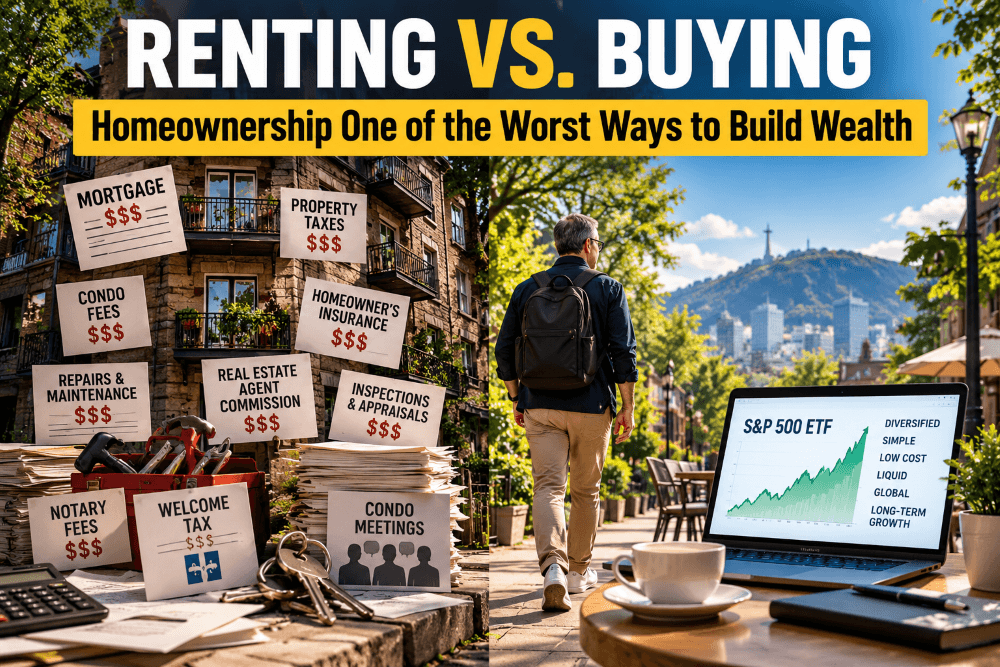
Depending on where you live and what you buy, there can be:
- Mortgage interest
- Real-estate-agent commissions
- Property inspections
- Appraisals
- Legal or notarial fees
- Municipal property taxes
- School taxes
- Homeowners insurance
- Condo fees
- Maintenance
- Repairs
- Special assessments
- Renovations
- Selling costs
And here in Montreal we have another wonderfully named expense: the “welcome tax.”
The official name is the property transfer duty. Montreal requires buyers to pay it after acquiring a property, with progressively higher rates applied to different portions of the property’s taxable value.
Some welcome.
And expenses don’t end after the transaction.
Montreal property owners receive annual municipal property-tax bills.
If you own a condo, there can also be another cost that doesn’t appear neatly on a spreadsheet:
your time.
There are condo meetings. Discussions about repairs. Arguments over budgets. Decisions about common areas. Rules concerning what owners can and cannot do.
Sometimes there are surprise assessments.
Sometimes the roof leaks.
Sometimes the elevator needs replacing.
I would rather spend my time doing something else.
My $910-a-Month Apartment in Montreal
My own situation makes the renting vs buying calculation a no-bariner. Renting is by far a better option.
I live in Montreal’s Plateau-Mont-Royal area, around Rachel, Dultuh, Saint-Denis, Clark and Saint-Laurent.
It’s an area I enjoy tremendously: walkable, central, close to Mont Royal and convenient to downtown.
A typical one-bedroom condo of roughly 550 to 700 square feet in my immediate area can easily cost $400,000. If I were to pay mortgage, and all the additional expenses, I would be paying around $3,000/month.
But instead I pay a rent of $910 a month.
That is about $2,000/month that stays in pocket by renting.
And I have almost no housing headaches.
If my stove breaks, I call my landlord.
If something in the apartment needs repairing, I’m not suddenly calculating how much money I need to take out of my investment account.
The building isn’t my business.
I pay my rent and live my life.
That simplicity has value.
Renting Gives Me Something Valuable: Capital
Suppose I bought a $450,000 condo.
Suddenly, a significant amount of capital would become tied up in my residence.
Then there would be transaction costs, taxes, insurance, condo fees, maintenance and potentially mortgage interest.
Instead, I can keep my housing expenses relatively low and invest my capital.
That’s the part of renting vs buying calculations people frequently overlook.
Money used for a down payment has an opportunity cost.
So does every additional dollar spent on ownership rather than renting.
So does every minute of your time you have to invest in managing your property.
A $100,000 down payment isn’t simply “$100,000 toward my house.”
It’s also $100,000 that is no longer invested somewhere else.
Compare That With Buying an S&P 500 ETF
This is where modern investing has completely changed the equation from the world our ancestors inhabited.
I can open my brokerage account and buy an exchange-traded fund tracking the S&P 500. No commssion. As opposed to a 6% commission in real estate transactions.
That’s it.
No building inspection.
No notary.
No property appraisal.
No condo board.
No arguments about whether someone is allowed to put a barbecue on the balcony.
No calls about a leaking roof.
Historically, U.S. equities have generated substantial long-term returns, although future returns are never guaranteed and stocks can fall dramatically over shorter periods.
For my own long-term planning, I would rather use a conservative assumption around 8% nominal annual returns than assume the historical performance of stocks will automatically continue.
The exact percentage isn’t really my main point, however.
It’s the extraordinary simplicity and liquidity of the investment.
I can own hundreds of businesses without becoming responsible for repairing a single toilet.
A House Doesn’t Compound at the Headline Appreciation Rate
There’s another problem when people talk about how much money they made on their homes.
Imagine someone saying:
“I bought my house for $300,000 and sold it 20 years later for $600,000. I doubled my money!”
Technically, the property’s price doubled.
But that doesn’t tell us the investment return.
What did the owner pay in mortgage interest during those 20 years?
Property taxes?
Insurance?
Repairs?
A new roof?
Renovations?
Transaction costs when buying?
Transaction costs when selling?
Once those expenses are included, the investment return can look considerably different.
That doesn’t mean buying the house was a mistake. The owner also received something extremely valuable for 20 years:
a place to live.
But we should distinguish between the consumption value of housing and its investment return.
The Emotional Side of Homeownership
Of course, people don’t buy homes entirely for financial reasons.
And that’s perfectly legitimate.
Someone might want the security of knowing that a landlord cannot decide to reclaim the property under applicable law (my landlord asked me to leave and I took him to court; I won and I am still in the same place. I have been here for 14 years). Parents may want stability for their children. Someone might love renovating a home or gardening.
Another person may simply get enormous emotional satisfaction from saying:
“This is mine.”
Those are benefits.
But they’re lifestyle benefits, not necessarily investment returns.
The problem occurs when we take an emotional purchase and automatically label it a great investment.
Homeownership Is Forced Saving — But We Can Save Without It
There is one argument for homeownership that I think deserves more respect.
A mortgage forces people to save.
Every month, part of the mortgage payment gradually builds equity. Someone who might otherwise spend every available dollar can eventually end up owning a substantial asset.
That’s powerful behavioral finance.
But there’s nothing magical about the house.
A disciplined renter can create the same mechanism.
Every month:
- Pay the rent.
- Automatically transfer money to an investment account.
- Buy diversified investments.
- Don’t touch them.
- Repeat for decades.
That’s what I did, and now I am financially indepentdent. I can buy a property cash, if I want to, but why? I let the landlord deal with all the headaches, while I enjoy a very low rent.
The house isn’t creating financial discipline.
The habit is.
Today’s Mortgage Rates Make the Calculation Even More Interesting
The current U.S. housing market provides a striking example.
As of September 24, 2026, Freddie Mac reported that the average U.S. 30-year fixed mortgage rate had reached 7.03%.
I live in Montreal and pay $910 per month.
When American mortgage rates move from 6% to 7%, my reaction isn’t panic.
It doesn’t affect my housing payment.
I continue paying my rent and investing.
That freedom has financial value too.
Renting Isn’t Automatically Better
There is an important qualification to everything I’ve written.
Renting isn’t automatically superior to owning.
A person who rents an expensive apartment and invests nothing isn’t necessarily getting ahead.
Likewise, someone who buys an affordable property, stays for 30 years, maintains it carefully and eventually lives mortgage-free may have made an excellent financial decision.
Real estate can also be a very different proposition when purchased specifically as an income-producing investment rather than as a personal residence.
And owning a home can provide stability that some people value more than liquidity or investment returns.
The correct calculation depends on the numbers.
My objection isn’t to homeownership.
It’s to the idea that homeownership is inherently financial progress.
The Rent-and-Invest Strategy Requires Discipline
There is one enormous condition attached to my argument.
If you’re going to rent rather than own, you need to actually invest the difference.
Suppose owning a comparable property would ultimately cost you $3,000 per month after considering financing and ownership expenses, while renting costs $1,500.
If you rent for $1,500 and spend the remaining $1,500 on restaurants, vacations and a more expensive car, you haven’t discovered an investment strategy.
You’ve discovered additional consumption.
But if you automatically invest a substantial portion of that difference month after month for decades, the comparison becomes much more interesting.
Renters deliberately directing money toward stocks and other financial assets instead of assuming that a house must be their primary wealth-building vehicle.
Maybe the Property Ladder Is the Wrong Ladder
For centuries, owning land was synonymous with wealth.
Today we have choices our ancestors couldn’t have imagined.
With a few clicks, an ordinary person can own pieces of companies operating all over the world.
We can diversify across hundreds or thousands of businesses.
We can invest small amounts.
We can sell investments without selling the roof over our heads.
And we don’t have to call a plumber afterward.
So perhaps it’s time to retire the assumption that adulthood follows a predetermined financial sequence:
Rent → buy a home → build equity → become wealthy.
There’s another perfectly legitimate path:
Rent → keep expenses low → invest → compound → build wealth.
I know which one I prefer.
I pay $910 a month to live in a neighborhood I love.
I don’t worry about property taxes, condo fees or whether the roof needs replacing.
If my stove breaks, I call my landlord.
Then I get on with my life.
To me, that’s not throwing money away.
It’s buying freedom while leaving my capital available to build wealth elsewhere.
Frequently Asked Questions
Is renting throwing money away?
No. Rent purchases housing in exactly the same sense that money spent on food purchases nutrition or insurance premiums purchase protection. The relevant financial question is whether renting or owning provides the better combination of cost, lifestyle and opportunity cost in your particular situation.
Is buying a home a good investment?
It can be. Location, purchase price, financing costs, appreciation, taxes, maintenance, transaction costs and how long you remain in the property all matter. The mistake is assuming that every owner automatically makes a better financial decision than every renter.
Is the S&P 500 better than real estate?
There is no guaranteed winner. Stocks offer liquidity, diversification and no transaction costs, while real estate can provide housing, leverage, rental income and potentially attractive appreciation. They also carry different risks. My preference is to rent my residence and invest my capital in financial assets.
Can you build wealth while renting your entire life?
Absolutely. Home equity is only one form of wealth. A renter who consistently saves and invests can accumulate stocks, bonds, businesses and other assets without ever owning a home. The key is that the money saved by renting must actually become invested capital rather than additional spending.
Other personal finance blog posts
Leave a Reply