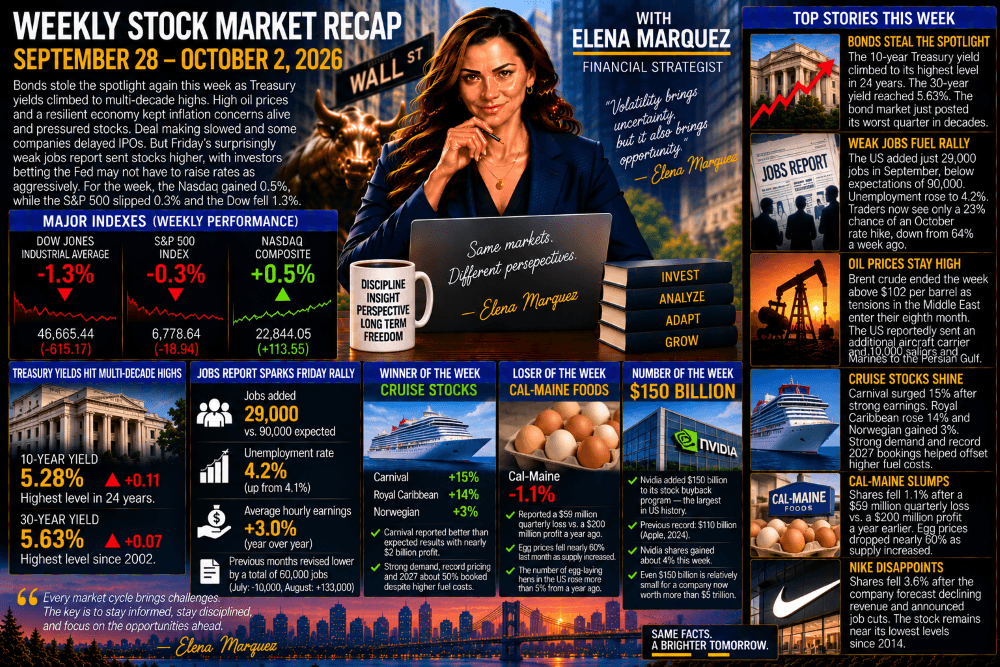
Wall Street spent another week learning an old lesson:
The bond market can be more powerful than the stock market.
Treasury yields surged to levels not seen in more than two decades as investors wrestled with stubborn inflation, expensive oil, enormous government borrowing and an economy that—until Friday—continued to look surprisingly resilient.
Then Friday changed the conversation.
A dramatically weaker-than-expected jobs report sent stocks sharply higher as investors concluded the Federal Reserve may finally have room to stop raising interest rates.
For the week:
📈 Nasdaq: +0.5%
📉 S&P 500: -0.3%
📉 Dow Jones: -1.3%
It was a difficult week for the broader market.
But beneath the indexes were some spectacular winners, painful losers—and one enormous number.
Let’s get into it.
The Bond Market Steals the Show
The most important market this week wasn’t stocks.
It was Treasurys.
The 10-year Treasury yield climbed above 5.3%, reaching its highest level since 2002.
The 30-year yield climbed above 5.6%.
Those aren’t just numbers on a financial screen.
Treasury yields influence borrowing costs throughout the economy.
Mortgages.
Corporate debt.
Auto loans.
Government borrowing.
Business investment.
And stock valuations.
When investors can earn more than 5% lending money to the US government, risky assets have to compete with a much more attractive alternative.
That’s putting pressure on virtually everything.
High Rates Are Starting to Have Consequences
For months we’ve talked about rising Treasury yields as a stock-market problem.
Now they’re increasingly becoming a corporate problem.
The IPO market is getting tougher.
Companies are delaying public offerings.
Financing giant acquisitions is becoming more expensive.
Corporations building enormous AI infrastructure projects must borrow at increasingly expensive rates.
That’s how monetary tightening works.
It doesn’t hit everything immediately.
It slowly moves through the financial system.
Eventually, somebody decides:
Money is simply too expensive.
Then Friday Changed Everything
The September jobs report arrived Friday morning.
Wall Street expected roughly 90,000 new jobs.
Instead:
29,000 jobs were created.
Unemployment increased:
4.1% → 4.2%.
Wage growth also slowed.
And previous months were revised downward by another 60,000 jobs.
Suddenly, the Federal Reserve had a reason to wait.
Only a week ago, financial markets were leaning toward another interest-rate increase in October.
After Friday’s report, those expectations collapsed.
Stocks surged.
📈 Nasdaq: +1.2% Friday
📈 S&P 500: +0.7%
📈 Dow: +0.5%
The Nasdaq even touched a new intraday record.
Once again:
Bad economic news became good news for stocks.
Winner of the Week: Cruise Stocks 🚢
This week’s winner may surprise you.
Cruise lines.
That’s because cruise operators entered the week facing an enormous problem:
Fuel.
The war involving Iran has driven oil dramatically higher this year.
And cruise ships burn enormous quantities of fuel.
That combination had punished the sector.
Then Carnival reported earnings.
And suddenly investors saw a very different story.
Carnival Cruises Past Expectations
Carnival reported record quarterly revenue of roughly:
$8.44 billion.
Net income reached a record:
$1.92 billion.
More importantly, strong customer demand and improved operating efficiency helped offset higher fuel expenses.
And the outlook was even more impressive.
Carnival is already approximately:
50% booked for 2027.
Both occupancy and pricing are at record levels.
Customer deposits reached approximately:
$7.6 billion.
In other words:
People aren’t abandoning vacations because fuel is expensive.
They’re booking cruises well into the future.
Carnival shares surged roughly 15% for the week, while Royal Caribbean and Norwegian Cruise Line also rallied.
That’s an important reminder.
Macroeconomic conditions matter.
But great businesses can sometimes overcome difficult macroeconomic conditions.
Loser of the Week: Cal-Maine Foods 🥚
Now for the loser.
America’s largest egg producer learned something this week:
Sometimes the cure for high prices is high prices.
Remember when egg prices were exploding?
Bird flu killed millions of hens.
Egg supplies collapsed.
Stores rationed cartons.
Restaurants added egg surcharges.
Producers responded exactly as economics would predict.
They produced more eggs.
A lot more.
And now America has the opposite problem:
Too many eggs.
The Great Egg Reversal
The US egg-laying flock has recovered sharply.
More hens.
More eggs.
More supply.
And prices collapsed.
Cal-Maine reported that conventional shell-egg prices fell roughly:
59%.
That’s fantastic news if you’re making breakfast.
It’s considerably less fantastic if your business is selling eggs.
Cal-Maine reported a quarterly net loss of:
$58.6 million.
A year earlier?
The company earned approximately:
$199 million.
That’s an extraordinary reversal.
Sales dropped roughly 42% to about $540 million.
The company went from benefiting from one of the biggest egg shortages in recent memory to suffering from an oversupplied market.
Economics textbooks call this supply and demand.
Investors call it painful.
Number of the Week: $150 Billion
Now for our Number of the Week.
And this one is enormous:
$150 BILLION
That’s how much Nvidia added to its stock-repurchase authorization.
It’s the largest increase in a US corporate buyback authorization on record.
For comparison:
Apple’s famous 2024 authorization was:
$110 billion.
Nvidia just went considerably bigger.
Its total remaining authorization is now approximately:
$235 billion.
That’s larger than the market capitalization of most companies in the S&P 500.
What Does a $150 Billion Buyback Actually Mean?
There’s an important distinction here.
Nvidia didn’t suddenly create $150 billion.
A stock buyback simply means the company has authorization to use cash to repurchase its own shares.
That reduces the number of shares outstanding.
Fewer shares can mean higher earnings per share.
Buybacks can also communicate something else:
Management believes its own stock remains attractive.
Investors certainly liked the announcement.
Nvidia shares rallied Monday and finished the week roughly 4% higher.
The stock also reached another record on Friday.
And Nvidia Is Worth More Than $5 Trillion
Here’s what makes the $150 billion number even more extraordinary.
For almost any company in history, a $150 billion buyback would be almost unimaginably large.
For Nvidia?
It’s manageable.
The company is now worth more than $5 trillion.
That’s how dramatically the AI boom has transformed Nvidia.
A buyback larger than the market value of many major corporations represents only a few percent of Nvidia’s valuation.
That’s extraordinary.
AI Is Still Driving the Market
Nvidia wasn’t the only reminder this week that artificial intelligence remains Wall Street’s dominant investment theme.
Micron delivered stronger-than-expected earnings and guidance as AI data centers continue consuming enormous quantities of advanced memory.
Broadcom reportedly agreed to provide Anthropic with as much as $42 billion in financing tied to computing infrastructure.
Anthropic is reportedly considering going public as soon as November.
The AI ecosystem is becoming larger.
More expensive.
And increasingly interconnected.
Chip companies finance AI companies.
AI companies rent computing infrastructure.
Cloud providers buy chips.
Investors finance all of them.
As long as AI revenue continues growing rapidly, the machine keeps turning.
But with Treasury yields above 5%, investors will increasingly demand evidence that these enormous investments eventually produce enormous profits.
Oil Remains the Wild Card
Another number investors can’t ignore:
$102+ oil.
Brent crude finished the week above $102 per barrel.
That’s particularly important because oil touches almost everything.
Transportation.
Shipping.
Manufacturing.
Air travel.
Food.
Consumer spending.
And inflation.
The Federal Reserve can raise interest rates.
It can’t produce oil.
That’s why the Middle East remains one of the biggest risks hanging over financial markets.
If oil continues rising, inflation could reaccelerate.
If oil falls, the Fed’s job becomes considerably easier.
The Market’s Strange New Logic
This week perfectly illustrated the unusual environment investors currently inhabit.
Monday through Thursday:
Strong economy → inflation fears → higher yields → weaker stocks.
Friday:
Weak jobs → lower Fed expectations → stronger stocks.
That’s the strange logic of a market obsessed with interest rates.
Investors don’t necessarily want a booming economy right now.
They want something much more specific:
An economy that’s slowing—but not collapsing.
Enough weakness to bring inflation down.
Enough strength to avoid recession.
That’s the soft landing.
And Friday’s jobs report moved the market slightly closer to believing it might happen.
The Bottom Line
Here’s the week:
📈 Nasdaq: +0.5%
📉 S&P 500: -0.3%
📉 Dow: -1.3%
📈 10-year Treasury: above 5.2%
🛢️ Brent crude: above $102
💼 September jobs: +29,000
👥 Unemployment: 4.2%
🚢 Carnival: roughly +15%
🥚 Cal-Maine: quarterly loss of $58.6 million
🤖 Nvidia: +$150 billion buyback authorization
This week’s market contained three excellent lessons.
First: interest rates matter.
When Treasury yields rise above 5%, everything from stocks to IPOs to corporate borrowing becomes more difficult.
Second: supply and demand always matter.
Carnival showed that strong consumer demand can overcome expensive fuel.
Cal-Maine showed that yesterday’s shortage can quickly become tomorrow’s glut.
And finally:
Cash matters.
Nvidia is generating so much of it that the company can authorize another $150 billion for share repurchases while continuing to spend enormous amounts building the future of artificial intelligence.
Bonds dominated this week.
But stocks finished Friday with something they haven’t had much of lately:
Relief.
The question heading into the new week is whether Friday marked the beginning of a calmer interest-rate environment—or simply another pause in the bond-market storm.
Other Stock Market blog posts
Leave a Reply