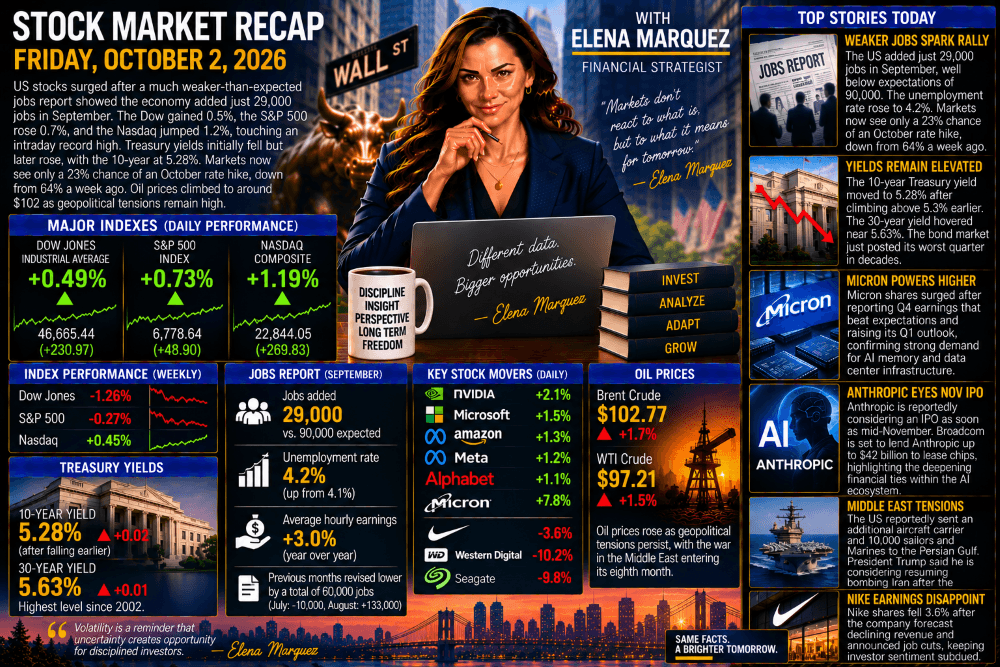
Sometimes bad economic news is good news for Wall Street.
Friday was one of those days.
The US economy created far fewer jobs than expected in September, providing the clearest evidence yet that the labor market is losing momentum.
Normally, that wouldn’t be something investors celebrate.
But stocks surged.
Why?
Because a weaker labor market makes another Federal Reserve interest-rate hike considerably less likely.
For the day:
📈 Dow Jones: +0.49%
📈 S&P 500: +0.73%
📈 Nasdaq Composite: +1.19%
The Nasdaq even touched a new intraday record.
Welcome to the strange world of modern markets:
Bad news for workers became good news for stocks.
Only 29,000 Jobs
This morning’s employment report delivered a major surprise.
The US economy added just:
29,000 jobs in September.
Wall Street expected roughly:
90,000.
That’s not a small miss.
And previous months weren’t as strong as we originally thought either.
August payroll growth was revised from:
+162,000 → +133,000
July was revised from:
+21,000 → -10,000
Combined, the economy created 60,000 fewer jobs in July and August than previously reported.
That’s important.
One weak month can be noise.
Several weaker readings begin to look like a trend.
Unemployment Rises to 4.2%
The unemployment rate also increased:
4.1% → 4.2%.
That isn’t remotely recessionary by historical standards.
In fact, unemployment has remained between 4.1% and 4.3% since March.
But today’s report reinforces a pattern we’ve been watching for months.
Low hiring. Low firing.
Companies aren’t conducting massive layoffs.
But they aren’t aggressively hiring either.
That creates a peculiar labor market.
People with jobs generally remain employed.
People searching for jobs may increasingly struggle to find them.
Wages Are Cooling Too
There was another important number buried inside today’s report.
Average hourly earnings increased only:
0.1% in September.
Over the past year, wages increased:
3.0%.
Slower wage growth matters enormously for the Federal Reserve.
Rapidly rising wages can contribute to inflation as companies pass higher labor costs to customers.
Cooling wage growth removes some of that pressure.
And Wall Street immediately understood what this report could mean.
The October Rate Hike Is Suddenly in Doubt
Only a week ago, financial markets were pricing roughly a 64% probability that the Federal Reserve would raise rates again in October.
After today’s jobs report?
That probability plunged to roughly:
23%.
That’s an enormous shift in just seven days.
And it explains much of Friday’s stock rally.
The Fed has been trying to slow inflation without crushing the economy.
Now the labor market appears to be cooling on its own.
That gives policymakers another reason to wait.
The Fed Can Afford to Watch
Several Federal Reserve officials have recently emphasized that inflation remains too high.
But they’ve also indicated that the central bank doesn’t need to rush.
Today’s employment report strengthens that argument.
The Fed can now watch:
Inflation.
Oil.
Wages.
Employment.
Consumer spending.
And financial conditions.
Then decide whether another rate increase is actually necessary.
That’s exactly what stock investors wanted to hear.
But Then Something Strange Happened
If investors suddenly believe the Fed is less likely to raise rates, you’d expect Treasury yields to fall.
Initially, they did.
Then they reversed.
The 10-year Treasury yield finished around:
5.28%.
The 30-year remained near:
5.63%.
That’s the bigger mystery hanging over this market.
The Fed controls short-term interest rates.
But long-term yields increasingly appear to be responding to other forces.
Government borrowing.
Large federal deficits.
Persistent inflation.
Global bond selling.
AI-related corporate borrowing.
And geopolitical risk.
So even if the Fed pauses in October, Wall Street’s bond problem may not disappear.
Nasdaq Hits Another Record
Technology stocks were the day’s biggest beneficiaries.
The Nasdaq surged 1.19% and touched a new intraday record.
That makes sense.
Growth stocks are particularly sensitive to interest rates because much of their value depends on profits expected years into the future.
Reduce expectations for future rate hikes and those future earnings become more valuable today.
The same logic helped rate-sensitive areas of the market.
The Russell 2000 gained roughly 0.9%, while real estate stocks also advanced.
But the rally wasn’t universal.
Nike’s Turnaround Still Has Work to Do
Nike shares dropped roughly 3.6% after the company forecast declining revenue and announced job cuts.
Nike is attempting one of the most closely watched corporate turnarounds in America.
But investors clearly aren’t convinced yet.
The company’s challenge is straightforward:
Reignite growth.
Rebuild its brand momentum.
Improve margins.
And compete more effectively against newer athletic brands.
That’s easier said than done.
The Memory Trade Gets Hit
Interestingly, some of the week’s hottest AI-related stocks struggled Friday.
Western Digital and Seagate both dropped around 10%.
That’s a reminder that even inside the AI boom, markets don’t move in straight lines.
Expectations have become extremely high across the semiconductor, memory and data-storage industries.
When expectations are enormous, even small disappointments can create large stock moves.
Oil Climbs Back Above $100
Meanwhile, another inflation problem isn’t going away.
Brent crude finished around:
$102.77 per barrel.
Oil remains elevated as geopolitical tensions continue in the Middle East.
That’s particularly important right now.
The labor market is cooling.
Wage growth is slowing.
Both developments should reduce inflation pressure.
But expensive energy pushes in the opposite direction.
That’s the Fed’s dilemma.
Domestic inflation pressures may be easing.
External energy pressures remain dangerous.
A Weak Labor Market — But Not a Collapsing One
There’s an important distinction investors shouldn’t miss.
Today’s employment report was weak.
But it wasn’t catastrophic.
The Bureau of Labor Statistics reported that employment across most major industries changed relatively little.
Healthcare continued adding jobs.
Layoffs remain subdued.
And more people entered the labor force.
So today’s report doesn’t necessarily say:
Recession.
It says something more nuanced:
The labor market is losing momentum.
For the Federal Reserve, that may be exactly what it wants.
What Happened This Week?
Despite Friday’s rally, it wasn’t a great week for the broader market.
For the week:
📈 Nasdaq: +0.45%
📉 S&P 500: -0.27%
📉 Dow: -1.26%
That divergence tells us something important.
Technology continues to carry the market.
The Nasdaq remains resilient because AI enthusiasm is powerful enough to offset many of the macroeconomic concerns weighing on other sectors.
But the Dow and S&P tell a more cautious story.
High Treasury yields are still creating pressure throughout the economy.
The Bigger Story
For months, investors worried that the economy was too strong.
Strong employment.
Strong spending.
Strong wages.
Those conditions could keep inflation elevated and force the Federal Reserve to continue raising rates.
Now another risk is emerging.
What happens if the economy becomes too weak?
That’s the balancing act Wall Street will increasingly confront.
A gradual slowdown could be ideal.
Inflation falls.
Hiring cools.
The Fed stops raising rates.
The economy keeps growing.
That’s the soft landing.
But if hiring deteriorates too quickly, investors could stop celebrating weak economic reports.
Today’s bad news was good news.
There is a point where bad news simply becomes bad news.
We’re not there yet.
But that line is becoming increasingly important.
The Bottom Line
Friday’s numbers tell the story:
📈 Dow: +0.49%
📈 S&P 500: +0.73%
📈 Nasdaq: +1.19%
💼 Jobs added: 29,000
👥 Unemployment: 4.2%
💵 Annual wage growth: 3.0%
📈 10-year Treasury: ~5.28%
📈 30-year Treasury: ~5.63%
🛢️ Brent crude: ~$102.77
🏦 October Fed hike odds: ~23%
The biggest change today wasn’t the stock market rally.
It was the interest-rate narrative.
One week ago, another October rate hike looked more likely than not.
Today, markets see a pause as the much more likely outcome.
That’s a dramatic shift.
But there’s still one uncomfortable question:
If Fed hike expectations are collapsing, why are long-term Treasury yields still above 5%?
That may be the most important question for investors heading deeper into October.
For today, though, Wall Street chose to celebrate.
The labor market slowed.
The Fed gained room to wait.
And the Nasdaq touched another record.
Other Stock Market blog posts
Leave a Reply