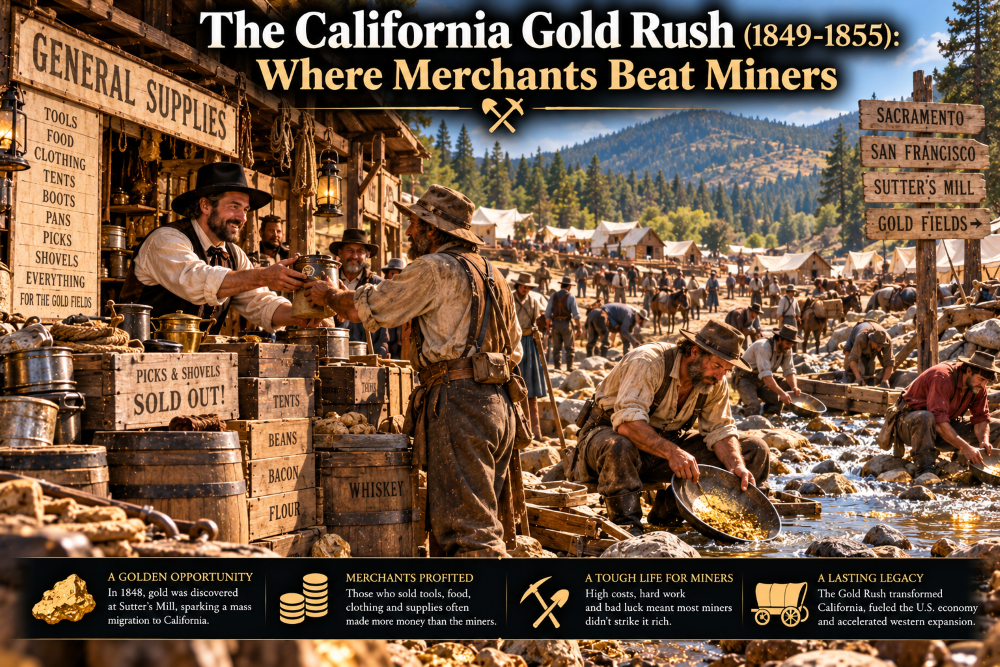
The California Gold Rush (1849-1855) is remembered as a story about prospectors striking it rich, but the real business lesson lies elsewhere. Most miners who rushed to California between 1849 and 1855 left with little or nothing. The people who consistently profited were merchants, suppliers, and service providers who built businesses around the needs of the gold-seekers themselves, a pattern that remains one of the clearest illustrations of opportunity hiding beside a boom rather than inside it.
What Triggered the California Gold Rush
Gold was discovered at Sutter’s Mill in January 1848, and news of the find spread rapidly across the country and eventually around the world.
- Within a year, tens of thousands of prospectors, known as “forty-niners,” had traveled to California by sea and overland routes in search of fortune.
- California’s population exploded almost overnight, transforming small settlements into booming, chaotic towns practically overnight.
- This sudden population surge created enormous demand for basic goods and services that California’s existing infrastructure simply couldn’t support.
This demand imbalance, far more people than available supplies or services, created the real entrepreneurial opportunity of the era.
Why Most Miners Didn’t Get Rich
The Harsh Mathematics of Prospecting
For the vast majority of participants, the California Gold Rush delivered disappointment rather than fortune.
- Easily accessible surface gold was depleted relatively quickly, forcing later arrivals into increasingly difficult and less productive mining methods.
- Living costs in gold rush boomtowns were extraordinarily high, often consuming whatever gold a miner actually found.
- Many miners ultimately left California with less money than they’d started with, after accounting for travel costs, living expenses, and lost time.
This pattern, a speculative rush where the majority of direct participants lose money, has repeated across numerous booms throughout business history.
Selling Shovels Instead of Mining Gold
The entrepreneurs who consistently profited from the California Gold Rush were rarely the miners themselves.
- Merchants selling basic supplies, including picks, shovels, pans, and tents, often earned more reliable income than the miners purchasing their goods.
- Prices for everyday goods in mining towns reached extraordinary levels due to scarcity and surging demand.
- This dynamic gave rise to the enduring business lesson often summarized as “selling shovels” rather than searching for gold directly.
Entrepreneurs Who Profited From the California Gold Rush
Samuel Brannan and Early Positioning
Samuel Brannan is often credited as one of the first people to profit significantly from the Gold Rush, and he did it without touching a single pickaxe.
- He reportedly learned of the Sutter’s Mill discovery early and purchased essentially all available mining supplies in the region beforehand.
- He then helped spread word of the gold discovery, driving demand directly toward the supplies he had already stockpiled.
- This combination of early information and aggressive positioning made him one of California’s first prominent gold rush millionaires.
Levi Strauss and Durable Workwear
Perhaps the most famous surviving business legacy of the California Gold Rush belongs to Levi Strauss, though his most significant innovation actually came slightly later in the era.
- Strauss initially sold dry goods and supplies to miners and merchants throughout California.
- Working with tailor Jacob Davis, he later helped develop sturdy, riveted work pants designed to withstand the demanding physical conditions miners faced.
- This product, eventually becoming the modern blue jean, built a company that has outlasted the Gold Rush itself by well over a century.
Banking, Transport, and Services
Beyond individual merchants, entire service industries emerged specifically to support the gold rush economy.
- Banking and financial services expanded rapidly to handle gold transport, currency exchange, and basic financial services for the sudden influx of wealth and population.
- Transportation businesses, including stagecoach lines and shipping services, profited enormously from moving people, mail, and goods to and from California.
- Hospitality businesses, including hotels, saloons, and boarding houses, served a constant stream of new arrivals with reliable, recurring demand.
The Darker Costs of the California Gold Rush
Devastating Impact on Native Populations
The California Gold Rush’s economic boom came at a severe and well-documented cost to the region’s Indigenous population.
- California’s Native American population declined catastrophically during this period, through violence, disease, and displacement directly connected to the rush of settlers and miners.
- State and local policies during this era actively enabled and, in some cases, encouraged violence against Native communities.
- This devastating human cost remains an essential and inseparable part of understanding this period honestly.
Environmental Destruction
The mining methods used during the California Gold Rush also caused significant and lasting environmental damage.
- Hydraulic mining techniques, which used powerful water jets to erode hillsides in search of gold, caused severe long-term environmental degradation.
- Rivers and waterways suffered significant sediment pollution and disruption from these mining practices.
- Some of this environmental damage remains visible in parts of California today, well over a century later.
Lessons from the California Gold Rush
- Booms create opportunity beside the obvious one. The most reliable profits often went to those serving the boom rather than chasing its central promise directly.
- Information and positioning matter enormously. Samuel Brannan’s early knowledge and preparation mattered more than any mining skill.
- Durable products outlast speculative booms. Levi Strauss’s workwear business survived and thrived long after gold rush mania itself faded.
Frequently Asked Questions
Did most people get rich during the California Gold Rush? No, the majority of miners earned little or lost money once travel costs and high living expenses in mining towns were accounted for, while merchants and suppliers often profited more reliably.
Who profited most from the California Gold Rush? Merchants selling supplies, service providers, and early positioned entrepreneurs like Samuel Brannan often profited more consistently than the miners themselves.
How is Levi Strauss connected to the California Gold Rush? Levi Strauss sold dry goods to miners and later helped develop durable riveted work pants that eventually became the modern blue jean, a business that outlasted the Gold Rush by generations.
What were the negative consequences of the California Gold Rush? The rush caused catastrophic harm to California’s Native American population through violence, disease, and displacement, along with significant long-term environmental damage from mining practices like hydraulic mining.
Related Articles
- Thomas Edison: Turning Invention Into Business
- John D. Rockefeller: Standard Oil and the Power of Consolidation
- Andrew Carnegie: Steel, Scale, and Vertical Integration
- The Panic of 1873: The Railway Bubble That Broke America
- The Railroad Revolution: How Railways Changed Entrepreneurship and Conquered Distance
- The Steam Revolution: How Power Rewrote Business
- The Rothschilds: How Information Built a Banking Empire
About The History of Entrepreneurship
This article is part of The History of Entrepreneurship, an ongoing series exploring how entrepreneurs, civilizations, technologies, financial institutions, and business innovations gradually created the modern economy.
Leave a Reply