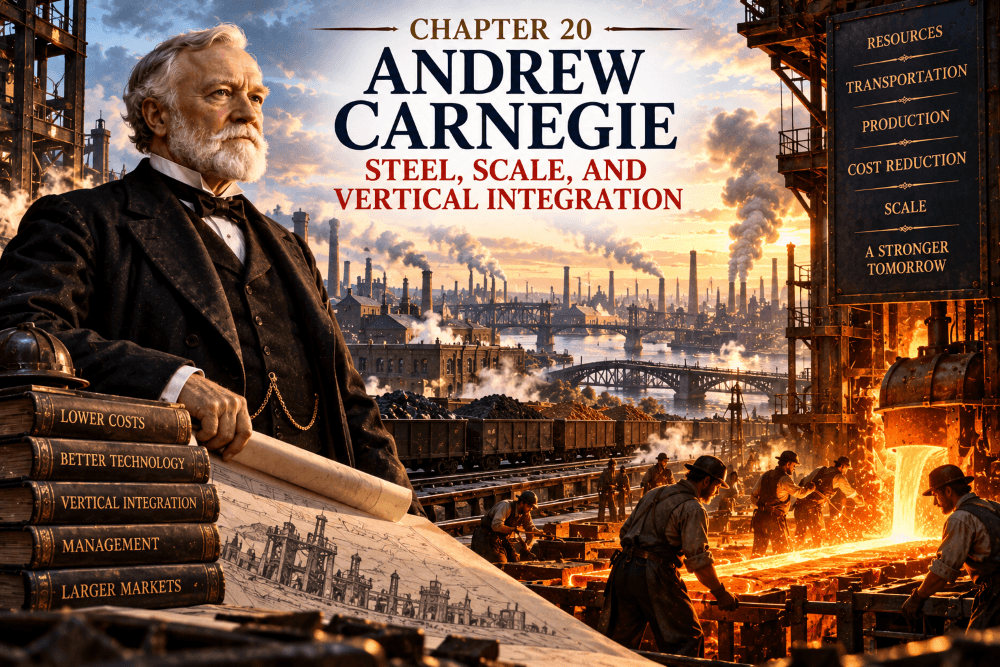
Andrew Carnegie did not invent steel.
He did not invent the Bessemer process.
He was not one of history’s great engineers.
Yet he built one of the most powerful industrial businesses of the nineteenth century and became one of the richest men in the world.
How?
Carnegie understood something fundamental about business:
The company that can produce at the lowest cost possesses an enormous competitive advantage.
He invested in better machinery.
Increased production.
Measured costs relentlessly.
Reinvested profits.
Controlled raw materials.
Controlled transportation.
Expanded capacity.
Then repeated the process.
Carnegie’s entrepreneurial genius was not simply making steel.
It was building a system capable of making enormous quantities of steel at increasingly lower costs.
His contribution to our history of entrepreneurship is:
Vertical integration and relentless cost reduction.
Who Was Andrew Carnegie?
Andrew Carnegie was born in Dunfermline, Scotland, in 1835.
His father was a handloom weaver.
But industrialization was transforming textile manufacturing.
Mechanized factories increasingly competed against traditional craftsmen.
The Carnegie family struggled financially.
In 1848, the family emigrated to the United States and settled near Pittsburgh, Pennsylvania.
Carnegie was still a boy.
He arrived with little money.
But he had arrived in exactly the right place at exactly the right moment.
Pittsburgh was becoming an industrial powerhouse.
Coal.
Iron.
Factories.
Railroads.
Rivers.
Capital.
The industrial economy was growing around him.
Andrew Carnegie Started as a Factory Worker
Carnegie’s first jobs were far removed from the boardrooms he would eventually dominate.
He worked as a bobbin boy in a textile factory.
The hours were long.
The work was repetitive.
The pay was low.
But Carnegie kept looking for opportunities to advance.
He eventually found work as a telegraph messenger.
That seemingly modest job exposed him to Pittsburgh’s business community.
He met businessmen.
Railroad executives.
Merchants.
Professionals.
He learned who controlled capital.
He learned how information moved.
And he learned telegraphy.
Eventually, Carnegie became a telegraph operator.
His career was accelerating.
The Railroad Became Carnegie’s Business School
Carnegie eventually attracted the attention of Thomas A. Scott, an executive with the Pennsylvania Railroad.
Scott hired him.
This became one of the most important developments in Carnegie’s life.
The Pennsylvania Railroad was a large, sophisticated organization.
Carnegie learned about:
- Management
- Transportation
- Logistics
- Accounting
- Cost control
- Capital investment
- Organizational structure
- Large-scale operations
The railroad was effectively Carnegie’s business school.
He was learning how enormous organizations worked from the inside.
Carnegie Learned the Importance of Mentorship
Thomas Scott became more than Carnegie’s employer.
He became a mentor.
Scott gave Carnegie responsibility and introduced him to investment opportunities and influential business networks.
This illustrates an entrepreneurial advantage that is difficult to quantify:
Proximity to experienced people accelerates learning.
Entrepreneurs need capital.
They need knowledge.
They need opportunity.
But relationships can also matter enormously.
Carnegie learned industrial capitalism by working alongside people already practicing it.
Carnegie Becomes an Investor
While working for the railroad, Carnegie began investing.
His investments included businesses connected with America’s expanding industrial economy.
Railroads.
Bridges.
Oil.
Sleeping cars.
Iron.
His financial life was changing.
At first, Carnegie earned money primarily from his labor.
Then he earned money from investments.
Eventually, he would combine ownership, management, capital, and entrepreneurship.
The employee was becoming an investor.
The investor was becoming an industrialist.
Carnegie Followed the Bottleneck
Railroads were expanding rapidly.
But expansion required enormous quantities of material.
Tracks.
Bridges.
Locomotives.
Equipment.
Iron had limitations.
The industrial economy needed something stronger and more durable.
Steel.
Steel existed already.
The problem was producing large quantities cheaply.
Carnegie recognized the opportunity.
Rather than simply asking:
What business is growing?
He effectively asked:
What does that growing business desperately need?
That question led him toward steel.
Henry Bessemer Changed Steel Production
During the 1850s, English inventor Henry Bessemer developed a process that helped dramatically reduce the time and expense involved in producing steel.
Other innovators contributed improvements, and alternative processes also developed.
But the economic direction was unmistakable.
Steel was becoming cheaper to manufacture.
That opened enormous possibilities.
Railroads needed steel.
Bridges needed steel.
Machines needed steel.
Ships needed steel.
Growing cities would need steel.
Carnegie understood what inexpensive steel could mean for an industrializing America.
Carnegie Didn’t Invent Steel — He Commercialized It at Scale
This distinction is important.
Carnegie was not the inventor.
He was the entrepreneur.
The inventor asks:
Can this technology work?
The entrepreneur asks:
Can we turn this technology into a scalable, profitable system?
Carnegie adopted improved steelmaking technologies aggressively.
He invested in modern plants.
Purchased new machinery.
Expanded capacity.
Improved operations.
He understood that technological innovation creates little economic value until someone deploys it effectively.
Carnegie Was Willing to Replace His Own Technology
Imagine spending a fortune on industrial equipment.
Then better equipment becomes available.
What do you do?
Many business owners think:
We already paid for the old machinery. We should keep using it.
Carnegie frequently took the opposite approach.
If new technology could significantly improve productivity, he was willing to modernize.
The money already spent was gone.
Economists call this a sunk cost.
The relevant question is not:
How much did yesterday’s machine cost?
The relevant question is:
Which machine gives us the best economics tomorrow?
This mindset became one of Carnegie’s competitive advantages.
Carnegie Was Obsessed With Costs
One of Carnegie’s defining business characteristics was his attention to production costs.
How much does each ton of steel cost?
Which mill produces more efficiently?
Where is material being wasted?
Which manager controls expenses?
Which machine improves output?
Where can costs be reduced?
Cost accounting became a competitive weapon.
Carnegie understood:
The lowest-cost producer can survive conditions that destroy competitors.
Why Being the Lowest-Cost Producer Matters
Imagine two steel companies.
Company A produces a ton of steel for $30.
Company B produces it for $20.
If steel sells for $40:
Company A earns $10.
Company B earns $20.
Now imagine competition pushes the market price down to $28.
Company A loses money.
Company B remains profitable.
The lower-cost producer has options its competitor does not.
It can:
Lower prices.
Survive downturns.
Invest more.
Expand production.
Pressure competitors.
Acquire weaker businesses.
Cost efficiency becomes strategic power.
Revenue Gets Attention. Costs Create Resilience.
Entrepreneurs naturally focus on revenue.
Sales are exciting.
New customers are exciting.
Growth is exciting.
But profit has two sides:
Revenue − Costs = Profit
Carnegie could not completely control the market price of steel.
Competition influenced prices.
Demand influenced prices.
Recessions influenced prices.
But Carnegie could influence what happened inside his mills.
He could attack costs.
Every unnecessary dollar removed from production strengthened the business.
Economies of Scale Made Carnegie Stronger
Steel production required expensive infrastructure.
Furnaces.
Buildings.
Machines.
Rail connections.
Equipment.
Management.
These costs existed before the first ton of steel was sold.
But as production increased, those fixed costs could be spread across more tons of steel.
This is called:
Economies of scale.
Carnegie pursued scale aggressively.
More production.
Better utilization.
Lower average costs.
Lower costs allowed more aggressive competition.
More sales created greater scale.
A powerful cycle emerged:
More scale → lower costs → stronger competition → more volume → more scale.
But Scale Wasn’t Enough
Carnegie’s mills depended on other companies.
They needed:
Iron ore.
Coal.
Coke.
Railroads.
Ships.
What happens when suppliers increase prices?
What happens when transportation becomes unreliable?
What happens when competitors gain better access to raw materials?
Carnegie wanted more control over the entire production system.
The solution was one of the most important strategies in business history:
Vertical integration.
What Is Vertical Integration?
Suppose you manufacture steel.
You buy iron ore from one company.
Coal from another.
Coke from another.
Transportation from another.
Each company earns a profit.
Each company controls part of your costs.
Each company creates another potential point of failure.
Vertical integration means bringing important stages of the supply chain under common ownership or control.
A vertically integrated steel company could control:
- Iron ore
- Coal
- Coke
- Transportation
- Steel mills
- Distribution
Instead of simply owning a factory, the entrepreneur increasingly owns a system.
Carnegie Controlled Critical Inputs
Carnegie’s organization gained control over important sources of raw materials and transportation.
Iron ore could move from mining regions toward Carnegie’s steel operations.
Coke resources helped supply furnaces.
Transportation connections helped move enormous quantities of material efficiently.
The objective was not ownership for its own sake.
The objective was:
Lower costs and greater reliability.
Carnegie wanted fewer critical parts of his business economics controlled by outsiders.
Vertical Integration Reduces Dependency
Suppose your factory depends heavily on one supplier.
That supplier raises prices.
Your costs rise.
The supplier experiences a disruption.
Your production stops.
The supplier prioritizes another customer.
You wait.
Controlling a critical supplier can reduce those risks.
Vertical integration can provide:
- More reliable supply
- Lower costs
- Better coordination
- Greater quality control
- Faster information
- Stronger bargaining power
For Carnegie, control of the supply chain became part of competitive strategy.
Should Every Business Vertically Integrate?
No.
Vertical integration creates costs of its own.
A company that owns mines, transportation, processing facilities, and factories becomes extremely complicated.
It requires more:
Capital.
Managers.
Systems.
Expertise.
Coordination.
An outside specialist may sometimes operate more efficiently than an internal division.
The important entrepreneurial question is therefore not:
Should I own everything?
It is:
Which parts of the value chain are strategically important enough that controlling them creates an advantage?
That question remains highly relevant today.
Carnegie Turned the Supply Chain Into Strategy
Carnegie’s generation increasingly looked beyond the factory itself.
Where does the raw material come from?
Who controls it?
How is it transported?
What does transportation cost?
Where is value added?
Where does waste occur?
Who controls the bottlenecks?
These questions form the foundation of modern supply-chain strategy.
Today the product may be different.
Semiconductors.
Electric vehicles.
Smartphones.
Food.
Cloud computing.
But the strategic question remains:
Which parts of the system determine our competitive advantage?
Numbers Became Carnegie’s Eyes
As Carnegie’s business grew, he could not personally watch every furnace or inspect every operation.
He needed information.
Costs.
Output.
Waste.
Efficiency.
Performance.
Accounting became the entrepreneur’s eyes.
This connects Carnegie with one of the earliest chapters in our history.
Thousands of years earlier, Mesopotamian entrepreneurs used recordkeeping to understand economic activity.
Carnegie used the same basic entrepreneurial tool at industrial scale.
The principle remained:
You cannot manage what you cannot see.
Numbers create visibility.
Measure, Compare, Improve
Detailed cost information allowed Carnegie’s managers to compare operations.
Which plant is more efficient?
Which furnace produces more?
Which manager controls costs?
Which technology reduces waste?
Measurement allowed comparison.
Comparison revealed opportunities.
Opportunities produced improvements.
This became a fundamental principle of modern management:
Measure → compare → improve.
Carnegie Needed Great Managers
Carnegie did not personally operate every steel mill.
He relied on talented managers.
One of the most famous was Charles M. Schwab, who rose through Carnegie’s organization and eventually became an important industrial executive.
As Carnegie’s business expanded, professional management became essential.
This represents another important stage in entrepreneurial development.
The entrepreneur’s job changes with scale.
At first:
Do the work.
Later:
Hire people to do the work.
Eventually:
Build a system in which talented people manage other talented people.
Delegation Creates a New Problem
Once founders delegate authority, another question appears:
How do you know managers are making good decisions?
Large companies require:
Reporting.
Incentives.
Accounting.
Performance measurement.
Culture.
Trust.
Accountability.
Management becomes a technology of its own.
Industrial entrepreneurs were not merely learning to manage machines.
They were learning to manage organizations.
Carnegie Used Downturns Strategically
Economic downturns frighten business owners.
Demand declines.
Prices fall.
Profits disappear.
Investment stops.
But financially strong companies can sometimes use downturns differently.
Assets become cheaper.
Competitors weaken.
Equipment becomes available.
Expansion becomes less expensive.
Carnegie sometimes continued investing when conditions were difficult.
A low-cost producer with sufficient financial strength could use economic weakness to improve its competitive position.
This creates an important distinction:
A recession is a threat to every business—but it can also create opportunities for businesses strong enough to survive it.
Lower Prices Can Become a Competitive Weapon
Suppose your competitor produces steel for $30 per ton.
You produce it for $20.
You can sell for $28.
You make money.
Your competitor loses money.
Cost reduction therefore creates strategic flexibility.
A company can:
Lower prices.
Gain market share.
Increase volume.
Pressure rivals.
This is why Carnegie’s obsession with cost was much more than bookkeeping.
Operational efficiency became competitive strategy.
But Where Do Lower Costs Come From?
Lower costs can come from:
Better technology.
Better logistics.
Less waste.
Higher productivity.
More efficient energy use.
Better management.
Economies of scale.
Those improvements can create enormous economic value.
But costs can also be reduced through:
Lower wages.
Longer working hours.
Fewer workers.
Poor working conditions.
This is where Carnegie’s story becomes more complicated.
The Human Cost of Steel
Nineteenth-century steelmaking was dangerous.
Workers faced:
Extreme heat.
Molten metal.
Heavy machinery.
Smoke.
Dust.
Noise.
Long hours.
Industrial accidents.
Carnegie Steel’s enormous productivity depended not only on machines.
It depended on thousands of workers.
A history that celebrates Carnegie’s management brilliance while ignoring those workers would tell an incomplete story.
The Homestead Strike
The conflict between industrial efficiency and worker interests became dramatically visible in 1892 at the Homestead steel works near Pittsburgh.
Management and unionized workers clashed over wages and control of the workplace.
Carnegie’s chairman, Henry Clay Frick, took a hard line.
A lockout followed.
Pinkerton agents were brought in.
Violence erupted.
Workers and Pinkerton agents were killed.
The Pennsylvania militia eventually intervened.
The strike collapsed, and organized labor suffered a major defeat at Homestead.
The event became one of the most famous labor conflicts of America’s industrial era.
The Carnegie Contradiction
The Homestead Strike makes Carnegie difficult to reduce to a simple hero-or-villain story.
Carnegie publicly expressed sympathy for workers and wrote extensively about social responsibility.
Yet his company pursued aggressive labor policies.
Carnegie was in Scotland during the Homestead confrontation, and Frick managed events directly.
But Carnegie remained the principal owner and supported management’s effort to operate without the union.
This creates a larger question about entrepreneurship:
Can a business create enormous economic value while distributing some of its costs unfairly?
Yes.
Productivity and morality are different measurements.
Both matter.
There is no unfairness. An employer offers a job at a particular wage. The employee accepts it as an adult. If the employee no longer feels satisfied with the agreement, he can always walk out.
Productivity and Distribution Are Different
Suppose technology doubles output.
That represents increased productivity.
But who receives the benefits?
Consumers through lower prices?
Workers through higher wages?
Owners through profits?
Managers through compensation?
Government through taxes?
Productivity tells us how much economic value can potentially be created.
Distribution tells us who receives that value.
Carnegie Steel was highly productive.
Carnegie put up the capital, he created the competitive supply chain, he created the systeme of increased productivity. He should get 100% the gains of increased productivity.
Carnegie Became One of the World’s Richest Men
Carnegie’s industrial strategy succeeded spectacularly.
His steel operations expanded.
Costs declined.
Production increased.
Meanwhile, demand for steel grew.
America needed:
Railroads.
Bridges.
Ships.
Factories.
Machinery.
Buildings.
Carnegie supplied the material that helped make industrial expansion possible.
By the end of the nineteenth century, he had become one of the world’s wealthiest people.
Then he decided to leave the steel business.
J.P. Morgan Buys Carnegie Steel
Financier J.P. Morgan wanted to combine major steel businesses into an enormous corporation.
Carnegie had built industrial capacity.
Morgan specialized in organizing capital.
In 1901, Carnegie sold his steel interests as part of the creation of United States Steel Corporation.
U.S. Steel became the first corporation with a valuation exceeding $1 billion.
The transaction symbolized how dramatically capitalism had changed.
Only generations earlier, most businesses had been small family enterprises.
Now corporations could command capital on a scale comparable to governments.
The Corporation Becomes Bigger Than Its Founder
Carnegie had built his empire around his own strategy and leadership.
But U.S. Steel became something larger.
It combined multiple industrial businesses into an organization capable of continuing beyond any individual entrepreneur.
This connects directly with our earlier chapter on the corporation.
Permanent capital allows organizations to outlive their founders.
The modern corporation was becoming an economic institution of extraordinary power.
Andrew Carnegie Becomes a Philanthropist
After retiring from business, Carnegie devoted much of his remaining life to philanthropy.
His philosophy had already been expressed in his famous 1889 essay:
The Gospel of Wealth.
Carnegie argued that wealthy individuals had responsibilities regarding how their fortunes should be used.
He believed surplus wealth should ultimately serve society.
His philanthropy supported:
Libraries.
Education.
Universities.
Scientific research.
Peace initiatives.
Cultural institutions.
His most famous legacy became public libraries.
Why Carnegie Built Libraries
Carnegie believed access to knowledge could allow people to improve themselves.
This idea came partly from personal experience.
As a young worker, Carnegie had gained access to books through a private lending library.
He never forgot the opportunity.
When he became wealthy, libraries became one of his primary philanthropic projects.
Thousands of Carnegie libraries were eventually established.
For generations of people, the name Carnegie became associated not with steel mills but with books.
The Gospel of Wealth
Carnegie believed wealthy individuals should not simply accumulate fortunes indefinitely.
Nor did he generally believe the best solution was distributing wealth directly as cash.
Instead, he favored creating institutions that could help people improve their own lives.
Libraries.
Universities.
Educational institutions.
His philosophy raises a question that remains relevant today:
What responsibility accompanies enormous private wealth?
Different people will answer differently.
In my opinion, the main responsability of a corporation is to create return for its share holders and to create products and services that people want to buy. Anything in excess of that is not a responsability, it’s just nice public relations.
Carnegie offered one answer:
The wealthy should use substantial portions of their fortunes to create institutions benefiting society.
But Philanthropy Raises Another Question
Carnegie’s philosophy also invites criticism.
Why should a billionaire decide how society’s resources should be used?
Because billionaires are the rain makers, they are the ones who create the wealth.
Would workers have benefited more from higher wages?
Should wealth have been distributed differently before becoming concentrated?
Can philanthropy compensate for harsh business practices?
These questions remain relevant today.
Modern debates surrounding billionaire philanthropy are, in many ways, continuations of debates that surrounded Carnegie.
Philanthropy Does Not Erase Business History
It is tempting to tell Carnegie’s life as a simple story.
Poor immigrant.
Builds fortune.
Gives fortune away.
But history is more complicated.
Carnegie created enormous economic value.
He helped make steel cheaper.
His businesses contributed to industrial growth.
His philanthropy created institutions that benefited millions.
But his industrial empire also operated within a system characterized by dangerous work and severe labor conflict. But even today, steel mills are dangerous, and even cousy government job have labor conflits.
Both parts belong in the story.
Entrepreneurship should be studied through its accomplishments and its consequences.
Carnegie’s Strategy Is Still Used Today
Vertical integration did not disappear with nineteenth-century steel.
Modern companies still use it.
A manufacturer might control:
Product design.
Components.
Factories.
Software.
Retail stores.
Distribution.
A retailer might build:
Warehouses.
Delivery networks.
Cloud infrastructure.
Payment systems.
A technology company might design both hardware and software.
The principle remains recognizable:
Control strategically important parts of the value chain.
But Outsourcing Can Be Powerful Too
Vertical integration is not automatically superior.
Many successful companies specialize.
They outsource manufacturing.
Rent infrastructure.
Use outside logistics providers.
Purchase components.
Work with specialist suppliers.
The correct strategic question is not:
Should we vertically integrate?
It is:
Which activities are so important to our competitive advantage that controlling them ourselves creates more value than outsourcing them?
Carnegie’s answer was aggressive integration.
Another entrepreneur may reasonably reach the opposite conclusion.
Carnegie’s Real Entrepreneurial Innovation
Carnegie is remembered as a steel magnate.
But his greatest entrepreneurial achievement was the system he created. He risked his captial and his time to create the system that made him so successful, and that’s why he deserve the credit that he got and the compensation that he got.
He combined:
Technology.
Scale.
Cost accounting.
Professional management.
Reinvestment.
Supply-chain control.
Vertical integration.
Aggressive competition.
Each reinforced the others.
Better technology increased productivity.
Higher productivity reduced costs.
Lower costs increased competitiveness.
Greater volume created scale.
Scale reduced costs further.
Profits financed new technology.
The cycle repeated.
The Carnegie Cost-Reduction Flywheel
Carnegie’s strategy can be summarized like this:
Invest in better technology
↓
Increase productivity
↓
Reduce unit costs
↓
Compete more aggressively
↓
Increase volume
↓
Gain economies of scale
↓
Generate additional capital
↓
Invest in better technology
Then repeat.
That is a business flywheel.
Many of today’s most successful companies use variations of the same idea.
Why Cheaper Steel Mattered to Everyone
Lower steel costs did not benefit only Carnegie.
Steel was an input into thousands of other products and projects.
Cheaper steel made possible:
More railways.
Stronger bridges.
Larger factories.
Better machinery.
Ships.
Urban construction.
Industrial equipment.
When entrepreneurs reduce the cost of a fundamental input, productivity gains spread throughout the economy.
Carnegie wasn’t simply selling steel.
His businesses helped reduce the cost of building industrial civilization.
The Entrepreneur Becomes a System Designer
Carnegie represents another evolution in entrepreneurship.
The entrepreneur is no longer merely asking:
What product should I sell?
He asks:
Where should raw materials come from?
What should we own?
What should we outsource?
Which technology should we adopt?
What should we measure?
How should managers be incentivized?
Where are costs hiding?
How can every part of the organization reinforce our advantage?
The entrepreneur becomes a system designer.
And increasingly, the system itself becomes the competitive advantage.
The Entrepreneur’s Toolbox
Vertical Integration and Relentless Cost Reduction
Andrew Carnegie adds two closely related tools to our entrepreneurial toolkit.
Vertical integration allows entrepreneurs to control strategically important stages of the supply chain.
Relentless cost reduction converts operational efficiency into competitive advantage.
Together, the strategy becomes:
Control important inputs.
Measure operations.
Adopt better technology.
Increase productivity.
Reduce costs.
Reinvest.
Scale.
Repeat.
Five Business Lessons From Andrew Carnegie
1. Follow the Bottleneck
Carnegie saw that railroad expansion created enormous demand for stronger, cheaper steel.
Ask:
What constraint is preventing an industry from growing?
Solving the constraint may reveal the opportunity.
2. Know Your Costs
Revenue attracts attention.
Costs determine resilience.
A business that understands its economics better than competitors possesses an important advantage.
3. Don’t Protect Obsolete Technology
Money already spent is gone.
Evaluate new technology according to future economics, not emotional attachment to past investments.
4. Control What Is Strategically Important
Vertical integration can create major advantages when critical inputs determine cost, quality, reliability, or differentiation.
5. Efficiency Does Not Eliminate Responsibility
A productive company can still impose costs on workers, communities, or the environment.
Profitability is an important business measurement.
It is not the only measurement that matters.
Frequently Asked Questions About Andrew Carnegie
Who was Andrew Carnegie?
Andrew Carnegie was a Scottish-born American industrialist who built one of the world’s largest steel businesses during the nineteenth century before selling his interests in 1901 and devoting much of his later life to philanthropy.
How did Andrew Carnegie become rich?
Carnegie first advanced through the telegraph and railroad industries and made investments before focusing increasingly on iron and steel. His steel empire grew through technological investment, economies of scale, cost control, professional management, and control of important parts of the supply chain.
Did Andrew Carnegie invent steel?
No. Steel existed long before Carnegie. His entrepreneurial achievement was helping build an enormous, efficient system for producing it at increasingly lower cost.
What is vertical integration?
Vertical integration occurs when a company controls multiple stages of its supply chain rather than relying entirely on independent suppliers.
How did Carnegie use vertical integration?
Carnegie’s steel businesses gained control over important raw materials, processing operations, and transportation connections, helping reduce costs and supply dependency.
What was the Homestead Strike?
The Homestead Strike was a major 1892 labor conflict between workers and management at Carnegie’s Homestead steel operation near Pittsburgh. The confrontation became violent and ultimately weakened the union.
What was Carnegie’s Gospel of Wealth?
The Gospel of Wealth was Carnegie’s 1889 essay arguing that wealthy people had a responsibility to use substantial portions of their fortunes for the broader benefit of society.
Why did Andrew Carnegie build libraries?
Carnegie believed access to books and education helped people improve their lives. His own experience borrowing books as a young worker strongly influenced his later support for public libraries.
Who bought Carnegie Steel?
J.P. Morgan organized the purchase of Carnegie’s steel interests in 1901 as part of the creation of United States Steel Corporation.
What can entrepreneurs learn from Andrew Carnegie?
Carnegie’s business career demonstrates the importance of understanding costs, adopting new technology, reinvesting, achieving economies of scale, controlling strategically important inputs, and designing an entire business system around competitive advantage.
The Entrepreneur’s Toolkit So Far
| Chapter | Entrepreneurial Contribution |
|---|---|
| Chapter 1 | Exchange |
| Chapter 2 | Surplus |
| Chapter 3 | Accounting |
| Chapter 4 | Professional Merchants |
| Chapter 5 | Money |
| Chapter 6 | Standardization |
| Chapter 7 | Continuous Improvement |
| Chapter 8 | Networks |
| Chapter 9 | Competition |
| Chapter 10 | Scale |
| Chapter 11 | Knowledge & Financial Innovation |
| Chapter 12 | Risk-Sharing & Commercial Institutions |
| Chapter 13 | Organizational Scale |
| Chapter 14 | Portable Trust |
| Chapter 15 | Pooled Capital |
| Chapter 16 | Tradable Ownership & Permanent Capital |
| Chapter 17 | Market Psychology & Price Discovery |
| Chapter 18 | Mechanization & Productivity |
| Chapter 19 | Speed, Connectivity & Infrastructure Networks |
| Chapter 20 | Vertical Integration & Relentless Cost Reduction |
Our entrepreneur can now do something extraordinarily sophisticated.
He can design the entire economic system surrounding a product.
The question is no longer simply:
What should we make?
It becomes:
How should the entire organization be constructed so that we can make it better and cheaper than anyone else?
Continue the Journey: John D. Rockefeller and Standard Oil
Carnegie built competitive advantage by controlling more of the steel supply chain.
Another entrepreneur was simultaneously building an even more controversial industrial empire.
His product was:
Oil.
The early petroleum industry was chaotic.
Refineries competed fiercely.
Prices fluctuated.
Quality varied.
Transportation was expensive.
Businesses appeared and disappeared.
Then one entrepreneur began imposing order.
John D. Rockefeller.
Rockefeller shared Carnegie’s obsession with efficiency and cost.
But his most famous strategy would be different.
Carnegie demonstrated the power of vertical integration.
Rockefeller would demonstrate the power of horizontal integration.
Acquire competitors.
Combine operations.
Standardize production.
Increase bargaining power.
Reduce duplication.
Control distribution.
Build enormous scale.
Standard Oil would eventually become so dominant that it provoked one of capitalism’s most important questions:
When does successful entrepreneurship become monopoly power?
That question would help shape modern antitrust law.
In Chapter 21:
John D. Rockefeller: Standard Oil and the Power of Consolidation
The next entrepreneurial contribution will be:
Horizontal Integration, Consolidation, and the Economics of Monopoly.
Related Articles
- The Panic of 1873: The Railway Bubble That Broke America
- The Railroad Revolution: How Railways Changed Entrepreneurship and Conquered Distance
- The Steam Revolution: How Power Rewrote Business
- The Rothschilds: How Information Built a Banking Empire
- Robert Owen: The Factory Owner Who Chose Workers
- Josiah Wedgwood: The Man Who Invented Branding
- Matthew Boulton: The Industrialist Who Scaled Genius
- John D. Rockefeller: Standard Oil and the Power of Consolidation (Coming Soon)
About The History of Entrepreneurship
This article is part of The History of Entrepreneurship, an ongoing series exploring how entrepreneurs, civilizations, technologies, financial institutions, and business innovations gradually created the modern economy.
Each chapter asks:
What entrepreneurial tool did this person or period add to the world?
Andrew Carnegie’s contribution is:
Vertical integration and relentless cost reduction.
Carnegie showed that competitive advantage does not necessarily come from inventing the product.
Sometimes it comes from designing a better system for producing it.
North Star
Andrew Carnegie transformed steelmaking by treating the entire business as a system. He combined technology, scale, cost accounting, professional management, reinvestment, and control of critical inputs to drive down the cost of steel. His career demonstrates the extraordinary power of vertical integration and operational efficiency, while the Homestead Strike reminds us that productivity and profitability do not by themselves tell us how the benefits and costs of entrepreneurship are distributed. Carnegie’s enduring entrepreneurial lesson is that competitive advantage is often built not in the final product, but in the system that produces it.
Leave a Reply