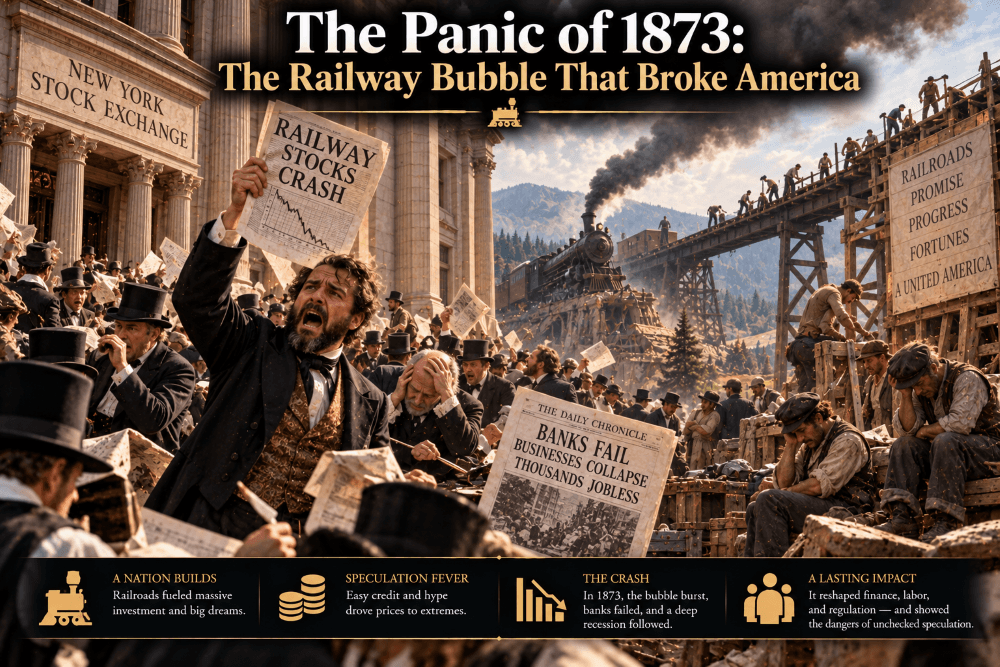
The Panic of 1873 stands as one of history’s clearest examples of how genuine technological progress and reckless financial excess can arrive in the exact same package. America’s railway boom created the infrastructure backbone of an industrial superpower, and it also produced a debt bubble so large it triggered a six-year depression. Its story offers a striking historical lens for evaluating today’s crypto currency hype and AI infrastructure spending boom.
Jay Cooke: The Titan Behind the Bubble
Rise to Prominence
Before becoming central to America’s greatest 19th-century financial collapse, Jay Cooke was the most influential financier in the United States.
- He rose to national prominence during the Civil War by pioneering retail bond sales, marketing low-denomination $50 bonds directly to ordinary citizens to help fund the Union war effort.
- This approach dramatically expanded who could participate in financing major national projects, moving well beyond wealthy institutional investors alone.
- His success during the war cemented his reputation as America’s premier financier heading into the postwar period.
The Transcontinental Ambition
Following the Civil War, the United States pursued an ambitious vision: connecting the country coast to coast through transcontinental railways.
- By 1869, Cooke had taken on financing for the Northern Pacific Railway, one of the era’s most ambitious infrastructure projects.
- He agreed to underwrite $100 million in bonds at a 7.3 percent interest rate, offered at a 12 percent discount, while taking up to a 60 percent equity stake in the arrangement.
- This structure exposed Cooke’s firm to enormous risk, tying his own financial fate directly to the railway’s completion and success.
The Scale of the Railway Bond Mania
An Explosion of Debt
The railway financing boom that Cooke helped drive reached a genuinely staggering scale within just a few years.
- U.S. railway bond issuance surged from $416 million in 1867 to $2.2 billion by 1874, and continued climbing to $5 billion by 1890.
- At its peak, railway bond debt represented roughly one-third of the entire U.S. gross domestic product.
- Relative to the size of the economy, this capital expenditure surge dramatically exceeded the scale of today’s AI data center investment, which by comparison represents roughly 1.2 percent of GDP.
This scale comparison matters significantly when evaluating how the Panic of 1873 relates to modern technology investment cycles, a point worth returning to later in this chapter.
Construction Struggles on the Ground
The Northern Pacific Railway project Cooke financed faced serious operational difficulties that strained his firm’s finances well before the broader crisis hit.
- The project encountered extreme geographical challenges across difficult and remote terrain.
- Significant cost overruns repeatedly exceeded original projections.
- The railway’s construction also involved serious conflict and resistance from Native American tribes whose lands were directly disrupted by the project.
These mounting difficulties forced Cooke’s firm to extend increasingly large advances to the railway, growing from an initial $500,000 to roughly $7 million as construction costs spiraled.
The Collapse and Its Global Trigger
European Contagion
The crisis that ultimately triggered the Panic of 1873 didn’t originate in the United States at all.
- In May 1873, Austria’s stock market crashed in an event known as the Gründercrash.
- This collapse prompted European investors to rapidly liquidate foreign assets, including substantial holdings of American railway bonds.
- This sudden withdrawal of European capital placed severe pressure on the already strained American railway financing system.
Jay Cooke & Co. Collapses
Depleted of liquidity and unable to withstand this pressure, Cooke’s firm reached a breaking point.
- Jay Cooke & Co. closed its doors on September 18, 1873, marking the dramatic collapse of America’s most prominent financial institution.
- This failure triggered immediate panic across American financial markets.
- The shock rippled quickly through an economy that had grown deeply dependent on continued railway financing.
The Long Depression and Its Aftermath
Economic Devastation
The consequences of this collapse extended far beyond a single firm’s failure.
- The New York Stock Exchange closed entirely for ten days, an extraordinary response reflecting the severity of the crisis.
- More than 120 railway companies went bankrupt in the aftermath.
- Roughly half of America’s iron foundries shut down as industrial demand collapsed alongside the railway sector.
This cascading collapse pushed the United States into a six-year economic contraction now known as the Long Depression, one of the most severe economic downturns in American history.
Modern Parallels to the Panic of 1873
Productive Bubbles Leave Something Behind
One of the most important historical patterns connects the Panic of 1873 to later technology-driven investment booms.
- Much like the 1990s fiber-optic infrastructure boom, which left behind extensive networking capacity that later fueled the internet era, America’s railway mania left behind physical infrastructure that transformed the country into an industrial power.
- Even though many individual railway companies and investors were financially devastated, the tracks, bridges, and rail networks themselves remained useful for generations afterward.
- This distinction, financial catastrophe alongside lasting physical value, is central to understanding why some bubbles produce long-term benefit despite short-term devastation.
The Open Question Around AI Investment
Applying this historical lesson to today’s AI infrastructure boom raises a genuinely open question that reasonable analysts answer differently.
- Supporters of current AI capital expenditure argue that data centers, chips, and computing infrastructure represent durable assets likely to retain value regardless of which specific software approaches ultimately dominate, much like railway tracks remained useful regardless of which specific railroad companies survived.
- Skeptics raise a different concern: unlike physical rail infrastructure, computing hardware depreciates quickly and specific AI architectures could become obsolete if underlying software paradigms shift significantly, potentially leaving today’s infrastructure investments stranded rather than durably valuable.
- Both perspectives draw legitimate insight from the historical pattern the Panic of 1873 established, and which view proves correct will likely depend on factors that remain genuinely uncertain at this point.
This uncertainty is worth sitting with rather than resolving prematurely. Historical parallels can illuminate real dynamics without guaranteeing identical outcomes.
Lessons from the Panic of 1873
- Massive capital expenditure cycles carry systemic risk. Railway debt reaching roughly a third of GDP created vulnerability that a single European shock was enough to trigger.
- Global contagion can strike suddenly. A stock market crash in Austria ultimately toppled America’s most prominent financier within months.
- Physical durability matters for long-term outcomes. Whether an investment boom leaves behind lasting value or stranded assets substantially shapes its long-term economic legacy.
Frequently Asked Questions
What caused the Panic of 1873? An Austrian stock market crash triggered European investors to liquidate American railway bond holdings, collapsing the overleveraged railway financing system that Jay Cooke had helped build, leading to his firm’s failure.
Who was Jay Cooke? Jay Cooke was America’s most prominent financier of the era, known for pioneering retail bond sales during the Civil War before his firm’s collapse triggered the Panic of 1873 through railway bond overexposure.
How does the Panic of 1873 compare to modern AI investment? Railway bond debt reached roughly one-third of U.S. GDP at its peak, far exceeding today’s AI data center spending at around 1.2 percent of GDP, though both cases raise similar questions about whether infrastructure investment will prove durable or become stranded.
What was the Long Depression? The Long Depression was a six-year economic contraction in the United States following the Panic of 1873, marked by widespread railway bankruptcies and significant industrial decline.
Related Articles
- The Railroad Revolution: How Railways Changed Entrepreneurship and Conquered Distance
- The Steam Revolution: How Power Rewrote Business
- The Rothschilds: How Information Built a Banking Empire
- Robert Owen: The Factory Owner Who Chose Workers
- Josiah Wedgwood: The Man Who Invented Branding
- Matthew Boulton: The Industrialist Who Scaled Genius
- James Watt: The Steam Engine That Powered Industry
- Andrew Carnegie: Steel, Scale, and Vertical Integration (Coming Soon)
About The History of Entrepreneurship
This article is part of The History of Entrepreneurship, an ongoing series exploring how civilizations, technologies, entrepreneurs, investors, and institutions gradually created the foundations of modern business.
Leave a Reply