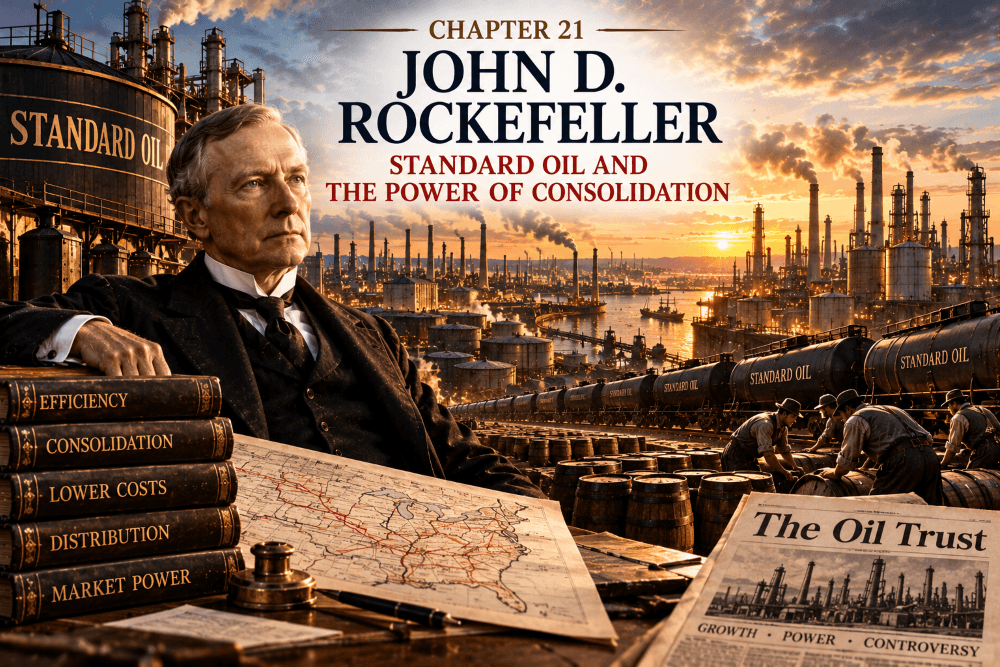
John D. Rockefeller did not discover oil.
He did not drill America’s first commercial oil well.
He did not invent kerosene.
Yet he built Standard Oil into one of the most powerful corporations in American history.
How?
Rockefeller looked at the chaotic early petroleum industry and saw something other entrepreneurs missed.
Waste.
Too many inefficient refineries.
Inconsistent quality.
Expensive transportation.
Unused byproducts.
Unpredictable production.
Destructive competition.
Rockefeller believed the industry could be organized more efficiently.
Reduce waste.
Standardize quality.
Lower transportation costs.
Buy competitors.
Combine operations.
Expand distribution.
Increase scale.
Then repeat.
His entrepreneurial contribution to our history is:
Horizontal integration, consolidation, and the economics of monopoly.
Who Was John D. Rockefeller?
John Davison Rockefeller was born in Richford, New York, in 1839.
His family later moved to Ohio.
His father, William Avery Rockefeller, was frequently absent and earned money through a variety of ventures.
His mother, Eliza, was disciplined and deeply religious.
Young Rockefeller developed habits that would remain with him throughout his life.
Save money.
Keep records.
Avoid waste.
Know where every dollar goes.
At sixteen, Rockefeller found work as an assistant bookkeeper in Cleveland.
That first job was more important than it might appear.
Before Rockefeller became an oil magnate, he learned:
Accounting.
Rockefeller Started With Numbers
Accounting is one of the oldest tools in our history of entrepreneurship.
Thousands of years earlier, Mesopotamian merchants used records to track economic activity.
Rockefeller used the same basic tool in nineteenth-century America.
He understood:
Costs.
Margins.
Inventory.
Interest.
Credit.
Transportation charges.
Cash flow.
He could look at a business through its numbers.
That ability became one of his greatest competitive advantages.
Why Small Costs Matter at Scale
Rockefeller became intensely focused on eliminating unnecessary expenses.
Save a few cents on a barrel.
Reduce transportation costs.
Use a refinery byproduct instead of discarding it.
Improve manufacturing efficiency.
Each saving may appear trivial.
Until you multiply it millions of times.
Imagine saving just one cent on 100 million units.
That’s:
$1 million.
This is one of the fundamental lessons of scale.
Small efficiencies become enormous efficiencies when multiplied across a large organization.
The Pennsylvania Oil Boom
The modern American petroleum industry accelerated dramatically after Edwin Drake successfully drilled for oil near Titusville, Pennsylvania, in 1859.
Oil prospectors rushed into the region.
Wells appeared.
Boomtowns emerged.
Fortunes were made.
Others disappeared.
The atmosphere resembled a gold rush.
But Rockefeller noticed something important.
Drilling was unpredictable.
A well might produce enormous quantities of oil.
Or nothing.
Rockefeller preferred a part of the industry where disciplined management could create a more predictable advantage.
Refining.
Why Rockefeller Chose Oil Refining
Crude petroleum was not particularly useful to ordinary consumers.
It had to be refined into usable products.
One of the most valuable was:
Kerosene.
Before widespread electric lighting, households needed fuel for lamps.
Whale oil and other traditional lighting fuels could be expensive.
Kerosene offered an increasingly attractive alternative.
Rockefeller saw the opportunity.
But rather than gambling primarily on finding oil underground, he focused on processing it efficiently after someone else found it.
That reveals an important entrepreneurial principle:
You don’t always need to control the discovery. Sometimes the opportunity lies in controlling the process.
Rockefeller Enters the Oil Business
Rockefeller initially worked with Maurice Clark in a commission business handling agricultural and other goods.
As Cleveland’s petroleum-refining industry expanded, Rockefeller and his partners invested in refining.
Cleveland was well positioned.
It had railroad connections.
Water transportation.
Access to growing markets.
Relative proximity to Pennsylvania’s oil fields.
Crude oil could arrive.
Refined products could leave.
Rockefeller increasingly focused his attention on petroleum.
He had found the industry that would make his fortune.
Rockefeller Hated Waste
Early oil refining could be extremely inefficient.
Kerosene was the principal product.
Other petroleum fractions and residues had less obvious value.
Rockefeller’s operations searched for ways to monetize more of the crude oil.
Products and byproducts could be developed for uses such as:
Lubricants.
Paraffin.
Fuel.
Industrial products.
Instead of seeing unwanted material simply as waste, Rockefeller asked:
Can we sell this too?
Turning waste into revenue improves profit from both directions.
Costs fall.
Revenue rises.
Standardization Creates Trust
Early kerosene quality varied.
Poorly refined products could smoke badly or create safety problems.
Rockefeller recognized that consistency had value.
Customers should know what they were buying.
A product should behave predictably.
The name of his company captured the idea perfectly:
Standard Oil.
Standard.
Reliable.
Consistent.
Think back to our chapter on the Indus Valley.
Standardized weights and measurements made commerce easier thousands of years ago.
The principle had not changed.
Standardization reduces uncertainty.
Reduced uncertainty creates trust.
Trust encourages commerce.
Standard Oil Is Created
In 1870, Rockefeller and his partners organized the Standard Oil Company of Ohio.
Rockefeller was only thirty years old.
But operating an efficient refinery was not enough for him.
He believed the petroleum-refining industry contained too much excess capacity and destructive competition.
His solution was consolidation.
Rather than merely outperform competitors:
Acquire them.
This introduces our next major entrepreneurial strategy.
What Is Horizontal Integration?
In Chapter 20, Andrew Carnegie demonstrated the power of vertical integration.
Vertical integration means controlling different stages of a supply chain.
Raw materials.
Transportation.
Production.
Distribution.
Rockefeller became famous for another strategy:
Horizontal integration.
Horizontal integration means combining companies operating at the same stage of an industry.
Imagine ten competing refineries.
One company acquires six.
Instead of ten competitors, there are now five.
The acquiring company gains:
More production.
More customers.
Greater scale.
More bargaining power.
Greater market share.
And fewer competitors.
Rockefeller Bought His Competitors
Standard Oil expanded partly by acquiring competing refineries.
Rockefeller could offer refinery owners money or, in some cases, ownership in the larger enterprise.
Some competitors saw an attractive opportunity.
Join Standard Oil.
Gain access to its scale.
Participate in its future profits.
Others viewed Rockefeller’s expansion very differently.
They believed Standard Oil’s growing transportation advantages and financial strength left them with little practical choice.
This tension would follow Rockefeller throughout his career.
Was Standard Oil creating efficiency?
Or eliminating competition?
Often, both questions were relevant.
The Cleveland Consolidation
In 1872, Standard Oil acquired a large number of competing Cleveland refineries in a remarkably short period.
Critics later referred to the episode as the:
Cleveland Massacre.
The name captures how competitors experienced Rockefeller’s consolidation campaign.
But Rockefeller possessed real competitive advantages.
Efficient operations.
Financial resources.
Transportation leverage.
Scale.
Cost control.
A small refiner faced a difficult decision.
Sell to Standard Oil.
Or compete against a company that might be able to operate more cheaply and withstand lower margins for much longer.
Many chose to sell.
Scale Creates Bargaining Power
Transportation was one of the petroleum industry’s largest expenses.
Railroads moved crude oil and refined petroleum products across the country.
Imagine two companies negotiating with a railroad.
One ships 100 barrels.
The other ships 100,000.
Which company has greater leverage?
The larger customer.
Standard Oil’s enormous shipping volumes gave it bargaining power.
Railroads valued its predictable traffic.
Rockefeller used that leverage to negotiate favorable rates.
Those lower transportation costs made Standard Oil even more competitive.
Rockefeller’s Railroad Rebates
Railroad rebates became one of the most controversial aspects of Standard Oil’s history.
Large shippers commonly negotiated discounts from published freight rates.
Standard Oil became exceptionally effective at obtaining favorable terms.
Some arrangements went beyond ordinary volume discounts and became politically explosive.
Critics argued that Standard Oil received transportation advantages smaller refiners could not realistically match.
Standard Oil’s defenders emphasized its enormous shipping volumes, predictable traffic, and logistical efficiencies.
This creates an entrepreneurial question that remains relevant:
When does a legitimate volume discount become an advantage that undermines competition?
The Standard Oil Flywheel
Rockefeller built a remarkably powerful business cycle.
Increase efficiency
↓
Reduce costs
↓
Offer competitive prices
↓
Increase volume
↓
Gain scale
↓
Increase bargaining power
↓
Reduce costs further
↓
Acquire competitors
↓
Increase scale again
Then repeat.
This is a business flywheel.
Each advantage strengthens the next.
Once the flywheel begins moving quickly, competitors can find it extremely difficult to catch up.
Standard Oil’s Efficiency Was Real
It would be misleading to explain Standard Oil’s rise entirely through aggressive competitive tactics.
The company also became exceptionally efficient.
It improved:
Refining.
Transportation.
Storage.
Packaging.
Distribution.
Byproduct utilization.
Management.
Quality control.
Rockefeller’s obsession with waste mattered.
Standard Oil could frequently produce and distribute petroleum products more efficiently than smaller rivals.
That efficiency created genuine economic value.
But Efficiency Created Power
Here we encounter the Rockefeller paradox.
Efficiency creates scale.
Scale creates bargaining power.
Bargaining power reduces costs.
Lower costs create more scale.
Eventually, the company may become so large that it begins influencing the market itself.
The advantages that make a company efficient can also make it dominant.
A large company can:
Negotiate lower supplier prices.
Invest more in technology.
Build superior distribution.
Spread fixed costs.
Standardize products.
These can benefit customers.
But the same company may also be able to:
Pressure suppliers.
Acquire rivals.
Control distribution channels.
Discourage new competitors.
Influence industry terms.
Efficiency and market power can grow together.
Did Standard Oil Lower Prices?
One reason Rockefeller’s story remains so interesting is that the economic effects were not simply:
Monopoly → higher consumer prices.
During Standard Oil’s rise, kerosene became significantly cheaper.
Several forces contributed.
Technological improvement.
Growing petroleum supplies.
Industry competition.
Better refining.
Transportation improvements.
And Standard Oil’s own efficiencies.
Consumers gained access to cheaper lighting.
This complicates the monopoly story.
What if a dominant company becomes dominant partly because it is exceptionally efficient?
What if customers receive lower prices?
Should society still worry about its power?
Competition Is About More Than Price
The answer requires looking beyond today’s price.
Competition affects:
Innovation.
Choice.
Supplier bargaining power.
Worker bargaining power.
New business creation.
Future prices.
Market entry.
A dominant company might charge low prices today.
But what happens if competitors disappear?
Can new companies enter tomorrow?
Can suppliers negotiate fairly?
Can the dominant company determine the rules of the market?
This is why monopoly is not simply a question of whether today’s price seems cheap.
What Is Monopoly Power?
A monopoly exists when one seller controls a market without meaningful competition.
Real markets are often more complicated.
A company may not control 100 percent of an industry but still possess substantial market power.
Market power can influence:
Prices.
Suppliers.
Distribution.
Competitors.
Terms of trade.
Rockefeller’s great entrepreneurial achievement created exactly this problem.
Standard Oil became so successful that its success changed the environment in which everyone else competed.
Standard Oil Creates the Trust
As Standard Oil expanded across the United States, its corporate structure became increasingly complicated.
Companies operated under different state laws.
Coordinating the growing empire became difficult.
In 1882, Standard Oil created its famous trust structure.
Shareholders transferred shares in numerous companies to trustees.
They received trust certificates in return.
The trustees could coordinate the entire enterprise.
The arrangement allowed Rockefeller and his associates to manage a vast group of businesses as a unified organization.
The legal structure became so famous that the word trust acquired a new political meaning.
How “Trust” Became a Dirty Word
Originally, a trust was simply a legal arrangement.
But enormous corporate combinations transformed public perception.
Americans began referring to dominant industrial combinations as:
The Oil Trust.
The Sugar Trust.
The Tobacco Trust.
And others.
“Trust” increasingly became shorthand for concentrated corporate power.
People began asking:
Are these simply highly efficient companies?
Or have they become powerful enough to undermine competition itself?
The question became one of the central political and economic issues of the era.
Rockefeller Also Used Vertical Integration
Although Rockefeller is most associated with horizontal integration, Standard Oil eventually controlled multiple stages of the petroleum business.
The company expanded into areas such as:
Transportation.
Pipelines.
Storage.
Barrel production.
Distribution.
Marketing.
And petroleum production.
In reality, Standard Oil used both strategies.
Horizontal integration helped consolidate refining.
Vertical integration helped control the broader petroleum supply chain.
Textbooks separate these concepts.
Successful entrepreneurs often combine them.
Pipelines Reduce Dependence on Railroads
Railroads originally held enormous power over the petroleum industry.
Oil needed transportation.
But pipelines created an alternative.
Instead of loading barrels onto trains, petroleum could move continuously through pipes.
Standard Oil expanded aggressively into pipeline infrastructure.
This reduced transportation costs.
It also reduced dependence on railroad companies.
The strategy would have looked familiar to Andrew Carnegie:
If someone else controls a critical bottleneck, consider controlling that bottleneck yourself.
Distribution Can Be More Powerful Than Production
A small refinery might produce excellent kerosene.
But could it deliver that kerosene across the country?
Could it store it?
Ship it?
Market it?
Supply retailers consistently?
Standard Oil built enormous distribution capabilities.
The company’s competitive advantage increasingly extended beyond the refinery.
The real product was surrounded by a system:
Production.
Transportation.
Storage.
Distribution.
Marketing.
Rockefeller understood something modern entrepreneurs sometimes forget:
Making the product is only half the business. Reaching the customer is the other half.
Standard Oil Goes Global
Kerosene demand extended far beyond the United States.
People around the world wanted affordable illumination.
Standard Oil built an enormous export business.
American petroleum products reached international markets.
Again, we see an entrepreneurial principle that has appeared repeatedly throughout history.
The Phoenicians understood it.
Silk Road merchants understood it.
Indian Ocean traders understood it.
The Dutch East India Company understood it.
Distribution expands the value of production.
A product trapped near the factory has limited value.
A product connected to global markets can create an empire.
Electricity Threatens Rockefeller’s Business
Then technological disruption arrived.
Electric lighting began spreading.
The kerosene lamp suddenly faced a formidable competitor.
Imagine being Rockefeller.
You have built an enormous business supplying fuel for illumination.
Then another technology threatens to eliminate the lamp.
This is the nightmare of every successful entrepreneur:
What happens when innovation attacks your core market?
But petroleum had another future.
And it would become much larger than kerosene.
Gasoline Goes From Byproduct to Essential Commodity
Early petroleum refiners cared primarily about kerosene.
Gasoline initially had much less commercial importance.
Then the internal combustion engine arrived.
Automobiles began spreading.
Cars needed fuel.
Suddenly gasoline became enormously valuable.
The product had not changed.
The ecosystem surrounding the product had changed.
This gives us an important entrepreneurial lesson:
Markets can be created by technologies outside your own industry.
The automobile transformed the economics of petroleum.
Don’t Define Your Business Too Narrowly
If Standard Oil had thought of itself only as:
A kerosene company
electricity would have represented an existential threat.
But petroleum had many possible uses.
Transportation.
Lubrication.
Industry.
Chemicals.
Energy.
This distinction matters.
Entrepreneurs should ask:
Are we selling a particular product?
Or are we providing a broader capability?
Markets change.
Technology changes.
Customer needs evolve.
The underlying resource may remain valuable even when the original product declines.
Ida Tarbell Investigates Standard Oil
Standard Oil’s enormous power attracted critics.
Among the most influential was journalist Ida Tarbell.
Tarbell had grown up in Pennsylvania’s oil region.
Beginning in 1902, she published an extensive investigation of Standard Oil in McClure’s Magazine.
Her work later appeared as:
The History of the Standard Oil Company.
Tarbell examined Rockefeller’s competitive methods, acquisitions, railroad relationships, and the experiences of independent oil producers and refiners.
Her reporting became one of the most famous examples of investigative journalism in American business history.
Journalism Becomes a Check on Corporate Power
Tarbell’s story introduces another institution into our entrepreneurial history.
Investigative journalism.
Corporations gather information about:
Customers.
Competitors.
Suppliers.
Markets.
But society also gathers information about corporations.
Journalists.
Regulators.
Courts.
Investors.
Auditors.
Transparency becomes increasingly important as companies become larger.
Information is not only a competitive weapon.
It can also become a mechanism of accountability.
The Sherman Antitrust Act
Growing concern about industrial combinations eventually led to federal legislation.
In 1890, the United States passed the Sherman Antitrust Act.
The law addressed restraints of trade and monopolization.
But the difficult questions began immediately.
What exactly counts as illegal monopolization?
Is becoming dominant through efficiency wrong?
How much market share is too much?
When does an acquisition harm competition?
When does aggressive competition become exclusionary?
These questions proved difficult in Rockefeller’s time.
They remain difficult today.
The Government Takes Standard Oil to Court
The federal government eventually pursued Standard Oil under the Sherman Antitrust Act.
The dispute reached the U.S. Supreme Court.
In 1911, the Court ruled against the Standard Oil combination and ordered it dissolved into separate companies.
The empire Rockefeller had spent decades helping assemble was broken apart.
But petroleum did not disappear.
The refineries continued operating.
Pipelines continued moving oil.
Customers continued buying petroleum products.
What changed was the structure of ownership and competition.
What Happened After Standard Oil Was Broken Up?
Standard Oil was separated into numerous companies.
Several descendants eventually became associated with famous petroleum businesses, including companies that would become part of:
Exxon.
Mobil.
Chevron.
Amoco.
And others.
Many successor businesses remained enormously valuable.
Rockefeller himself owned substantial shares.
As the successor companies grew, his wealth also benefited.
There is a remarkable irony here.
Breaking apart Standard Oil did not destroy Rockefeller’s fortune.
His ownership in the pieces remained extraordinarily valuable.
Was Standard Oil Really a Monopoly?
This apparently simple question requires a more careful answer.
It depends on:
The year.
The geographic market.
The petroleum product.
The part of the supply chain.
Standard Oil controlled a very large share of American petroleum refining during important periods of its history.
Its dominance later faced changing technologies, new oil discoveries, competitors, and legal challenges.
For entrepreneurs, the more interesting question is:
What happens when a company becomes successful enough to influence the structure of its own market?
Rockefeller forces us to confront that question.
Winning the Market vs. Controlling the Market
Entrepreneurs normally begin by adapting to markets.
Customers determine demand.
Competitors create pressure.
Suppliers negotiate.
The entrepreneur responds.
But very large companies can begin influencing those conditions.
They can affect:
Industry standards.
Supplier economics.
Distribution.
Pricing structures.
Competitor behavior.
Regulation.
At that point, the company is no longer merely participating in the market.
It may be helping shape the market itself.
That creates enormous strategic power.
It also attracts enormous scrutiny.
Efficiency vs. Competition
Imagine ten companies merge.
The combined company eliminates duplicated warehouses.
Negotiates cheaper transportation.
Uses better technology.
Standardizes production.
Costs fall 30 percent.
Consumers receive lower prices.
That appears beneficial.
But suppose the combined company now controls almost the entire market.
Potential competitors struggle to enter.
Is consolidation still beneficial?
The answer depends on more than efficiency alone.
Society must consider:
Prices.
Innovation.
Market entry.
Consumer choice.
Supplier power.
Long-term competition.
Rockefeller’s career helped force economics and law to confront this trade-off.
Horizontal Integration Today
Rockefeller’s strategy is still widely used.
A company buys a competitor.
Then another.
Operations are combined.
Duplicate costs disappear.
Purchasing power increases.
Distribution expands.
Market share grows.
We see horizontal integration in:
Airlines.
Banking.
Media.
Telecommunications.
Pharmaceuticals.
Retail.
Food production.
Technology.
Consolidation can create legitimate efficiencies.
But large acquisitions often attract regulatory scrutiny because fewer competitors can also mean greater market power.
The Rockefeller question has never disappeared.
Rockefeller’s Consolidation Flywheel
His strategy can be summarized:
Operate efficiently
↓
Generate profits
↓
Acquire competitors
↓
Increase scale
↓
Gain bargaining power
↓
Reduce costs
↓
Increase market share
↓
Generate more profits
↓
Acquire more competitors
Then repeat.
But eventually the flywheel can change.
More scale
↓
Fewer competitors
↓
Greater market power
↓
Higher barriers to entry
↓
Even greater scale
At that point, entrepreneurial strategy becomes a question of competition policy.
Carnegie vs. Rockefeller: Vertical and Horizontal Integration
Andrew Carnegie and John D. Rockefeller provide an excellent way to remember two major business strategies.
Andrew Carnegie: Vertical Integration
Move up and down the supply chain.
Control raw materials.
Transportation.
Production.
Critical inputs.
The objective:
Control the system producing the product.
John D. Rockefeller: Horizontal Integration
Move across the industry.
Acquire competitors.
Combine operations.
Increase market share.
Gain economies of scale.
The objective:
Consolidate the market.
Modern companies frequently use both strategies.
Rockefeller Becomes a Philanthropist
Like Andrew Carnegie, Rockefeller eventually devoted enormous resources to philanthropy.
His giving supported:
Medicine.
Scientific research.
Education.
Public health.
Universities.
Medical institutions.
His philanthropic organizations helped support major public-health initiatives and scientific research.
The Rockefeller Foundation was established in 1913.
Rockefeller’s later life therefore raises a question similar to Carnegie’s:
What responsibility accompanies enormous wealth?
The Industrial Billionaire Paradox
Carnegie and Rockefeller both became symbols of extraordinary wealth.
Both built businesses that contributed significantly to industrial development.
Both were criticized for the power and practices of their corporations.
Both later created enormous philanthropic legacies.
This produces a recurring tension.
Concentrated wealth can finance:
Research.
Universities.
Libraries.
Hospitals.
Public-health programs.
But the concentration of wealth itself raises questions about:
Competition.
Political influence.
Labor.
Economic power.
Distribution.
The industrial age forced society to confront both sides simultaneously.
Rockefeller’s Real Entrepreneurial Innovation
Rockefeller’s achievement was not simply building a large oil company.
He constructed a system of scale.
Efficiency.
Standardization.
Cost control.
Distribution.
Transportation.
Acquisition.
Management.
Finance.
Every part reinforced the others.
The system became the competitive advantage.
Carnegie had demonstrated how entrepreneurs could design the supply chain.
Rockefeller demonstrated how entrepreneurs could reorganize an entire industry.
The Entrepreneur’s Toolbox
Horizontal Integration, Consolidation, and Market Power
Rockefeller adds another powerful tool:
Consolidation.
Fragmented industries often contain inefficiencies.
Duplicated infrastructure.
Excess capacity.
Weak purchasing power.
Inconsistent quality.
Poor distribution.
Combining companies can eliminate some of those inefficiencies.
But consolidation contains an inherent tension.
The same scale that creates efficiency can create market power.
The same bargaining leverage that lowers costs can weaken suppliers.
The same acquisition that improves operations removes a competitor.
Rockefeller’s entrepreneurial lesson therefore comes with a warning:
Scale can change not only your business. It can change the market around your business.
Five Business Lessons From John D. Rockefeller
1. Look for Waste
Rockefeller saw economic value where competitors saw refinery waste.
Ask:
What resources are we already paying for but failing to monetize?
2. Small Savings Compound at Scale
Saving a few cents can become enormously valuable when repeated millions of times.
Efficiency compounds.
3. Distribution Can Be a Competitive Advantage
A great product means little if customers cannot get it cheaply and reliably.
4. Consolidation Can Create Genuine Efficiency
Combining fragmented businesses can eliminate duplication, improve operations, and reduce costs.
5. Market Power Changes the Entrepreneur’s Responsibility
Once a company becomes large enough to influence suppliers, competitors, customers, and markets, its decisions have consequences far beyond its own shareholders.
Frequently Asked Questions About John D. Rockefeller
Who was John D. Rockefeller?
John D. Rockefeller was an American industrialist who helped build Standard Oil into the dominant petroleum company of its era and later became one of America’s most important philanthropists.
When was Standard Oil founded?
The Standard Oil Company of Ohio was organized in 1870.
How did Rockefeller become rich?
Rockefeller built wealth primarily through the petroleum industry. Standard Oil expanded through cost control, efficient refining, transportation advantages, distribution, economies of scale, acquisitions, and both horizontal and vertical integration.
What is horizontal integration?
Horizontal integration occurs when a company acquires or combines with businesses operating at the same stage of an industry, such as one oil refiner acquiring other oil refineries.
How is horizontal integration different from vertical integration?
Horizontal integration expands across an industry by combining competitors.
Vertical integration expands along the supply chain by controlling suppliers, production, transportation, or distribution.
Was Standard Oil a monopoly?
Standard Oil achieved a dominant position in American petroleum refining and other parts of the oil business. Its exact share varied by period and market. Its market power and business practices ultimately became the subject of federal antitrust litigation.
Why was Standard Oil broken up?
The U.S. Supreme Court ruled in 1911 that the Standard Oil combination violated federal antitrust law and ordered its dissolution into separate companies.
Who was Ida Tarbell?
Ida Tarbell was an investigative journalist whose serialized investigation of Standard Oil began appearing in McClure’s Magazine in 1902 and was later published as The History of the Standard Oil Company.
What companies came from Standard Oil?
Companies descended from parts of the former Standard Oil organization eventually became associated with major petroleum companies including Exxon, Mobil, Chevron, and Amoco, among others.
What can entrepreneurs learn from Rockefeller?
Rockefeller’s career demonstrates the importance of cost control, standardization, distribution, economies of scale, monetizing waste, and building systems. It also demonstrates how extreme market power can create legal, economic, and social challenges.
The Entrepreneur’s Toolkit So Far
| Chapter | Entrepreneurial Contribution |
|---|---|
| Chapter 1 | Exchange |
| Chapter 2 | Surplus |
| Chapter 3 | Accounting |
| Chapter 4 | Professional Merchants |
| Chapter 5 | Money |
| Chapter 6 | Standardization |
| Chapter 7 | Continuous Improvement |
| Chapter 8 | Networks |
| Chapter 9 | Competition |
| Chapter 10 | Scale |
| Chapter 11 | Knowledge & Financial Innovation |
| Chapter 12 | Risk-Sharing & Commercial Institutions |
| Chapter 13 | Organizational Scale |
| Chapter 14 | Portable Trust |
| Chapter 15 | Pooled Capital |
| Chapter 16 | Tradable Ownership & Permanent Capital |
| Chapter 17 | Market Psychology & Price Discovery |
| Chapter 18 | Mechanization & Productivity |
| Chapter 19 | Speed, Connectivity & Infrastructure Networks |
| Chapter 20 | Vertical Integration & Relentless Cost Reduction |
| Chapter 21 | Horizontal Integration, Consolidation & Market Power |
The entrepreneur has evolved again.
He can now do more than create a company.
He can reorganize an industry.
And that creates a new question entrepreneurship has never fully escaped:
When does competitive success become too much market power?
Continue the Journey: Thomas Edison
Rockefeller took an existing industry and reorganized it.
Our next entrepreneur approached business differently.
He started with:
Invention.
Electric light.
Recorded sound.
Electrical systems.
Motion pictures.
But calling Thomas Edison simply an inventor misses an important part of his significance.
Edison understood that an invention by itself was not enough.
Consider the electric light bulb.
A light bulb without electricity is nearly useless.
Customers also need:
Power stations.
Generators.
Electrical wires.
Switches.
Meters.
Distribution systems.
Maintenance.
Financing.
The entrepreneur must build an ecosystem around the invention.
Edison also helped pioneer something that would transform modern business:
The industrial research laboratory.
Instead of waiting for isolated inventors to produce occasional breakthroughs, Edison assembled teams of researchers, machinists, chemists, and engineers.
Innovation itself became organized.
Repeatable.
Commercial.
In Chapter 22:
Thomas Edison: Turning Invention Into Business
The next entrepreneurial contribution will be:
Commercializing Innovation and Building the Industrial R&D Laboratory.
Related Articles
- Andrew Carnegie: Steel, Scale, and Vertical Integration
- The Panic of 1873: The Railway Bubble That Broke America
- The Railroad Revolution: How Railways Changed Entrepreneurship and Conquered Distance
- The Steam Revolution: How Power Rewrote Business
- The Rothschilds: How Information Built a Banking Empire
- Robert Owen: The Factory Owner Who Chose Workers
- Josiah Wedgwood: The Man Who Invented Branding
- Thomas Edison: Turning Invention Into Business (Coming Soon)
About The History of Entrepreneurship
This article is part of The History of Entrepreneurship, an ongoing series exploring how entrepreneurs, civilizations, technologies, financial institutions, and business innovations gradually created the modern economy.
Each chapter asks:
What entrepreneurial tool did this person or period add to the world?
John D. Rockefeller’s contribution is:
Horizontal integration, consolidation, and market power.
Rockefeller demonstrated that entrepreneurs could create enormous efficiencies by consolidating fragmented industries.
But Standard Oil also demonstrated something equally important:
A company can become successful enough that its power begins changing the competitive system around it.
North Star
John D. Rockefeller transformed entrepreneurship by demonstrating the power of consolidation. Standard Oil reduced waste, standardized quality, built extraordinary distribution systems, lowered costs, and used scale to reorganize a fragmented industry. But its success also demonstrated that efficiency and market power can grow together. Rockefeller’s enduring lesson is therefore both powerful and cautionary: consolidation can make an industry more efficient, but when an entrepreneur becomes powerful enough to shape the competitive environment itself, business strategy becomes a question not only of entrepreneurship—but of economic power.
Leave a Reply