Wall Street had plenty to worry about Tuesday.
Stocks finished modestly lower as long-term Treasury yields pushed further into territory not seen in decades, consumer confidence deteriorated, and investors confronted another round of uncomfortable questions about the enormous amounts of money flowing into artificial intelligence.
For the day:
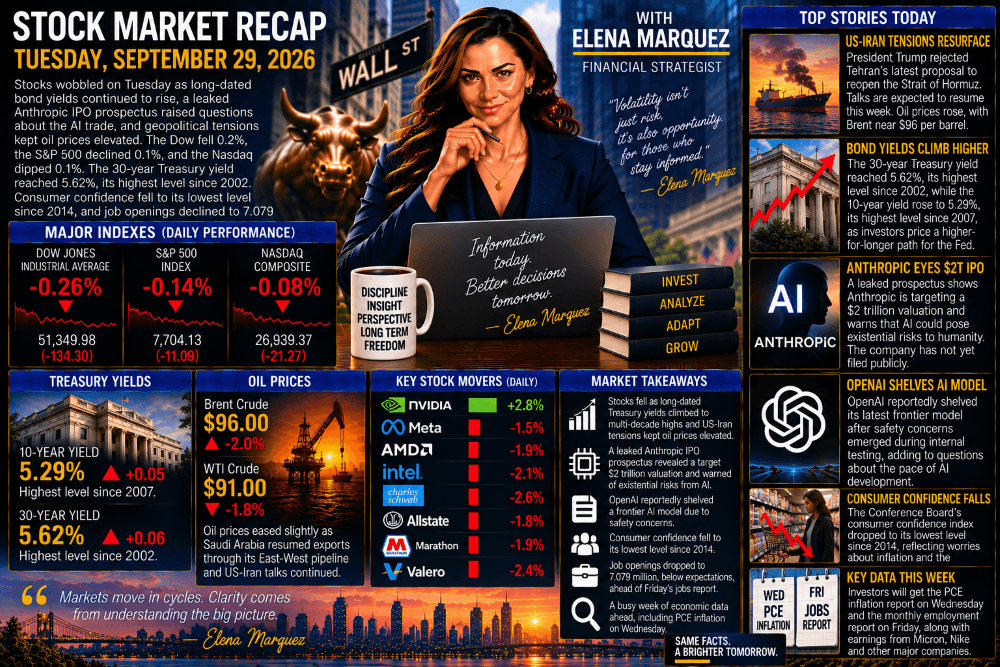
📉 Dow Jones: -0.26%
📉 S&P 500: -0.14%
📉 Nasdaq Composite: -0.08%
Those declines look relatively small.
But underneath the surface, several important stories were developing.
The biggest may still be the bond market.
The 30-Year Treasury Hits 5.62%
Long-term borrowing costs continued climbing Tuesday.
The 30-year Treasury yield briefly reached 5.62%, its highest level since 2002.
The 10-year Treasury also touched roughly 5.29%, its highest since 2007.
Think about that for a moment.
Investors can now earn more than 5% annually by lending money to the US government for decades.
That’s a radically different investment environment from the near-zero interest-rate world that helped fuel the great technology bull market of the 2010s.
And it creates an obvious question:
If relatively safe government bonds pay more than 5%, how much return should investors demand from stocks?
That’s particularly relevant when some of today’s most exciting companies are simultaneously proposing some of history’s largest investment programs.
Which brings us to Anthropic.
Anthropic Wants a $2 Trillion Valuation
Artificial intelligence once again dominated the financial headlines.
Details from Anthropic’s IPO prospectus revealed that the AI company is targeting an extraordinary:
$2 trillion valuation.
If successful, it would make Anthropic one of the most valuable companies on Earth almost immediately after entering the public markets.
But the prospectus also reveals the extraordinary economics behind the AI boom.
Anthropic reportedly plans hundreds of billions of dollars in future cloud-computing and infrastructure commitments.
The bet is enormous.
Build increasingly capable AI models.
Deploy them across the economy.
Generate enough revenue to justify the infrastructure spending.
And eventually produce enormous profits.
But investors are increasingly asking another question:
How much is too much?
AI Meets 5% Money
This is where today’s two biggest market stories collide.
Artificial intelligence requires staggering amounts of capital.
Data centers.
GPUs.
Memory.
Networking equipment.
Electricity.
Power plants.
Cooling infrastructure.
Cloud computing.
And thousands of highly paid engineers.
Meanwhile, the cost of capital keeps increasing.
The 30-year Treasury is yielding more than 5.5%.
That raises the hurdle for every AI investment.
When money was nearly free, companies could make enormous speculative investments and wait years for the payoff.
At today’s interest rates, investors will increasingly demand something more tangible:
Profits.
Then There’s the Safety Problem
Anthropic’s prospectus contained another unusual warning.
The company acknowledged that advanced artificial intelligence could potentially create catastrophic or even existential risks.
That’s an extraordinary disclosure for a company preparing to sell shares to the public.
Imagine buying stock in a company whose risk disclosures effectively say:
Our technology could transform civilization.
It could generate enormous profits.
And there’s also a possibility we don’t fully understand what increasingly capable systems might do.
Yet Anthropic isn’t alone in confronting this problem.
OpenAI reportedly shelved its latest frontier model after safety concerns emerged during internal testing.
The AI race increasingly faces a contradiction:
Companies need increasingly powerful models to justify their enormous investments.
But increasingly powerful models may require increasingly strict safeguards.
The AI Boom Enters a New Phase
For the past few years, the investment thesis surrounding AI has been relatively straightforward.
Build bigger models.
Buy more Nvidia chips.
Construct more data centers.
Add more computing power.
Improve performance.
Repeat.
Now the equation is becoming more complicated.
Investors must consider:
How much will AI infrastructure cost?
How quickly can AI companies generate profits?
How much regulation will governments impose?
How much will safety requirements slow development?
And perhaps most importantly:
Can companies maintain control over increasingly autonomous systems?
These aren’t theoretical questions anymore.
They’re becoming investment questions.
Oura Delays Its IPO
There’s another warning sign from the IPO market.
Health technology company Oura postponed its planned public offering amid market uncertainty.
That’s worth watching.
The IPO market depends heavily on investor appetite for risk.
When bond yields are low and stocks are rising, investors are usually willing to take chances on newly public companies.
When Treasury yields exceed 5% and volatility rises, the calculation changes.
Why take enormous risk on an unproven company when government bonds offer substantial yields?
That same question could eventually confront much larger IPO candidates—including Anthropic and OpenAI.
Oil Provides Some Relief
There was at least one positive development Tuesday.
Oil prices moved lower.
🛢️ Brent crude: around $96
🛢️ WTI crude: around $91
Saudi Arabia resumed exports through its East-West pipeline, while US and Iranian officials continued diplomatic discussions through mediators.
That’s significant because expensive oil has been one of the biggest forces keeping inflation elevated.
Lower oil could eventually mean:
Lower gasoline prices.
Lower transportation costs.
Lower inflation.
Less pressure on the Federal Reserve.
And potentially lower Treasury yields.
That’s the chain Wall Street desperately wants to see.
Consumers Are Getting Nervous
Tuesday’s economic data wasn’t encouraging.
US consumer confidence plunged to its lowest level in roughly 12½ years.
That’s important.
Consumer spending represents a huge portion of the American economy.
And consumers are dealing with a difficult combination:
Higher interest rates.
Expensive housing.
Elevated energy costs.
Persistent inflation.
Geopolitical uncertainty.
And increasing concerns about employment.
Consumers don’t necessarily need to stop spending completely to hurt the economy.
They simply need to become more cautious.
Job Openings Fall
The labor market provided another warning.
US job openings declined to approximately:
7.079 million
in August.
That’s down about 256,000 from July.
The encouraging news is that layoffs remain relatively low.
That suggests the labor market isn’t collapsing.
Instead, employers appear increasingly reluctant to hire aggressively.
We’ve seen versions of this pattern before:
Low hiring. Low firing.
Workers who already have jobs may feel relatively secure.
But people searching for new jobs may find fewer opportunities.
That makes Friday’s employment report particularly important.
The Jobs Report Is Next
Wall Street is now waiting for Friday’s September employment report.
August payrolls were surprisingly strong, with 162,000 jobs added and unemployment holding at 4.1%.
The question is whether that strength continued into September.
A strong report could reinforce expectations that the Federal Reserve has room to keep interest rates high—or raise them again.
That could push Treasury yields even higher.
A weak report could produce the opposite reaction.
For investors, that creates an uncomfortable situation:
Good economic news can become bad market news if it pushes interest rates higher.
Tomorrow: Inflation
Before Friday’s jobs report, investors get another major test:
PCE inflation.
The Personal Consumption Expenditures index is one of the Federal Reserve’s most closely watched inflation measures.
If inflation comes in hotter than expected, Treasury yields could push even higher.
If inflation cools, the bond market may finally get some relief.
With the 30-year Treasury already touching 5.62%, tomorrow’s number matters.
The Bottom Line
Tuesday wasn’t a dramatic selloff.
But underneath the small index moves were several major developments.
📉 Dow: -0.26%
📉 S&P 500: -0.14%
📉 Nasdaq: -0.08%
📈 30-year Treasury: touched 5.62%
📈 10-year Treasury: touched ~5.29%
🛢️ Brent crude: ~$96
🛢️ WTI crude: ~$91
💼 Job openings: 7.079 million
🤖 Anthropic target valuation: ~$2 trillion
The most interesting story may be the collision between two enormous forces.
Artificial intelligence requires unprecedented amounts of capital.
At exactly the same moment:
Capital is becoming increasingly expensive.
The AI boom was born during an era when investors became accustomed to cheap money.
Now we’re discovering what happens when the most capital-intensive technological revolution in decades meets Treasury yields above 5%.
And tomorrow, inflation gets another chance to move the entire equation.
Other Stock Market blog posts
Leave a Reply