Wall Street just received some good news about inflation.
And strangely enough, most stocks still fell.
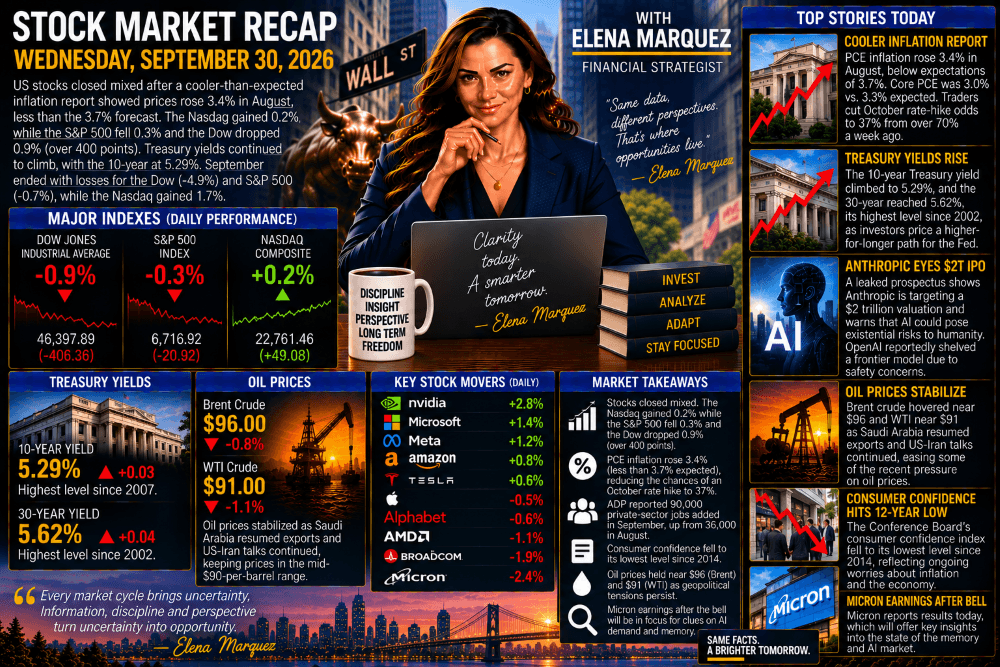
The Federal Reserve’s preferred inflation measure came in cooler than expected Wednesday, dramatically reducing expectations for another interest-rate hike in October.
Technology stocks welcomed the news.
The broader market wasn’t nearly as enthusiastic.
For the day:
📈 Nasdaq Composite: +0.2%
📉 S&P 500: -0.3%
📉 Dow Jones: -0.9%
The Dow dropped more than 400 points.
And with today’s closing bell, we can officially close the books on September.
It wasn’t a particularly pleasant month.
September Lives Up to Its Reputation
For the month:
📉 Dow: -4.9%
📉 S&P 500: -0.7%
📈 Nasdaq: +1.7%
Technology was the notable survivor.
That’s impressive considering everything investors confronted during September:
Oil above $100.
War in Iran.
A Federal Reserve rate hike.
Treasury yields above 5%.
AI safety fears.
Trade tensions.
And persistent inflation.
But today’s inflation report finally offered investors some encouraging news.
Inflation Comes in Cooler Than Expected
The Personal Consumption Expenditures index — PCE — is one of the Federal Reserve’s most closely watched inflation measures.
And Wednesday’s number surprised Wall Street.
Headline PCE inflation rose:
3.4% year over year.
Economists had expected:
3.7%.
Core PCE, which removes volatile food and energy prices, was even more encouraging.
Core inflation came in at:
3.0%
versus expectations around:
3.3%.
That’s meaningful.
Inflation remains well above the Federal Reserve’s 2% target.
But today’s numbers suggest price pressures may finally be moving in the right direction.
October Rate Hike? Maybe Not
The market reaction was immediate.
Just a week ago, traders believed another Federal Reserve rate hike in October was highly likely.
Now?
The probability has fallen to roughly:
37%.
That’s a dramatic change.
New York Fed President John Williams reinforced that view when he said there was “no need for urgency” regarding another rate hike.
The Federal Reserve already raised rates by 25 basis points earlier this month.
Today’s inflation report gives policymakers something valuable:
Time.
They can wait.
Watch the data.
And determine whether inflation continues cooling before tightening monetary policy again.
So Why Didn’t Stocks Rally?
This is where today’s market gets interesting.
Inflation came in better than expected.
Expectations for another rate hike declined.
Technology stocks rose.
Yet the Dow dropped more than 400 points.
Why?
Because the bond market still isn’t cooperating.
The 10-Year Treasury Remains Above 5%
The 10-year Treasury yield finished around 5.27% after initially falling following the inflation report.
The 30-year yield remained around 5.62%.
Those are extraordinary levels.
And they tell us that inflation isn’t the only force driving long-term interest rates.
Investors are also thinking about:
Government borrowing.
Federal deficits.
Strong consumer spending.
Economic growth.
Corporate debt issuance.
And enormous capital requirements for AI infrastructure.
That’s why today’s cooler inflation number didn’t solve Wall Street’s bond problem.
The Federal Reserve controls short-term interest rates.
The market controls long-term rates.
And right now, the market is demanding a substantial return for lending money long term.
Technology Finds a Bright Spot
The Nasdaq managed to finish higher despite the difficult environment.
That makes sense.
Technology companies—particularly high-growth companies—are extremely sensitive to interest-rate expectations.
If the Federal Reserve doesn’t need to raise rates again in October, that’s helpful for technology valuations.
But another major test arrives after today’s closing bell.
Micron.
Micron Tests the AI Boom
Micron reports earnings tonight.
And this isn’t simply another semiconductor earnings report.
Memory has become one of the critical components of the AI infrastructure boom.
Advanced AI accelerators require enormous amounts of high-bandwidth memory.
That means Micron sits directly inside one of the biggest investment themes in the world.
Investors will be watching for clues about:
AI demand.
Memory pricing.
Data-center spending.
Supply constraints.
And future capital expenditures.
The question isn’t simply whether AI spending remains strong.
It’s whether companies throughout the AI supply chain can turn that spending into sustainable profits.
The Labor Market Looks Stronger
Wednesday also brought another important economic report.
Private employers added:
90,000 jobs in September.
That’s a substantial improvement from the revised 36,000 jobs added in August.
Hiring accelerated for the first time since May.
That’s encouraging for the economy.
But once again, Wall Street faces a strange situation.
Strong employment is good for workers and economic growth.
But a strong labor market can also keep inflation elevated.
Which means investors simultaneously want:
Inflation to fall
while hoping:
The economy doesn’t fall with it.
That’s the soft landing the Federal Reserve has been trying to engineer.
Today’s data suggest that possibility remains alive.
Consumers Are Still Spending
Another interesting piece of Wednesday’s PCE report was consumer spending.
Americans increased spending by 0.9% in August.
That’s strong.
But personal income increased only 0.2%.
That gap matters.
It suggests consumers are increasingly financing spending by reducing savings or borrowing.
The personal saving rate has fallen to around 4.1%, its lowest since late 2022.
Consumers haven’t stopped spending.
But maintaining that spending could become more difficult if prices remain elevated and borrowing costs stay high.
Oil Stabilizes — But the Problem Isn’t Gone
Oil prices remained around the mid-$90 range.
That’s an improvement from earlier this month when Brent crude surged above $100.
But energy remains one of the biggest wild cards for inflation.
The war involving Iran has disrupted global energy markets for months.
If oil moves higher again, inflation could quickly reaccelerate.
That’s why the Federal Reserve can’t declare victory yet.
Today’s PCE report was encouraging.
But one inflation report doesn’t establish a trend.
Friday Becomes the Next Big Test
Now Wall Street turns toward Friday.
That’s when we’ll get the government’s September employment report.
And today’s ADP number just made that report even more interesting.
Private employment came in stronger than expected.
If Friday’s payroll report also surprises to the upside, Treasury yields could rise again.
And once again Wall Street could face the strange situation where:
Good economic news becomes bad market news.
A strong economy gives the Federal Reserve more freedom to fight inflation aggressively.
A weaker economy gives policymakers more reason to pause.
That’s the balancing act markets are trying to price.
The Bottom Line
September ended with a complicated message.
📈 Nasdaq: +0.2%
📉 S&P 500: -0.3%
📉 Dow: -0.9%
🔥 Headline PCE: 3.4%
🔥 Core PCE: 3.0%
📈 10-year Treasury: ~5.27%
📈 30-year Treasury: ~5.62%
💼 ADP private jobs: +90,000
🏦 October Fed hike probability: ~37%
And for September:
📉 Dow: -4.9%
📉 S&P 500: -0.7%
📈 Nasdaq: +1.7%
The encouraging news is straightforward:
Inflation came in cooler than expected.
The less encouraging news:
Long-term interest rates remain extraordinarily high.
That’s the contradiction investors are carrying into October.
The Federal Reserve may finally be getting some help from inflation.
But the bond market still isn’t convinced that money should become cheaper.
For stocks, that means the battle we’ve been following all month isn’t over:
Growth and AI optimism vs. the price of money.
Next stop:
Friday’s jobs report.
Other Stock Market blog posts
Leave a Reply