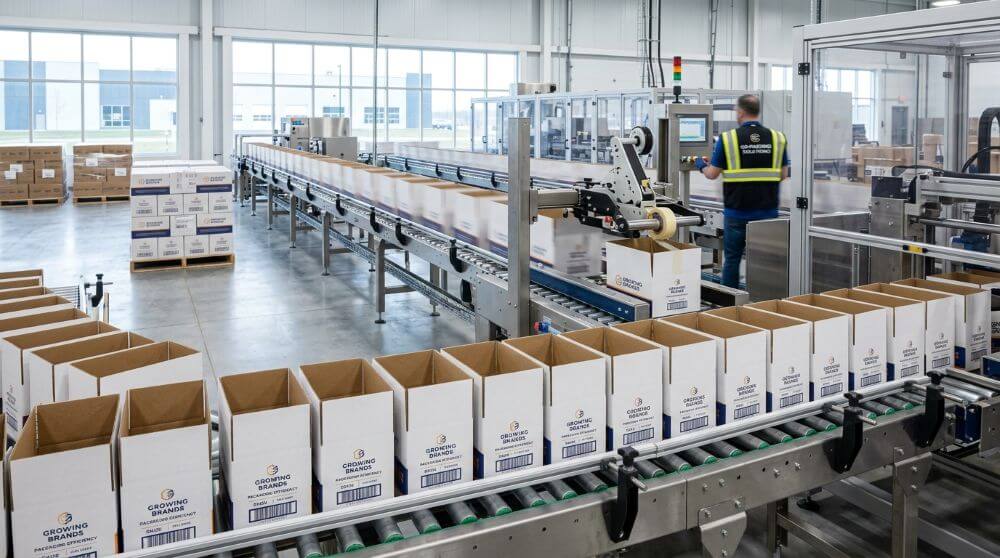
Growth tends to break packing first. Orders climb, SKUs multiply, and the team that once handled everything starts missing dates. The practical fix may be borrowed scale from a co-packer with the space, machinery and people already in place, rather than a bigger shed filled with more equipment.
Most brands do not first feel the strain in the formula or the sales process. It shows up at the end of the line. One new flavour requires new cartons and labels, while two retail accounts can bring different case counts and barcodes. Soon, the bench that used to cope is buried in changeovers.
The pattern is common in food and personal care. Founders pack after hours, and the operations manager pulls staff from other jobs to hit a shipping date. Overtime climbs while accuracy slips, turning a seasonal run that should be a win into a scramble.
A new cartoner or case packer is a hard sell at this point. Cash is tied up in stock and advertising, floor space is short, and no one wants to approve automation for a SKU that might change in six months.
Capacity planning gets messy too. Forecast demand rarely lines up neatly with rosters or available line hours. Brands carry idle labour for weeks, then run short just as a launch lands.
Borrowed scale beats buying machines
Co-packing is another name for contract packaging. You rent time on someone else’s line instead of buying your own equipment. That line may already have cartoners and case packers, with the ability to handle both primary packs and secondary cartons.
When you pay per unit, cash stays available for stock and marketing. That matters when a business is growing. You avoid tying up funds in machinery that may sit idle between production runs.
SKU proliferation is what tips many teams over. One base product turns into four sizes and two bundle packs, with each change requiring new settings and checks. Running those variations on a shared co-packer line can be faster than resetting a small in-house bench every day.
Take the staffing pressure off your team
Labour is another pinch point. Finding temporary staff takes time, and training them takes longer. This is where contract packing can take pressure off the internal team during demand spikes and seasonal runs.
The co-packer manages the roster and runs the shifts. Your team is less likely to spend weekends catching up, and good staff are not worn down by repeated hand-packing work.
If the forecast jumps from 5,000 units to 20,000 units in a month, you do not have to find a second shift and extra floor space at short notice when suitable capacity is already available nearby.
You can also avoid much of the administrative drag. Payroll and cover for sick days remain with the co-packer, giving the operations manager valuable hours back each week.
That is borrowed scale in practice.
Support retail audit readiness without building the system in-house
Retail buyers ask hard questions. They want batch codes, traceability and evidence that the pack line operates to an appropriate standard.
An established co-packer will usually work to audited quality-control steps. Stock is checked in, and packs are checked throughout the run. For food, this often includes HACCP controls and clean-down records that can be difficult for a young brand to run credibly on its own.
Traceability becomes especially useful when something goes wrong. A batch code ties a carton back to its production run and materials, helping the brand narrow the scope in hours rather than days. Buyers notice that level of discipline.
Launch faster and test without committing floor space
New SKUs can stall in queues. Artwork needs sign-off, components may arrive late from two suppliers, and the line you own could already be busy with core volume.
Using an established line can reduce that wait. You book a slot and run 2,000 units to see how the product sells. If it moves, you scale production; if it does not, you have not given up valuable floor space.
Kitting presents the same challenge. Gift sets and multipacks can consume hours on a manual bench, while a co-packer with semi-automatic stations can complete them in a shift and keep the counts accurate. The service can also sit alongside 3PL storage and freight, allowing finished packs to move directly into distribution.
Speed is often the quiet win. A booked slot can turn approved artwork into shelf stock within weeks, allowing you to test a seasonal idea without clearing your own floor. If demand holds, you repeat the run. If not, you move on.
Start small, then hand over more
This does not have to be an all-or-nothing decision. Most brands begin with one pain point, such as a trial run for a new pack size.
If that works, move a core line across while keeping your internal team focused on hero SKUs if that suits the business. Send overflow to the co-packer when peaks hit.
You gain a steadier supply without signing for extra space. Some brands keep this split for years because paying per finished unit can be more practical than carrying idle equipment. That is why contract packaging often becomes a long-term arrangement.
Capacity stays flexible as well. You can lift volume for a promotion and drop back afterwards, without leaving idle machines sitting in the corner in February.
Scale should not have to mean strain. Borrow the line and the team until you genuinely need your own, and even then, keep the release valve handy.
Leave a Reply