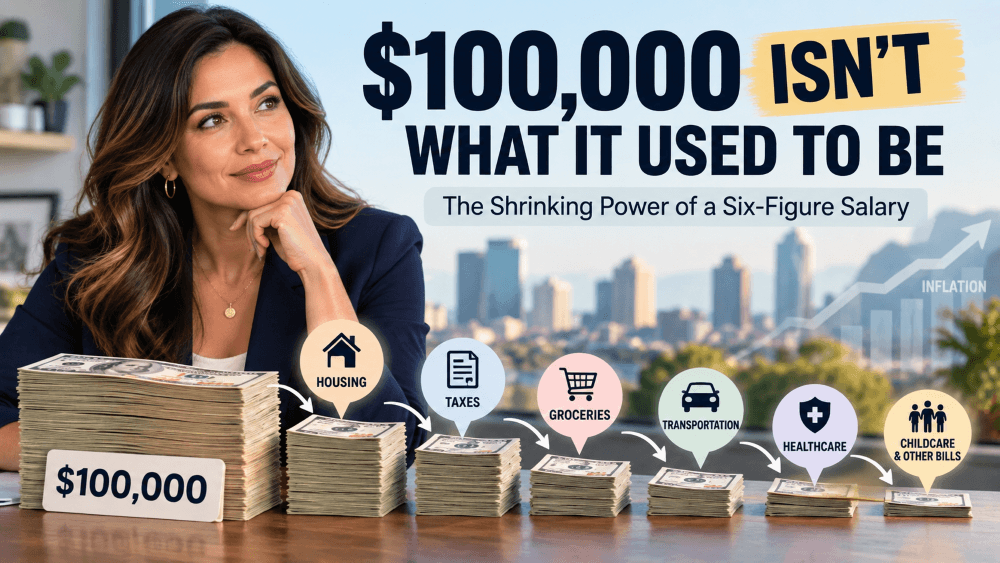
For generations, earning a $100,000 salary represented an important financial milestone. Crossing into six figures meant you were doing well, moving into the upper-middle class, and perhaps finally had enough money to stop worrying about everyday expenses.
But $100,000 isn’t what it used to be.
Inflation, housing costs, taxes, insurance, childcare, food, and other expenses have dramatically changed what a $100,000 salary can buy. Six figures can still provide a comfortable lifestyle, particularly for a single person in a lower-cost city, but it no longer automatically means you’re wealthy.
In some expensive cities, it can feel surprisingly ordinary.
What Happened to the $100,000 Salary?
The biggest culprit is inflation.
Inflation doesn’t necessarily make the number in your bank account smaller. Instead, it reduces what each dollar can buy.
Imagine that a cart of groceries once cost $100. If the same groceries eventually cost $120, you need 20% more money simply to maintain the same standard of living.
This erosion happens gradually, which makes it easy to underestimate.
A person earning $100,000 today may look much richer on paper than someone who earned $60,000 or $70,000 decades ago. But once we adjust for inflation, the difference becomes considerably smaller.
For example, $100,000 in 2000 had roughly the purchasing power of about $195,000 in 2026.
Think about that for a moment.
Someone earning approximately $195,000 today would need almost twice the nominal salary to have purchasing power comparable to someone earning $100,000 around the beginning of the century.
That’s why six figures doesn’t feel like six figures anymore.
Then Taxes Take Their Share
Your salary isn’t the amount you actually get to spend.
A worker earning a $100,000 gross salary must first pay federal income taxes and payroll taxes, plus state income taxes where applicable. Canadian workers similarly face federal and provincial income taxes along with CPP/QPP and EI contributions.
The exact amount depends heavily on where you live, deductions, family circumstances, retirement contributions, and other factors.
The important number isn’t your gross salary. It’s your after-tax income.
And after taxes, the person earning $100,000 has considerably less than $100,000 available for housing, food, transportation, savings and everything else.
Assume for a moment that you pay 20% of your income in taxes. That leaves you with about $80,000.
Then the bills begin.
Housing Has Changed the Six-Figure Lifestyle
For many households, housing is where the decline in purchasing power becomes most obvious.
A $100,000 salary sounds impressive until a household is paying $3,000 or $4,000 per month for housing.
Add utilities, property taxes or renters insurance, transportation, groceries and healthcare, and the supposedly wealthy six-figure household can quickly find itself with little left over.
Location therefore makes an enormous difference.
Someone earning $100,000 in a relatively inexpensive city could enjoy a comfortable standard of living. Someone earning the same amount in New York, San Francisco, Toronto or Vancouver faces a completely different financial reality.
The salary is identical.
The lifestyle it buys isn’t.
Why Some Six-Figure Earners Live Paycheck to Paycheck
One of the more surprising developments is the number of relatively high-income households describing themselves as living paycheck to paycheck.
Research has found that paycheck-to-paycheck living extends well into six-figure incomes.
There are several reasons:
- High housing expenses
- Childcare costs
- Car payments
- Healthcare and insurance
- Student loans and other debt
- Rising grocery and utility bills
- Lifestyle inflation
- Insufficient emergency savings
There is also an important distinction.
Not every person earning six figures who lives paycheck to paycheck is struggling to afford necessities. Higher-income households may spend heavily on larger homes, expensive vehicles, travel, restaurants and other discretionary purchases.
In other words, sometimes it’s the cost of living.
Sometimes it’s the cost of the lifestyle.
$100,000 for One Person Isn’t $100,000 for a Family
Household size may matter almost as much as location.
Consider two people earning identical salaries.
Person A: Single, no children, rents a modest apartment and has no major debt.
Person B: Married with two children, paying for childcare, a larger home, two vehicles, groceries for four people and family insurance expenses.
Both earn a $100,000 salary.
Financially, however, they may live in completely different worlds.
This is why salary alone is a poor measurement of wealth.
Income Is Not the Same as Wealth
Perhaps we’ve been asking the wrong question.
Instead of asking, “Do I earn six figures?”, consider asking:
- How much of my income do I keep?
- How much do I save and invest?
- How much debt do I have?
- How many months could I survive without a paycheck?
- Is my net worth increasing?
- How much freedom does my money give me?
Someone earning $80,000 while consistently investing $15,000 per year could ultimately become wealthier than someone earning $150,000 and spending every dollar.
Income is what flows into your household. Wealth is what you keep and build.
So What Salary Makes You Financially Successful?
Our expectations have certainly changed.
In an Empower survey, Americans said the average salary associated with financial success was an astonishing $270,000 per year.
The average net worth associated with success?
$5.3 million.
Those figures tell us something interesting about modern attitudes toward money. The psychological goalpost has moved far beyond $100,000.
But there’s a danger in replacing one arbitrary number with another.
If $100,000 isn’t the magic number, $270,000 probably isn’t either.
A person earning $270,000 can still spend $280,000.
Financial Success Is About Freedom, Not a Salary
The decline in the purchasing power of a $100,000 salary is real. Inflation means six figures simply cannot purchase what it once could.
But that doesn’t mean $100,000 is a bad salary.
It means we should stop confusing a particular income with wealth.
Real financial success might be better measured by whether you can:
- Pay your bills without anxiety
- Avoid high-interest consumer debt
- Handle an unexpected expense
- Save and invest consistently
- Take time away from work when necessary
- Choose where and how you live
- Eventually become financially independent
A six-figure salary can certainly help accomplish those goals.
But the number printed on your paycheck is only the beginning.
Twenty-five years ago, $100,000 sounded rich.
Today, it sounds successful—but depending on where you live and how many people depend on that income, it may increasingly describe something much more ordinary:
middle-class life with a bigger number attached to it.
Frequently Asked Questions
Is $100,000 still a good salary in 2026?
Yes. A $100,000 salary remains a strong income compared with what many workers earn. However, whether it provides a comfortable lifestyle depends heavily on taxes, housing costs, household size, debt and location.
What is $100,000 from 2000 worth today?
Approximately $100,000 in 2000 would require roughly $195,000 in 2026 to provide similar purchasing power. The exact figure varies slightly depending on the inflation measurement and dates used.
Why do people earning $100,000 live paycheck to paycheck?
High housing costs, childcare, transportation, debt, insurance and food can consume a large portion of take-home income. Lifestyle inflation can also cause spending to increase as income rises.
How much salary do you need to be financially successful?
There is no universal number. An Empower survey found that Americans, on average, associated financial success with a $270,000 annual salary and $5.3 million net worth. In practice, financial success depends more on expenses, savings, debt, investments and financial independence than on salary alone.
Other personal finance blog posts
Leave a Reply