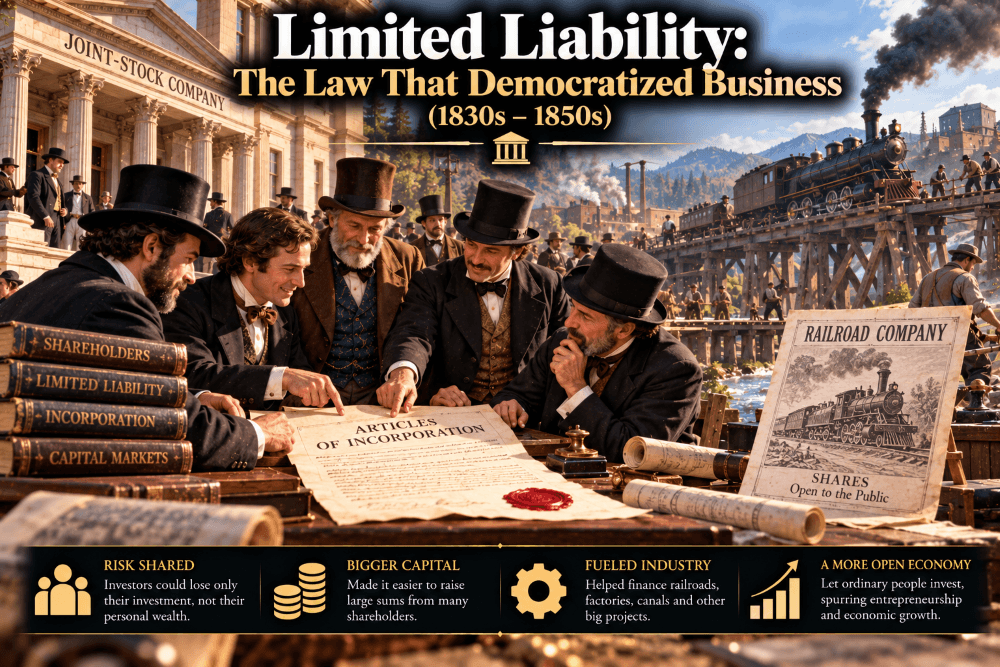
For most of commercial history, starting or investing in a business meant risking everything you owned. Limited liability, the legal principle that an investor can only lose what they put in, not their house, their savings, or their future earnings, changed that equation permanently. Formalized into general law across Britain and the United States between the 1830s and 1850s, it became one of the quietest but most consequential legal innovations in business history, unlocking a scale of investment and entrepreneurship the world hadn’t seen before.
The Problem Before Limited Liability
Unlimited Personal Risk
Before limited liability became widely available, business ownership carried genuinely frightening personal exposure.
- Partners and investors in most ventures were personally liable for the full extent of a business’s debts, not just their original investment.
- A single failed venture could legally cost an investor their home, savings, and virtually all personal assets.
- This risk discouraged many potential investors from participating in ambitious, capital-intensive ventures, regardless of how promising they appeared.
This structure made sense for small, closely managed partnerships where owners directly controlled operations. It made far less sense as businesses grew larger and investors became more distant from daily management decisions.
Charters as a Scarce Privilege
Earlier joint-stock companies, like the VOC and British East India Company covered elsewhere in this series, operated under limited liability protections, but only because governments granted them special charters.
- These charters were typically rare, politically negotiated privileges rather than something available to ordinary businesses.
- Obtaining one usually required significant political connections, lobbying, or direct royal favor.
- This scarcity meant limited liability protection remained available only to a small, well-connected segment of the business world for centuries.
This restriction created exactly the kind of bottleneck that eventually generated pressure for broader legal reform.
The Push Toward General Incorporation
Early Steps in the United States
The United States began moving toward broader access to limited liability protection earlier than many European nations.
- Individual states gradually began passing general incorporation statutes, allowing businesses to incorporate through a standardized legal process rather than requiring a special legislative charter for each company.
- New York’s early general incorporation laws, developed in the early 19th century, represented significant steps toward making limited liability a widely accessible legal structure rather than an exclusive privilege.
- Other states gradually followed similar paths throughout the following decades, expanding access to this protection across the growing American economy.
Reform in Britain
Britain underwent a similarly significant legal transformation during the 1840s and 1850s.
- Legal reforms during this period gradually simplified the process of forming a joint-stock company, moving away from requiring individual royal charters or acts of Parliament.
- Limited liability protection for shareholders became formally and broadly established in British law through legislation passed during the mid-1850s.
- This reform directly addressed long-standing concerns that unlimited personal liability was discouraging legitimate investment in genuinely productive ventures.
Why Limited Liability Mattered for Entrepreneurship
Expanding the Investor Pool
Limited liability fundamentally changed who was willing and able to invest in new ventures.
- Investors could now contribute capital to a business without risking their entire personal financial position if the venture failed.
- This protection made it significantly easier to attract a broader range of investors, including those with modest capital seeking diversified opportunities.
- The resulting expansion of available investment capital helped fuel increasingly ambitious, capital-intensive business ventures throughout this period.
Fueling Industrial and Railroad Expansion
The timing of broader limited liability adoption coincided directly with a period of enormous capital-intensive industrial growth.
- Railroad construction, one of the era’s most capital-hungry industries, benefited enormously from an expanded pool of investors willing to provide necessary funding.
- Manufacturing enterprises increasingly organized as corporations, taking advantage of limited liability to raise capital beyond what a small group of unlimited-liability partners could reasonably provide.
- This legal shift helped enable the scale of industrial expansion that defined much of the 19th century economy.
A More Democratic Form of Ownership
Perhaps the most significant long-term impact of limited liability was how it broadened participation in business ownership itself.
- Ordinary individuals, not just wealthy elites with political connections, could now meaningfully participate in corporate investment.
- This democratization of ownership helped establish the foundation for modern stock markets, where millions of ordinary investors hold shares in companies they have no direct role in managing.
- The corporate structure that emerged from this period remains the dominant form of business organization worldwide today.
The Trade-offs of Limited Liability
Benefits and Risks Together
Limited liability wasn’t universally celebrated as an unambiguous improvement, and legitimate concerns accompanied its expansion.
- Critics worried that reduced personal accountability might encourage excessive risk-taking by business managers and owners.
- Creditors and other parties dealing with corporations faced new limits on their ability to recover losses, since they could no longer pursue shareholders’ personal assets.
- These tensions, balancing investment encouragement against accountability, remain actively debated in corporate law and regulation today.
Lessons from Limited Liability
- Legal structure shapes economic possibility. Expanding access to limited liability directly enabled the scale of industrial investment that followed.
- Removing catastrophic risk changes behavior. Investors became willing to fund far more ambitious ventures once personal ruin was no longer the downside of failure.
- Broad access matters as much as the innovation itself. Limited liability existed for centuries before general incorporation laws made it genuinely available to ordinary entrepreneurs and investors.
Frequently Asked Questions
What is limited liability? Limited liability is a legal principle protecting investors and shareholders from being personally responsible for a company’s debts beyond the amount they originally invested.
How was limited liability different before general incorporation laws? Earlier limited liability protection was typically available only through special government charters granted to specific companies, rather than through a standardized process available to ordinary businesses.
When did limited liability become widely available? General incorporation laws expanding access to limited liability developed gradually across the United States in the early 19th century, with Britain formally establishing broader shareholder limited liability protection during the mid-1850s.
Why was limited liability important for industrial growth? It encouraged a much broader pool of investors to fund capital-intensive ventures like railroads and manufacturing, since investors no longer risked their entire personal wealth if a venture failed.
Related Articles
- Wells Fargo: Banking Built on the Gold Rush
- Sam Brannan: California’s First Gold Rush Millionaire
- Levi Strauss: The Immigrant Who Invented Denim
- The California Gold Rush: Where Merchants Beat Miners
- Thomas Edison: Turning Invention Into Business
- John D. Rockefeller: Standard Oil and the Power of Consolidation
- Andrew Carnegie: Steel, Scale, and Vertical Integration
About The History of Entrepreneurship
This article is part of The History of Entrepreneurship, an ongoing series exploring how entrepreneurs, civilizations, technologies, financial institutions, and business innovations gradually created the modern economy.
Leave a Reply