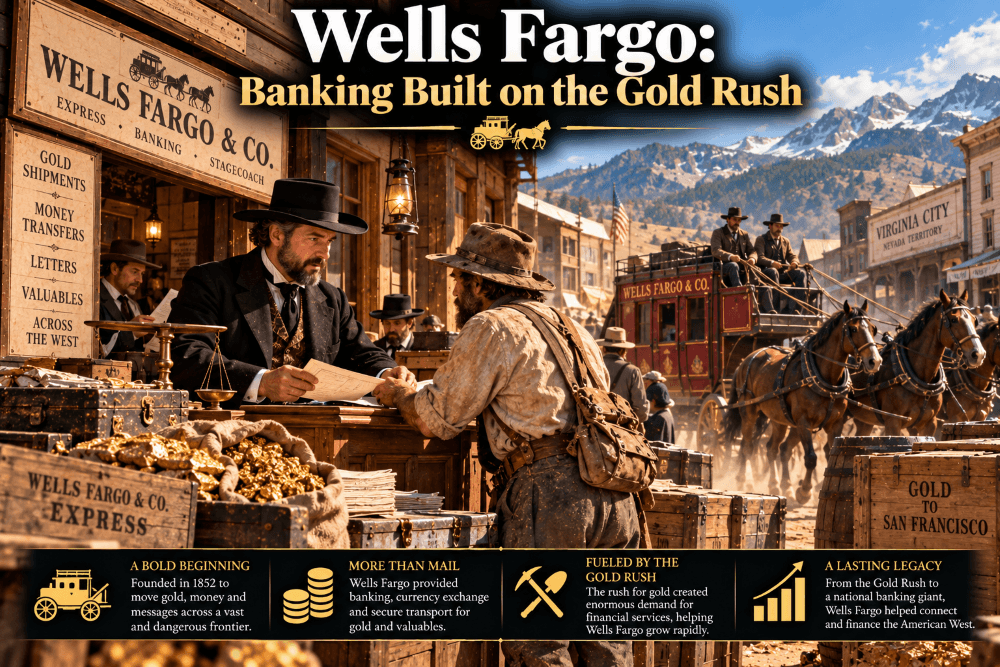
Wells Fargo began as a solution to a very specific problem: California’s Gold Rush had created enormous new wealth, but no reliable way to move it, bank it, or communicate across the vast distances separating mining camps from the rest of the country. Founded in 1852, the company built its early fortune not by mining gold, but by solving the logistics and trust problems that an entire economy full of newly wealthy, widely scattered people desperately needed solved.
The Problem Wells Fargo Was Built to Solve
By the early 1850s, California’s Gold Rush had created a genuinely strange economic situation.
- Miners and merchants across California were accumulating significant quantities of gold with few safe, reliable ways to store, transport, or convert it into usable currency.
- Communication and mail delivery between California’s scattered mining camps and the rest of the country remained slow, unreliable, and often dangerous.
- Existing financial institutions were poorly equipped to handle the specific logistical challenges of the sparsely populated, rapidly growing American West.
This combination of wealth and logistical chaos created exactly the kind of structural problem that rewards a well-organized business solution.
Founding Wells Fargo
Henry Wells and William Fargo
Wells Fargo was founded in 1852 by Henry Wells and William Fargo, both experienced businessmen who had already built successful careers in the express shipping industry on the East Coast.
- The two men had previously been involved in American Express, giving them direct, practical experience running long-distance delivery and logistics operations.
- They recognized that California’s gold rush economy needed the same kind of organized, trustworthy delivery infrastructure they had already built in the East.
- They established Wells Fargo specifically to provide banking and express delivery services tailored to California’s unique frontier conditions.
Combining Banking and Express Delivery
From its earliest days, Wells Fargo operated as a genuinely dual-purpose business, combining financial services with physical transportation.
- The company offered banking services, including gold purchasing, currency exchange, and safe deposit services for miners and merchants.
- It simultaneously operated express delivery services, transporting mail, packages, and valuables between California’s mining camps and broader commercial centers.
- This combination allowed Wells Fargo to serve as a trusted intermediary for both the financial and logistical needs of a rapidly growing, geographically scattered population.
Building Trust Across the Frontier
Stagecoaches and Reliable Delivery
Wells Fargo became famous for its network of stagecoaches, which provided essential transportation across California’s difficult terrain.
- The company’s stagecoach network connected remote mining camps to larger towns and cities, carrying mail, gold shipments, and passengers.
- Reliability became Wells Fargo’s defining competitive advantage, since customers needed genuine confidence that valuable shipments would actually arrive safely.
- This reputation for dependable service helped the company expand rapidly as California’s economy continued growing throughout the 1850s and beyond.
A Broader Western Network
As the American West continued developing, Wells Fargo steadily expanded its operations well beyond California alone.
- The company extended its express delivery and banking services into other rapidly developing western territories.
- It became closely associated with the broader expansion of American commerce and communication across the frontier during this period.
- This expansion positioned Wells Fargo as one of the dominant financial and logistical institutions throughout the American West for decades to come.
From Frontier Express Company to Modern Bank
Evolving With the Country
As railroads and other transportation infrastructure gradually made stagecoach delivery less essential, Wells Fargo evolved its business focus accordingly.
- The company increasingly concentrated on its core banking operations as express delivery became less central to its business.
- It continued expanding its financial services throughout the following decades, growing into one of the largest banking institutions in the United States.
- Today, Wells Fargo remains one of the country’s major national banks, its name carrying direct lineage back to its Gold Rush-era founding.
A Cautionary Modern Chapter
Wells Fargo’s long history also includes a significant and well-documented modern controversy worth noting in any honest account of the company’s full story.
- In 2016, the company faced major public scandal after it was revealed that employees had opened millions of unauthorized customer accounts to meet aggressive internal sales targets.
- This scandal resulted in significant regulatory penalties, executive resignations, and lasting reputational damage to the institution.
- It serves as a notable example of how even a company built on a founding reputation for trust and reliability can face serious consequences when internal incentives become badly misaligned.
Lessons from Wells Fargo
- Solve the infrastructure problem behind a boom. Wells Fargo profited by addressing the logistics and trust gaps the Gold Rush created, not by prospecting itself.
- Reliability becomes a genuine competitive advantage. The company’s reputation for dependable delivery directly fueled its early growth and customer trust.
- Reputation built over generations can still be damaged quickly. The 2016 scandal shows how internal incentive problems can undermine even a long-established institution’s hard-earned trust.
Frequently Asked Questions
When was Wells Fargo founded, and why? Wells Fargo was founded in 1852 by Henry Wells and William Fargo to provide banking and express delivery services for California’s rapidly growing Gold Rush economy.
What services did Wells Fargo originally offer? The company combined banking services, including gold purchasing and currency exchange, with express delivery of mail, packages, and valuables via stagecoach across the American West.
How did Wells Fargo become a major modern bank? As railroads reduced the need for stagecoach delivery, Wells Fargo increasingly focused on its core banking operations, growing over subsequent decades into one of the largest banks in the United States.
What was the 2016 Wells Fargo scandal? Wells Fargo employees were found to have opened millions of unauthorized customer accounts to meet aggressive sales targets, resulting in significant regulatory penalties and lasting reputational damage.
Related Articles
- Sam Brannan: California’s First Gold Rush Millionaire
- Levi Strauss: The Immigrant Who Invented Denim
- The California Gold Rush: Where Merchants Beat Miners
- Thomas Edison: Turning Invention Into Business
- John D. Rockefeller: Standard Oil and the Power of Consolidation
- Andrew Carnegie: Steel, Scale, and Vertical Integration
- The Panic of 1873: The Railway Bubble That Broke America
About The History of Entrepreneurship
This article is part of The History of Entrepreneurship, an ongoing series exploring how entrepreneurs, civilizations, technologies, financial institutions, and business innovations gradually created the modern economy.
Leave a Reply