Wall Street started the week with an impressive message:
Higher bond yields aren’t killing this rally—at least not yet.
US stocks climbed Monday despite Treasury yields remaining near multi-decade highs, renewed economic uncertainty in Europe, oil above $100, and another reminder that inflation pressures haven’t completely disappeared.
Technology led the charge.
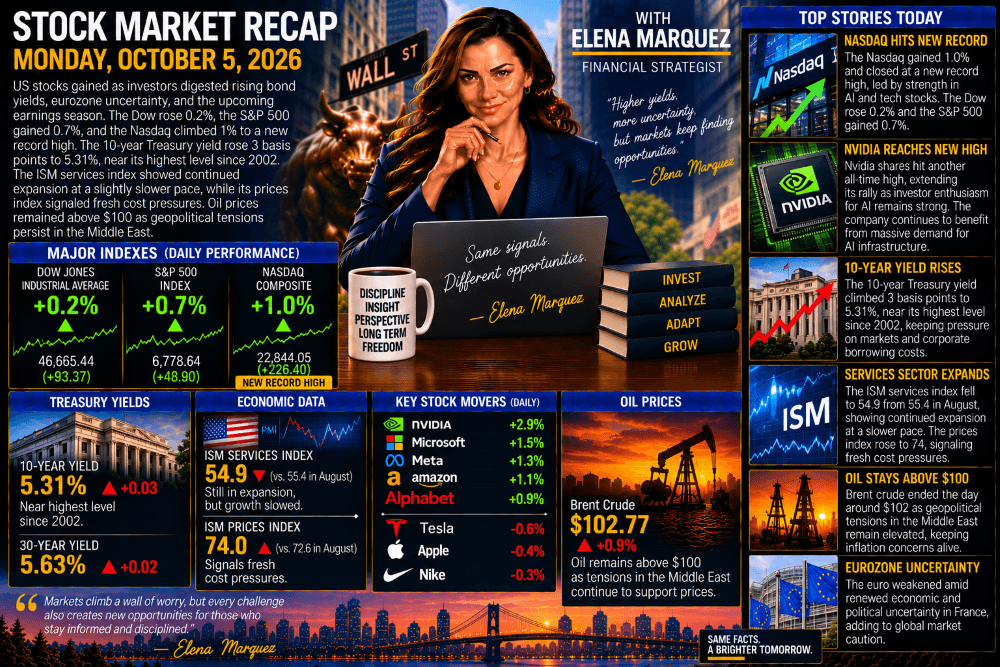
📈 Dow Jones: +0.2%
📈 S&P 500: +0.7%
📈 Nasdaq Composite: +1.0% — NEW RECORD
And once again, artificial intelligence was at the center of the action.
Nvidia reached another all-time high.
Nasdaq Sets Another Record
The Nasdaq gained 1% Monday, extending Friday’s rally and setting another record.
That’s particularly notable given what’s happening in the bond market.
The 10-year Treasury yield climbed another 3 basis points to approximately:
5.31%
That’s near its highest level since 2002.
Normally, rapidly rising yields are especially painful for technology stocks.
Higher yields reduce the present value investors assign to profits expected far into the future—and provide stocks with increasingly attractive competition from government bonds.
But right now, AI enthusiasm appears powerful enough to overcome that pressure.
Nvidia Does It Again
Nvidia reached another all-time high Monday as its market capitalization moved closer to an extraordinary milestone:
$6 trillion.
Think about that number.
Only a few years ago, reaching a $1 trillion valuation was considered an extraordinary achievement for any corporation.
Now Nvidia is approaching six times that level.
The company’s stock also entered Monday with momentum after finishing last week higher and announcing an additional $150 billion share-repurchase authorization.
Investors continue to bet that enormous spending on AI infrastructure will translate into equally enormous demand for Nvidia’s chips.
For now, that bet keeps working.
Why Didn’t 5.31% Treasury Yields Sink Stocks?
This may be today’s most interesting question.
The 10-year Treasury yield is now around 5.31%.
Yet the Nasdaq just reached another record.
One reason is Friday’s surprisingly weak employment report.
The US economy added only 29,000 jobs in September, dramatically below expectations.
That caused investors to slash expectations for another Federal Reserve rate hike.
So Wall Street is currently balancing two seemingly contradictory signals:
Long-term bond yields remain extremely high.
But:
Expectations for additional Fed tightening have fallen sharply.
For stocks, the second factor won today.
The Economy Is Still Expanding
Monday’s economic data offered another interesting signal.
The ISM Services Index slipped slightly:
August: 55.4
September: 54.9
Remember, anything above 50 indicates expansion.
So America’s enormous services sector continues growing.
That’s good.
But another part of the report wasn’t nearly as comforting.
The ISM prices index increased:
72.6 → 74.0
That’s a sign businesses continue facing significant cost pressures.
And that’s exactly what the Federal Reserve doesn’t want to see.
The Fed’s Dilemma
Friday’s employment report said:
The labor market is cooling.
Monday’s services report said:
Inflation pressures haven’t disappeared.
That’s a difficult combination.
The Fed doesn’t want to continue raising interest rates if employment is deteriorating.
But it also can’t declare victory over inflation while businesses continue reporting rising input costs.
That’s why the next few inflation reports could become extremely important.
The Fed may have room to pause.
It doesn’t necessarily have room to celebrate.
Oil Remains Above $100
And then there’s oil.
Brent crude remains above:
$100 per barrel.
The ongoing conflict in the Middle East continues to keep energy markets—and inflation expectations—on edge.
Oil acts almost like a tax on the global economy.
Higher fuel costs affect:
Airlines.
Shipping.
Manufacturing.
Agriculture.
Trucking.
Consumers.
And eventually inflation.
That’s why oil remains one of the biggest wild cards for both stocks and the Federal Reserve.
Trouble in Europe
Investors were also watching developments across the Atlantic.
The euro weakened as renewed political and economic uncertainty in France raised questions about Europe’s outlook.
For American investors, Europe’s problems may seem distant.
But financial markets are interconnected.
Political instability can weaken currencies, move global bond yields and change international capital flows.
For now, Wall Street largely shrugged it off.
Earnings Season Is Coming
Monday’s corporate calendar was relatively quiet.
That won’t last.
Later this week we’ll hear from companies including:
Levi Strauss
Applied Digital
PepsiCo
Delta Air Lines
Then Q3 earnings season begins in earnest in mid-October.
And expectations are high.
That’s important.
Markets don’t simply respond to whether companies make money.
They respond to whether companies make more money than investors already expect.
With stocks near records, the bar is rising.
The Market’s Wall of Worry
Consider everything investors are currently dealing with:
📈 10-year Treasury yields above 5.3%
🛢️ Oil above $100
🔥 War in the Middle East
🏦 Uncertainty over the Fed
🇪🇺 Political and economic concerns in Europe
📊 Persistent inflation
💼 A weakening US labor market
And yet:
The Nasdaq just hit another record.
That’s remarkable resilience.
But resilience shouldn’t be confused with invulnerability.
The Question Is Becoming Valuation
When markets rise despite bad news, that’s usually a sign of strong underlying demand.
But eventually price matters.
The higher technology stocks climb, the more future growth they’re already pricing in.
That creates an increasingly demanding equation.
Nvidia doesn’t merely need to grow.
It needs to grow fast enough to justify a valuation approaching $6 trillion.
AI companies don’t simply need to generate revenue.
They eventually need to generate profits capable of justifying the hundreds of billions being invested in infrastructure.
And the broader market must generate enough earnings growth to compete with Treasury securities yielding more than 5%.
That’s a much higher hurdle than investors faced several years ago.
What I’m Watching Next
The next major catalyst will increasingly become corporate earnings.
After months dominated by:
The Fed.
Oil.
War.
Inflation.
And bond yields.
Companies are about to get their turn.
The central question will be simple:
Are corporate profits strong enough to justify record stock prices?
AI will remain central to that conversation.
But consumer companies will be equally interesting.
PepsiCo can tell us about consumer spending.
Delta can tell us about travel demand.
Levi Strauss can tell us about discretionary spending.
And Applied Digital can give us another window into AI infrastructure demand.
Together, those reports will begin telling us whether Wall Street’s optimism is supported by Main Street.
The Bottom Line
Monday’s numbers:
📈 Dow: +0.2%
📈 S&P 500: +0.7%
📈 Nasdaq: +1.0% — record high
🤖 Nvidia: record high
📈 10-year Treasury: ~5.31%
📊 ISM Services: 54.9
🔥 ISM Prices: 74.0
🛢️ Brent crude: above $100
The market continues climbing a remarkable wall of worry.
The bond market says money is expensive.
The oil market says inflation remains a threat.
The labor market says the economy is slowing.
But the stock market—particularly technology—keeps saying:
The AI boom isn’t finished yet.
For now, investors are listening.
The Nasdaq has another record.
Nvidia has another record.
And Wall Street’s resilience continues to surprise.
But with Treasury yields above 5% and earnings season approaching, companies will soon have to prove that the optimism is justified.
Other Stock Market blog posts
Leave a Reply