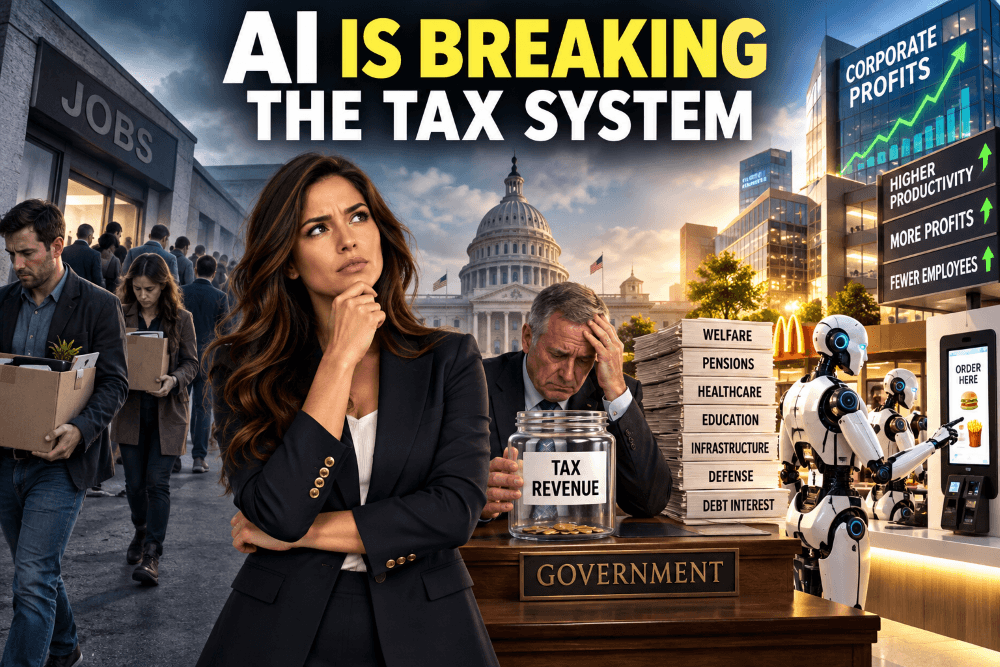
AI and taxes are about to become one of the most important economic debates of the next decade.
For generations, governments have built tax systems around a simple economic reality: people work, companies employ them, workers receive salaries, and governments collect taxes from those salaries.
Super Intelligence could disrupt that model.
In September 2026, President Donald Trump directed the U.S. executive branch to begin calling artificial intelligence “Super Intelligence,” or SI. Whatever terminology eventually wins, the economic transformation is already underway.
Companies can increasingly produce more with fewer workers. And that creates a strange problem: the economy can become more productive while parts of the government’s traditional tax base become less productive.
AI and Taxes: The Problem Nobody Has Solved
Governments have enormous financial commitments.
They fund pensions, healthcare, unemployment benefits, infrastructure, education, defense, debt interest, social programs and enormous public bureaucracies.
Politically, reducing these commitments is extremely difficult. Once citizens become dependent on receiving a government benefit, politicians who propose taking it away risk losing elections. It seems that no one politician has the courage that Margaret Thatcher had.
The traditional response has been predictable: raise taxes.
But AI and taxes introduce a new complication. Governments may increasingly find themselves trying to tax an economy in which human labor represents a smaller share of production.
That’s important because labor is relatively easy to tax.
A worker receives a paycheck. Income taxes are withheld. Payroll taxes and social contributions are collected. Employers frequently make additional contributions.
The government gets paid almost automatically.
A machine doesn’t receive a paycheck.
Neither does an algorithm.
Super Intelligence Can Make Workers Far More Productive
I see this transformation personally.
I use SI every day. It helps me research, write, organize ideas, analyze information and accomplish tasks much faster than I could before.
Multiply that productivity increase across millions of workers and thousands of corporations.
One employee equipped with increasingly powerful SI may eventually accomplish work that previously required two, five or perhaps ten people.
From the corporation’s perspective, that’s fantastic.
Productivity rises. Costs can fall. Profits may increase.
But from the government’s perspective, something unusual has happened.
If five taxable salaries become one taxable salary plus software, computing infrastructure and capital investment, the composition of the tax base changes dramatically.
Consider the McDonald’s Kiosk
Imagine a McDonald’s restaurant replaces an employee taking orders with an automated ordering kiosk.
With the employee, the business pays a salary. The employee may pay income and payroll taxes, while the employer may owe payroll or social-security contributions.
Now replace that worker with a machine.
The restaurant purchases the kiosk as a capital investment. Depending on the jurisdiction and applicable tax rules, the business may be able to deduct or depreciate some or all of that investment over time.
The kiosk doesn’t pay income tax.
It doesn’t make pension contributions.
It doesn’t pay Social Security, CPP/QPP or similar payroll taxes.
It doesn’t receive vacation pay.
It can work all day.
This simple example illustrates the coming AI and taxes dilemma.
Automation can increase economic output while reducing the amount of economic activity flowing through payroll.
Governments Depend Heavily on Workers
This matters particularly in countries where employment carries a large tax burden.
The OECD (Organisation for Economic Co-operation and Development) measures something called the tax wedge: the difference between what employing a worker costs and what that worker ultimately takes home after income taxes and employee and employer social-security contributions.
For a single average worker in 2025, the OECD calculated tax wedges of approximately:
- Germany: 49.3%
- France: 47.2%
- Italy: 45.8%
- Canada: 32.1%
- United States: 30.0%
Across the OECD, the average was approximately 35.1%.
European economies such as Germany, France and Italy therefore have particular exposure if SI significantly reduces employment or wage growth.
Nearly half the cost of employing an average worker in some of these countries can represent taxes and mandatory social contributions.
Machines don’t have a tax wedge.
The Great Tax Migration From Labor to Capital
This is the deeper issue surrounding AI and taxes.
Imagine a company that once required 10,000 employees eventually producing the same output with 5,000 employees assisted by extremely capable SI.
Society hasn’t necessarily become poorer.
Quite the opposite.
The company might produce more products, generate higher profits and create more value than before.
But some economic value has migrated from labor to capital.
Governments designed their tax systems for yesterday’s economy.
They now have to figure out how to tax tomorrow’s.
Why Not Simply Tax Corporations More?
The obvious solution would be higher corporate taxes.
If corporations are earning more because SI makes them more productive, governments could simply take a larger percentage of corporate profits.
Unfortunately, international taxation isn’t that simple.
Capital is mobile.
Corporations can invest in different countries. Intellectual property can cross borders. Headquarters can move. Governments compete with one another for investment.
Raise corporate taxes too aggressively and governments risk encouraging companies to invest somewhere else.
There is another problem.
Governments generally want businesses to invest in productivity-enhancing equipment. Tax systems therefore frequently allow companies to deduct, depreciate or otherwise receive tax treatment for capital investments.
That makes sense economically.
But it creates an unusual situation when capital investment is specifically being used to replace taxable labor.
Solution #1: Shrink the Welfare State
The mathematically simplest solution would be for governments to spend less.
If SI causes structural declines in labor-tax revenue, governments could reduce spending to match their new tax base.
Politically, I consider this the least likely solution.
Voters generally enjoy government benefits. Politicians generally enjoy getting elected.
Cutting pensions, healthcare benefits, subsidies or social programs is considerably more difficult politically than creating them.
And SI could make the situation even harder.
If automation eliminates significant numbers of jobs, governments may face demands for more unemployment assistance, retraining programs, wage subsidies or even some form of universal basic income.
The tax base could weaken precisely when demands on government increase.
Solution #2: Tax the Wealthy More
The second obvious answer is to tax wealthy individuals more heavily.
This will undoubtedly be politically attractive.
But wealth is much more mobile than labor.
A middle-class worker with a family, job and house cannot easily move countries because the government increases taxes by a few percentage points.
A multimillionaire can.
Countries such as Switzerland, Singapore and the United Arab Emirates, among others, compete internationally for entrepreneurs, investors and wealthy residents.
There is also a limit to how heavily governments can tax investment before changing behavior.
At some point, investors invest less, entrepreneurs take fewer risks, capital moves elsewhere or sophisticated taxpayers restructure their affairs.
The theoretical tax rate and the amount of money the government actually collects aren’t necessarily the same thing.
Solution #3: Tax Consumption
This brings us to what I believe may ultimately become the most practical answer to the AI and taxes problem:
Tax consumption rather than production.
Consumption taxes include systems such as VAT in Europe and GST/HST in Canada.
They have one enormous advantage in an SI economy.
Robots may not receive salaries, but the owners and customers benefiting from their productivity eventually spend money.
Imagine SI makes a business owner $10 million richer.
The government doesn’t necessarily need to figure out exactly how many human jobs were displaced, how much productivity came from SI, or how much an algorithm should theoretically be taxed.
When that wealth is eventually spent on cars, houses, restaurants, entertainment, services and other consumption, taxation occurs at the point of purchase.
Why Consumption Taxes Fit an SI Economy
A broad consumption tax has several advantages.
It doesn’t punish companies specifically for adopting technology.
It doesn’t require governments to determine whether a robot has replaced a human worker.
It captures revenue when economic value is ultimately consumed.
It is also considerably harder to avoid ordinary consumption taxes when purchasing goods and services domestically.
Most importantly, the tax base isn’t directly dependent on the number of people employed.
If 100 workers produce $10 million worth of goods today and 20 workers plus SI produce $20 million tomorrow, consumption can increase even though employment has fallen.
Government revenue can therefore follow economic activity rather than employment.
People claim that consumption taxes can be regressive because lower-income households spend a larger percentage of their income. But that’s not true. Consumption taxes are fair. Assuming a consumption tax of 10%. If low income person buys a small Toyota for $20,000, he pays $2,000 tax. If a millionaire buys a $1,000,000 Lamborghinii, he pays $100,000 tax. Fair is fair.
That problem can be addressed through exemptions, rebates, tax credits or direct transfers targeted toward lower-income households.
The objective should be to have a tax system better aligned with the economy that actually exists.
Don’t Tax the Robots
Some politicians will inevitably propose a “robot tax.”
I think that’s the wrong approach.
If a machine allows one worker to produce twice as much, society should generally want businesses to buy that machine.
Taxing automation directly risks penalizing productivity.
Imagine if governments during the Industrial Revolution had heavily taxed every tractor, factory machine or computer because it replaced some human labor.
Economic progress would have slowed.
The objective shouldn’t be to preserve every existing job forever.
The objective should be to allow productivity to increase while designing a tax system capable of functioning when employment is no longer the primary mechanism through which economic value is created.
The Economy Could Boom While Governments Go Broke
This is the paradox that makes AI and taxes so interesting.
SI could create extraordinary economic growth.
Companies could become dramatically more productive. Goods and services could become cheaper. New industries could appear. Entrepreneurs could create businesses with tiny teams that once would have required hundreds of employees.
Private wealth could explode.
And yet governments could simultaneously struggle with their finances if their tax systems remain disproportionately dependent on labor.
That would be an extraordinary situation:
A richer society with a poorer government.
The political pressure would be enormous.
The Tax System of the 20th Century Won’t Survive the 21st
For most of modern history, governments could assume that economic growth meant more employment, higher wages and therefore more taxable payroll.
Super Intelligence may break that relationship.
Economic growth could increasingly come from algorithms, software, robotics and capital rather than additional workers.
Governments will eventually have to choose.
They can reduce spending.
They can tax capital and wealthy people more aggressively.
They can attempt to tax robots and SI.
Or they can gradually move taxation away from labor and toward consumption.
I believe the last option is the most economically sensible.
We should encourage investment, entrepreneurship, automation and productivity rather than penalize them.
If Super Intelligence creates enormous amounts of new wealth, governments don’t need to stop that wealth from being created.
They simply need a tax system designed for where that wealth eventually goes.
Frequently Asked Questions
Will AI reduce government tax revenue?
It could. If AI and automation significantly reduce employment or wage growth, governments that depend heavily on income taxes and payroll contributions could see parts of their tax base weaken. The ultimate effect will depend on how much new employment, corporate profit, investment and consumption SI creates.
Should governments tax robots that replace workers?
A robot tax is possible, but it could discourage businesses from investing in productivity-enhancing technology. A broader consumption-based system could collect revenue from the wealth generated by automation without directly penalizing companies for becoming more efficient.
Why could consumption taxes work better in an AI economy?
Consumption taxes are based on spending rather than employment. Even if SI allows companies to produce more goods and services with fewer workers, taxes can still be collected when the resulting income and wealth are spent.
Which countries are most exposed to AI disrupting labor taxes?
Countries with high taxes and mandatory contributions on employment could face greater fiscal pressure if labor’s share of economic activity declines. OECD figures for 2025 show particularly high average-worker tax wedges in Germany, France, Italy, Austria and Belgium.
Leave a Reply