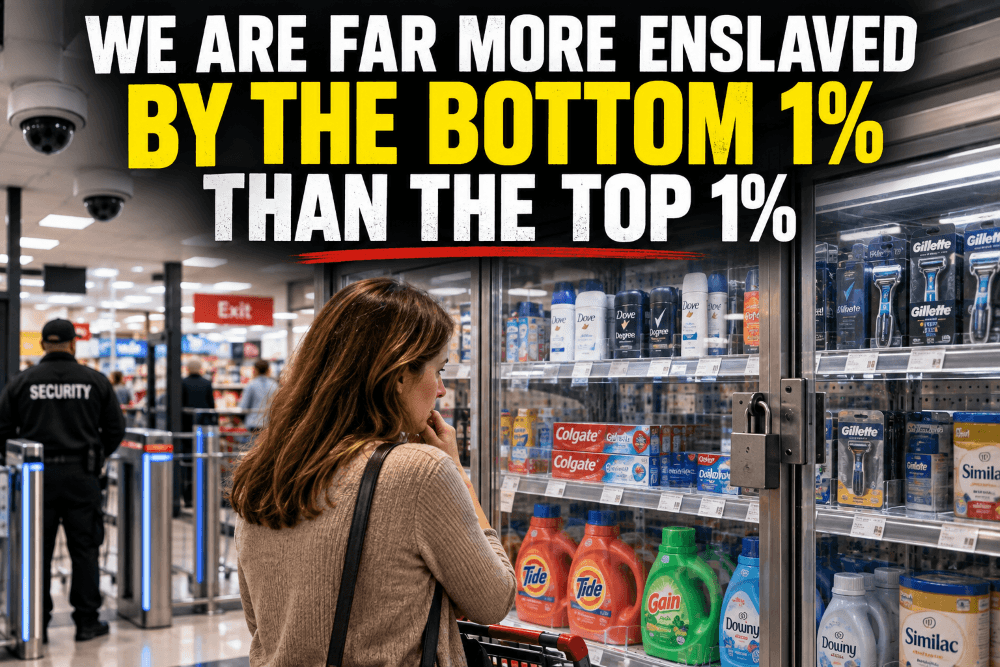
We spend an enormous amount of time talking about the top 1%.
Politicians talk about billionaires. Newspapers publish charts showing wealth inequality. Activists complain about CEO compensation, Wall Street profits, and the growing fortunes of entrepreneurs.
But there is another group whose influence on our daily lives receives much less attention.
Call them, for rhetorical purposes, the “bottom 1%.”
I don’t mean the poorest 1% of Americans. Most poor people don’t steal, vandalize stores, commit fraud, assault strangers, or make their neighbors miserable.
I mean the relatively small number of people whose repeated criminal behavior, chronic disorder, fraud, vandalism, and—in some cases—long-term avoidable dependency impose disproportionate costs on everybody else.
When we look at the cost of crime and dependency, this small group may interfere with the ordinary person’s daily life far more directly than the billionaires we hear about constantly.
And you can see the evidence every time you walk into a store.
Why Is the Deodorant Locked Up?
Walk into certain pharmacies or supermarkets today and you may find yourself staring through plexiglass.
Razor blades are locked up.
Laundry detergent is locked up.
Baby formula may be secured.
Cosmetics, electronics, medications, and toiletries may require an employee to retrieve them.
You aren’t stealing anything. You came into the store with money and every intention of paying.
Yet you have to find an employee, press a button, wait, and sometimes have the merchandise carried toward the register.
Why?
Because somebody else keeps stealing it.
According to the National Retail Federation’s 2023 National Retail Security Survey, total retail “shrink”—which includes theft as well as employee theft, administrative errors and other losses—reached $112.1 billion in 2022, equivalent to about 1.6% of sales. Theft was an important component of those losses.
Ultimately, somebody pays.
Retailers pay for cameras, security guards, locked cabinets, electronic tags, inventory controls and loss-prevention departments. Businesses cannot necessarily pass every dollar of those costs directly to consumers, but security and losses become part of the economics of operating a store.
Meanwhile, honest customers pay with something else that matters:
their time.
The Cost of Crime and Dependency Is Everywhere
Security friction has gradually become part of normal life.
We barely notice it anymore.
At stores we encounter receipt checks, security cameras, locked merchandise, electronic gates and increasingly sophisticated self-checkout monitoring.
At home we buy video doorbells, stronger locks, alarm systems, steering-wheel locks and package lockers.
Banks require two-factor authentication, fraud alerts, identity verification and increasingly elaborate passwords.
Businesses spend billions protecting databases, payments, inventory and physical property.
Public transit systems install increasingly difficult-to-jump fare gates and deploy inspectors to catch fare evasion.
Cities repair vandalized infrastructure and remove amenities from public places when those amenities are repeatedly destroyed or abused.
Each individual measure may be reasonable.
But taken together, they reveal something remarkable: law-abiding people spend a significant portion of their lives proving that they are law-abiding.
The Civilization Tax
Think about the absurdity of it.
You want to buy a $7 product, but it is locked behind plexiglass.
You want a package delivered, but you worry that someone will steal it from your porch.
You want to park your car, but you need an alarm, insurance and perhaps a steering lock.
You want to log into your bank account, but you need a password, authentication code, biometric identification and fraud monitoring.
None of these things exists primarily to make the honest person’s life better.
They exist because systems have to be designed around the possibility that someone will abuse them.
I think of this as a civilization tax.
It doesn’t always appear on a government bill. Sometimes we pay it with money. Sometimes with higher insurance premiums. Sometimes with taxes. Sometimes with inconvenience. Sometimes with our time.
And sometimes we pay with lost trust.
The Top 1% Versus the Bottom 1%
Consider the contrast.
Some highly successful entrepreneurs and investors helped build companies that allow us to order something tonight and have it appear at our door tomorrow.
A thief can make us afraid to leave that package sitting on the porch.
Technology companies created smartphones, online banking, cloud computing and instant digital communication.
Fraudsters and identity thieves helped create a world in which we need passwords, PINs, two-factor authentication, fraud departments and constant cybersecurity upgrades.
Pharmaceutical companies have developed medicines that allow millions of people to live longer and healthier lives.
Criminal misuse of some products creates restrictions for everybody. Pseudoephedrine, for example, must be kept behind the counter or in locked cabinets under federal law because it can be used in illegal methamphetamine production.
Innovators continually look for ways to make transactions faster.
Criminals continually give businesses reasons to add another security layer.
That is the paradox.
Innovation removes friction. Antisocial behavior puts friction back.
Poverty Is Not the Same Thing as Criminality
This distinction is essential.
A person earning minimum wage and struggling to pay rent is not part of what I’m calling the bottom 1%.
Neither is a disabled person receiving assistance.
Neither is a single mother receiving food benefits.
Neither is someone who loses his job during a recession.
Millions of low-income people work, raise families, obey the law, help their neighbors and contribute to their communities.
In fact, they frequently suffer the consequences of crime and disorder more severely because they have fewer resources to escape dangerous neighborhoods or absorb financial losses.
The “bottom 1%” in this essay therefore isn’t an income category.
It is shorthand for the small group of chronic offenders and persistently destructive people capable of imposing enormous negative externalities on everyone around them.
Dependency Has Costs Too
Crime isn’t the only part of this conversation.
There is also the question of long-term economic dependency.
A compassionate society should help people who genuinely cannot support themselves and provide temporary assistance to people experiencing hardship.
But compassion doesn’t eliminate arithmetic.
Government transfers must ultimately be financed through taxes, borrowing or other government revenues.
Congressional Budget Office data illustrate how redistributive the American fiscal system already is.
In 2019, households in the lowest income quintile received more than half of all means-tested transfers. Transfers and federal taxes together increased their average income from approximately $23,800 before transfers and taxes to $38,900 afterward.
At the opposite end, households in the highest quintile paid substantially more in federal taxes than they received in means-tested benefits. The CBO estimated that households in the top 1% faced an average federal tax rate of about 30% in 2019.
That doesn’t tell us whether the system is too generous or not generous enough.
But it does challenge the simplistic idea that wealthy Americans contribute nothing while everyone below them supports the system.
They plainly contribute substantial tax revenue.
Welfare Can Also Create Bad Incentives
Another uncomfortable question is what happens when earning another dollar causes someone to lose government benefits.
Suppose a worker earns more money but consequently loses some SNAP benefits, housing assistance or other income-tested benefits while simultaneously paying additional taxes.
The worker’s effective gain from working more can be considerably smaller than the additional wage.
Economists call this an effective marginal tax rate.
The Congressional Budget Office has specifically examined this issue and noted that benefit reductions combined with taxes can affect incentives to work. All else equal, CBO notes, higher marginal rates tend to reduce hours worked.
That doesn’t mean we should abolish assistance.
It means assistance should be designed carefully.
A safety net should function like a trampoline whenever possible—not a hammock and certainly not a trap.
What About the Top 1%?
None of this means wealthy people are saints.
There are legitimate concerns about monopoly power, political influence, regulatory capture, tax avoidance, corporate subsidies and businesses using government to protect themselves from competition.
Crony capitalism deserves criticism precisely because it isn’t genuine free-market competition.
And inequality itself can raise legitimate questions about opportunity and access.
But we should distinguish wealth created by providing something people voluntarily buy from wealth acquired through political privilege, fraud or coercion.
An entrepreneur who becomes wealthy because millions of customers voluntarily purchase a useful product hasn’t necessarily made those customers poorer.
Often the opposite has happened.
The customer decided that the product was worth more than the money surrendered for it.
That is why trade happens.
The Tax System Is Already Highly Progressive
The claim that America’s richest households pay nothing in taxes is also misleading when presented as a general description.
IRS Statistics of Income data provide detailed breakdowns of adjusted gross income, income-tax payments and average tax rates by income percentile. The IRS’s current tables allow comparisons extending through tax year 2023.
A separate CBO measure—which includes individual income, payroll, corporate and excise taxes—estimated that the top 1% paid about 25% of all federal taxes in 2019, while receiving about 16% of income before transfers and taxes.
One can reasonably debate whether wealthy households should pay more or less.
But the factual starting point should be that the American fiscal system already transfers substantial resources downward through a combination of progressive taxation and government benefits.
Who Really Gets Squeezed?
The person I worry about most isn’t the billionaire.
It isn’t the person temporarily receiving SNAP either.
It’s the ordinary working person in between.
The nurse.
The teacher.
The plumber.
The restaurant owner.
The warehouse employee.
The accountant.
The immigrant running a convenience store.
The family trying to raise two children while paying a mortgage.
They earn too much to qualify for many forms of assistance but nowhere near enough to consider money irrelevant.
They pay taxes.
They pay insurance.
They pay higher operating costs embedded in the products and services they buy.
They wait for someone to unlock the toothpaste.
They worry about their car being stolen.
They replace the stolen package.
They watch businesses disappear from struggling neighborhoods.
And when public disorder becomes intolerable, those with enough money move somewhere safer.
Those without the money remain behind.
Disorder Hurts Poor Communities Too
This is another reason we shouldn’t confuse poverty with the “bottom 1%.”
Poor communities have perhaps the greatest interest in maintaining public order.
A wealthy person can respond to neighborhood deterioration by moving, installing sophisticated security systems, shopping somewhere else or sending children to private school.
A working-class family often cannot.
When a neighborhood pharmacy becomes unpleasant or unsafe, its closure hurts the elderly woman without a car far more than it hurts the wealthy executive.
When buses become unsafe, people who depend on public transportation suffer most.
When stores lock merchandise behind plexiglass, the person shopping at that store every week bears the inconvenience.
Tolerating destructive behavior isn’t compassion for poor communities.
Those communities frequently pay the highest price.
We Have Built a Society Around Distrust
Perhaps the largest cost is difficult to measure because it doesn’t appear in GDP.
Trust.
High-trust societies are extraordinarily efficient.
When people generally expect others to behave honestly, fewer resources need to be spent verifying identities, guarding property, monitoring transactions and enforcing agreements.
Every dollar spent preventing theft is a dollar that cannot be spent somewhere else.
Every employee assigned to unlock merchandise could potentially be doing something more productive.
Every hour spent dealing with fraud is an hour that produces nothing.
Security is necessary.
But needing more of it isn’t progress.
Accountability and Compassion Are Not Opposites
We don’t have to choose between helping people and expecting responsible behavior.
We can do both.
A sensible social contract should provide generous support for people genuinely unable to support themselves while creating strong incentives for able-bodied adults to work, acquire skills and become independent.
Likewise, criminal justice doesn’t need to be cruel to be consistent.
Repeat property crime should have consequences. Safe city streets should be a basic right.
Violent offenders should be removed from situations where they can repeatedly victimize others.
Police, prosecutors and courts should distinguish between an isolated mistake and habitual predatory behavior.
Welfare programs should be evaluated partly by whether they help recipients eventually need less assistance—not merely by how much money governments distribute.
And public policy should recognize that order itself is a social good.
Stop Confusing Compassion With Tolerance for Disorder
For decades, America’s political conversation has obsessed over who possesses too much.
Maybe we should devote more attention to who destroys too much.
The greatest problem with what I’m calling the bottom 1% isn’t that they have too little money.
It is that a relatively small number of people can impose remarkably large costs on millions of other people.
They steal.
They vandalize.
They commit fraud.
They threaten workers.
They repeatedly abuse systems designed around trust.
And everybody else adjusts.
Another lock.
Another camera.
Another password.
Another insurance premium.
Another security guard.
Another product behind plexiglass.
We should absolutely debate inequality, corporate power and how much wealthy people should contribute to society.
But we should also be willing to discuss the cost of crime and dependency without pretending that doing so amounts to attacking poor people.
A civilized society should protect its vulnerable members.
It should also protect its productive, law-abiding members from people who repeatedly exploit that civilization.
The top 1% may own a disproportionate share of the wealth.
But the destructive 1% can make the other 99% live behind locks.
And the next time you have to find an employee just to unlock a $7 bottle of deodorant, ask yourself:
Who exactly is making your life more difficult?
Frequently Asked Questions
What does “bottom 1%” mean in this article?
It isn’t a statistical income category. It is a rhetorical description of a small population responsible for disproportionate levels of repeated crime, fraud, disorder or persistently destructive behavior.
Does poverty cause crime?
The relationship between poverty, inequality and crime is complicated, and poverty should not be treated as synonymous with criminality.
Millions of people experience financial hardship without committing crimes. Crime is influenced by many factors, including opportunity, policing, family and social conditions, substance abuse, local institutions and individual behavior.
Does retail theft really increase prices?
Inventory losses and loss-prevention expenses are real business costs, although retailers cannot automatically pass every dollar of additional cost to consumers.
The National Retail Federation estimated total retail shrink at $112.1 billion in 2022. Shrink includes external theft, employee theft, administrative errors and other losses, so it should not be described as $112 billion of shoplifting.
Doesn’t the top 1% create economic costs too?
Yes. Concentrated economic power can create problems through regulatory capture, monopoly behavior, subsidies, barriers to competition or political influence.
The argument here isn’t that wealthy people never impose costs. It is that public debate should also account for the highly visible economic and quality-of-life costs imposed by chronic crime, fraud and disorder.
Leave a Reply