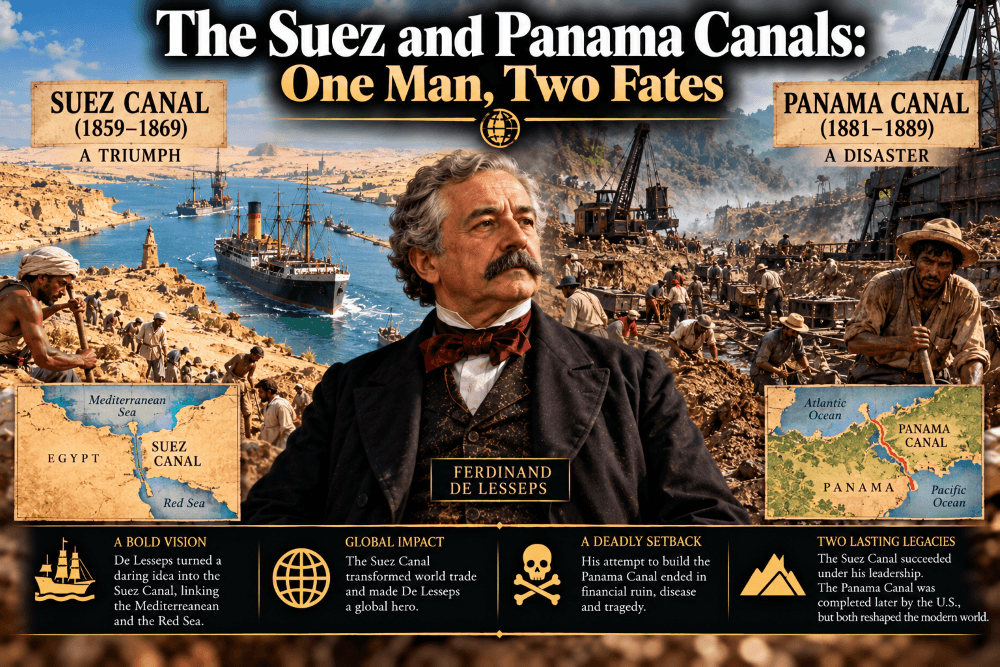
Few entrepreneurial stories capture both triumph and disaster as starkly as the Suez and Panama Canals, two of the most ambitious infrastructure projects of the 19th century, led by the very same man. Ferdinand de Lesseps became a global hero for completing the Suez Canal in 1869, then lost nearly everything, including his reputation and the lives of thousands of workers, attempting to replicate that success in Panama just over a decade later.
Ferdinand de Lesseps and the Suez Canal
A Diplomat Turned Builder
Ferdinand de Lesseps came to the Suez Canal project not as an engineer, but as a former French diplomat with extensive connections across the Middle East and North Africa.
- His diplomatic background gave him relationships and credibility with Egyptian leadership that proved essential to securing approval for the massive project.
- He lacked formal engineering training, relying instead on skilled engineers and technical experts to handle the project’s physical execution.
- His core contribution was organizational and political: raising capital, securing permissions, and maintaining momentum across a project that took a full decade to complete.
Building a Waterway Between Seas
Construction on the Suez Canal began in 1859, aiming to connect the Mediterranean and Red Seas and dramatically shorten shipping routes between Europe and Asia.
- The project required cutting a canal through roughly 120 miles of Egyptian desert terrain, an enormous undertaking even by modern standards.
- Construction relied heavily on forced labor during its early years, a troubling aspect of the project that later gave way to increased use of mechanized dredging equipment.
- The canal officially opened in 1869, a full decade after construction began, successfully connecting the two seas as intended.
A Resounding Commercial Success
The Suez Canal fundamentally transformed global shipping almost immediately after opening.
- Ships traveling between Europe and Asia no longer needed to sail around the entire African continent, dramatically reducing both distance and travel time.
- The canal quickly became one of the world’s most important shipping routes, generating substantial revenue and global commercial significance.
- De Lesseps emerged from this success as an internationally celebrated figure, widely regarded as one of the era’s great visionary builders.
This triumph set the stage, both financially and psychologically, for his next and far more disastrous undertaking.
The Panama Canal Disaster
Overconfidence After Suez
Riding high on his Suez success, de Lesseps turned his attention to an even more ambitious project: connecting the Atlantic and Pacific Oceans through Panama.
- He raised substantial capital from French investors, largely based on his enormous reputation following the Suez triumph.
- He insisted on building a sea-level canal in Panama, essentially replicating the design approach that had worked in Egypt’s desert terrain.
- This decision would prove catastrophically mismatched to Panama’s radically different geographic and environmental conditions.
A Fatal Miscalculation
Panama’s terrain and climate differed from Egypt’s desert conditions in ways that proved devastating to de Lesseps’s approach.
- Panama’s dense jungle, mountainous terrain, and heavy rainfall made a sea-level canal design far more difficult and dangerous to construct than Suez had been.
- Tropical diseases, particularly yellow fever and malaria, spread rampantly among workers in Panama’s harsh environment.
- Historians estimate that thousands of workers died during the Panama construction effort, a staggering human cost that stands in stark contrast to de Lesseps’s earlier Egyptian triumph.
Financial Collapse and Scandal
As construction costs spiraled far beyond original projections and progress stalled, the Panama venture’s financial structure began to unravel.
- The company repeatedly returned to investors for additional funding, sustained partly through increasingly questionable financial practices.
- The venture eventually collapsed entirely in 1889, wiping out the investments of hundreds of thousands of French citizens who had purchased shares.
- The ensuing scandal revealed evidence of bribery involving French officials and journalists, severely damaging de Lesseps’s reputation and leading to his prosecution.
De Lesseps, once celebrated as a visionary hero, died in 1894 with his reputation and personal fortune largely destroyed by the Panama failure.
What the Suez and Panama Canals Teach About Entrepreneurship
Success Doesn’t Guarantee Repeatability
The dramatic contrast between the Suez and Panama Canal projects offers a powerful lesson about the limits of applying past success to new circumstances.
- De Lesseps’s Suez success came partly from favorable conditions, including terrain and political circumstances that didn’t necessarily translate to Panama.
- His insistence on replicating the same sea-level design approach, despite drastically different geography, reflects a dangerous overconfidence following his earlier triumph.
- This pattern, assuming a winning formula will automatically transfer to a new context, has repeated throughout business history well beyond infrastructure projects.
The Human Cost Behind Ambitious Projects
Any honest account of these two projects must directly acknowledge their very different human costs.
- While Suez also relied on troubling forced labor practices during its early construction phase, Panama’s death toll from disease reached a catastrophically higher scale.
- This human cost represents an essential and inseparable part of understanding both projects accurately, not merely a footnote to their engineering or financial outcomes.
- These costs illustrate the genuine danger when ambition outpaces careful risk assessment and environmental understanding.
The Panama Canal’s Eventual Completion
Though de Lesseps’s effort failed catastrophically, Panama’s canal was eventually completed decades later under different leadership and with a substantially revised engineering approach.
- American engineers eventually completed the canal in 1914, using a lock-based system rather than de Lesseps’s sea-level design.
- This later success, achieved only after addressing both the engineering miscalculations and disease control failures that had doomed the earlier effort, underscores just how significant de Lesseps’s original errors had been.
Lessons from the Suez and Panama Canals
- Past success can create dangerous overconfidence. De Lesseps assumed his Suez approach would transfer directly to Panama’s entirely different conditions.
- Environmental and human factors can’t be engineered around. Disease and terrain ultimately proved more decisive than financial capital or ambition.
- Reputation is a fragile asset. De Lesseps’s fall from celebrated hero to disgraced failure happened within a single decade.
Frequently Asked Questions
Who was Ferdinand de Lesseps? He was a French diplomat who led the successful construction of the Suez Canal, completed in 1869, before later leading the disastrous and ultimately failed attempt to build the Panama Canal in the 1880s.
Why did the Suez Canal succeed while the Panama Canal initially failed? Suez’s desert terrain suited de Lesseps’s sea-level canal design, while Panama’s jungle terrain, heavy rainfall, and disease-ridden environment made the same approach catastrophic, leading to the project’s collapse.
How many people died building the Panama Canal under de Lesseps? Historians estimate thousands of workers died during the French construction effort, primarily due to tropical diseases like yellow fever and malaria.
Was the Panama Canal ever completed? Yes, American engineers completed the Panama Canal in 1914, using a lock-based system rather than de Lesseps’s original sea-level design, succeeding where the earlier French effort had failed.
Related Articles
- Limited Liability: The Law That Democratized Business
- Wells Fargo: Banking Built on the Gold Rush
- Sam Brannan: California’s First Gold Rush Millionaire
- Levi Strauss: The Immigrant Who Invented Denim
- The California Gold Rush: Where Merchants Beat Miners
- Thomas Edison: Turning Invention Into Business
- John D. Rockefeller: Standard Oil and the Power of Consolidation
About The History of Entrepreneurship
This article is part of The History of Entrepreneurship, an ongoing series exploring how entrepreneurs, civilizations, technologies, financial institutions, and business innovations gradually created the modern economy.
Social Media Distribution
X (Twitter): Ferdinand de Lesseps built the Suez Canal and became a global hero. A decade later, he tried the same playbook in Panama’s jungle, and it collapsed into financial scandal and thousands of worker deaths. One man, two canals, two wildly different fates. 🚢⚰️ #SuezCanal #PanamaCanal #Entrepreneurship
LinkedIn: Ferdinand de Lesseps’s story is one of the starkest rise-and-fall arcs in infrastructure history. After successfully completing the Suez Canal in 1869 and becoming an internationally celebrated figure, he applied the exact same sea-level design approach to Panama a decade later, a decision that proved catastrophically mismatched to Panama’s jungle terrain, heavy rainfall, and disease-ridden environment. Thousands of workers died from yellow fever and malaria, the project collapsed financially in 1889, and a bribery scandal destroyed de Lesseps’s reputation entirely. The canal was eventually completed decades later by American engineers using a fundamentally different approach. In my latest History of Entrepreneurship piece, I explore what this dramatic contrast teaches about the limits of repeating past success. #BusinessHistory #Entrepreneurship #InfrastructureHistory
Leave a Reply