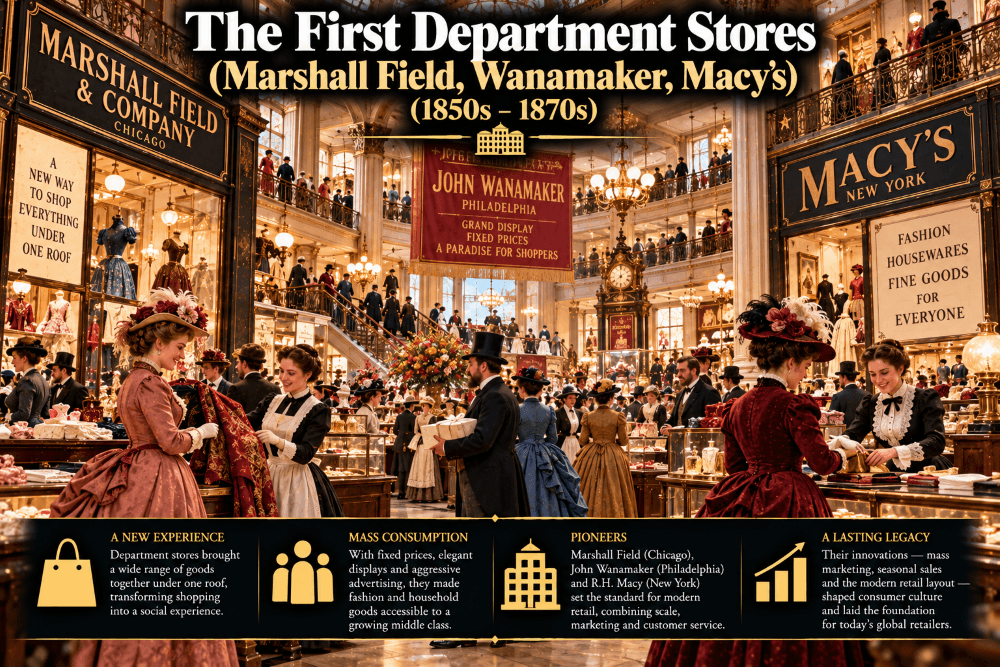
Walking into a store, browsing freely, seeing a clearly marked price, and returning an item if it didn’t work out seems unremarkable today. In the mid-19th century, none of it existed. The department store, pioneered by retailers like Marshall Field, John Wanamaker, and the founders of Macy’s between the 1850s and 1870s, didn’t just sell more goods under one roof. It rewrote the basic rules of how shopping itself worked.
Shopping Before the Department Store
A Transaction Built on Negotiation
Retail before this period operated under assumptions almost entirely foreign to modern shoppers.
- Prices were typically negotiated individually between shopkeeper and customer, with haggling treated as a normal and expected part of nearly every transaction.
- Smaller specialty shops dominated retail, each typically selling a narrow category of goods rather than a broad range under one roof.
- Returns and refunds were rarely guaranteed, leaving customers with little recourse if a purchased item proved unsatisfactory.
This system placed significant pressure and uncertainty on customers, who needed negotiating skill and market knowledge just to avoid being overcharged.
A Retail Experience Built on Distrust
The negotiation-heavy retail culture of this era reflected a deeper lack of trust between merchants and customers.
- Buyers often approached transactions defensively, assuming merchants would attempt to extract the highest possible price.
- This dynamic discouraged casual browsing, since entering a shop typically meant committing to a negotiation rather than simply looking around.
- Shopping remained a transactional, often tense experience rather than something resembling leisure or exploration.
The Department Store Innovation
Fixed Prices Change Everything
One of the most significant innovations associated with early department stores was the introduction of fixed, clearly marked prices.
- Retailers like John Wanamaker began marking merchandise with set prices, eliminating the need for individual negotiation on every purchase.
- This approach required customers to trust that the marked price was genuinely fair, representing a significant shift in the merchant-customer relationship.
- Fixed pricing also simplified operations considerably, allowing stores to train staff more easily and manage significantly higher transaction volumes.
This single change fundamentally altered the psychological experience of shopping, removing the adversarial negotiation that had defined retail for generations.
The Money-Back Guarantee
John Wanamaker is widely credited with pioneering another transformative retail practice: the money-back guarantee.
- Customers could return merchandise and receive a refund if they weren’t satisfied, a genuinely novel concept in retail at the time.
- This policy directly addressed the trust problem that had long discouraged confident, exploratory purchasing.
- By absorbing this risk themselves, department stores effectively signaled confidence in their own merchandise quality.
Browsing Without Obligation
Department stores also fundamentally reimagined the physical shopping experience itself.
- Large, open retail floors allowed customers to walk freely among displayed merchandise without immediate pressure to purchase.
- Elaborate window displays and in-store merchandising were designed specifically to attract attention and encourage casual exploration.
- This shift transformed shopping from a purely transactional errand into something resembling entertainment and leisure activity.
The Pioneers Behind the Department Store
Marshall Field in Chicago
Marshall Field built his Chicago retail operation around a deep commitment to customer service and a carefully cultivated reputation for quality and fair dealing.
- His store became closely associated with the principle that customer satisfaction should guide business decisions, reportedly popularizing variations of the phrase “give the lady what she wants.”
- Field’s operation grew into one of the largest and most influential department stores in the country during this period.
- His approach helped establish customer-centered service as a genuine competitive advantage within retail.
John Wanamaker in Philadelphia
John Wanamaker’s Philadelphia store became closely associated with several of the era’s most significant retail innovations.
- Beyond fixed pricing and refund guarantees, Wanamaker was an aggressive and creative advertiser, using newspapers extensively to promote his store’s offerings.
- He organized his large store into distinct departments, each specializing in different merchandise categories, reinforcing the department store concept itself.
- His store became a prominent example of how retail could be organized at genuinely large scale while still emphasizing customer trust and satisfaction.
Macy’s in New York
Macy’s, founded in New York, grew into one of the most recognizable department store brands associated with this broader retail transformation.
- The store expanded its merchandise offerings considerably over time, reflecting the broader department store trend toward offering diverse goods under one roof.
- It became deeply associated with the department store model’s growing cultural significance within American retail and urban life.
- Macy’s continued growing throughout subsequent decades, eventually becoming one of the most prominent retail brands in the country.
Why the Department Store Mattered for Entrepreneurship
Scaling Trust, Not Just Inventory
The department store’s core innovation wasn’t simply offering more products. It was finding ways to scale customer trust across an operation far larger than a traditional shopkeeper could personally manage.
- Fixed prices and return policies allowed trust to be built into store policy itself, rather than depending entirely on individual merchant relationships.
- This systematized trust made it possible to employ large staffs of salespeople while maintaining consistent customer experience.
- This approach allowed retail operations to grow dramatically in scale while still preserving customer confidence.
A Template for Modern Retail
The practices pioneered by these department store founders became standard practice across retail more broadly in the following decades.
- Fixed pricing, return policies, and inviting in-store browsing experiences remain foundational expectations in modern retail.
- These innovations helped establish shopping as a genuine leisure activity, not merely a necessary transaction.
- Modern retail, from large department stores to e-commerce platforms, still relies heavily on principles these 19th-century innovators first established.
Lessons from the Department Store
- Removing friction unlocks demand. Fixed pricing and guarantees eliminated the negotiation anxiety that had long discouraged confident purchasing.
- Trust can be systematized. Department stores built customer confidence into policy itself, allowing trust to scale well beyond individual relationships.
- Experience matters as much as product. Inviting, browsable retail environments transformed shopping into something customers genuinely wanted to do.
Frequently Asked Questions
Who pioneered the modern department store? Marshall Field, John Wanamaker, and the founders of Macy’s were among the key figures who developed the department store model between the 1850s and 1870s.
What was the money-back guarantee, and why was it significant? John Wanamaker is widely credited with pioneering the money-back guarantee, allowing unsatisfied customers to return merchandise for a refund, a genuinely novel practice that helped build customer trust.
How did fixed pricing change retail? Fixed pricing eliminated the need for individual negotiation on every purchase, simplifying transactions and removing the adversarial dynamic that had previously defined much of retail shopping.
Why are department stores considered important to entrepreneurship history? They demonstrated how customer trust could be systematized through policy, allowing retail operations to scale dramatically while still maintaining strong customer confidence and satisfaction.
Related Articles
- The Birth of Modern Management: Railroads Invent the Org Chart
- Early Advertising: How Hype Became a Business Tool
- Singer Sewing Machine: Selling What No One Could Afford
- The Suez and Panama Canals: One Man, Two Fates
- Limited Liability: The Law That Democratized Business
- Wells Fargo: Banking Built on the Gold Rush
- Sam Brannan: California’s First Gold Rush Millionaire
About The History of Entrepreneurship
This article is part of The History of Entrepreneurship, an ongoing series exploring how entrepreneurs, civilizations, technologies, financial institutions, and business innovations gradually created the modern economy.
Leave a Reply