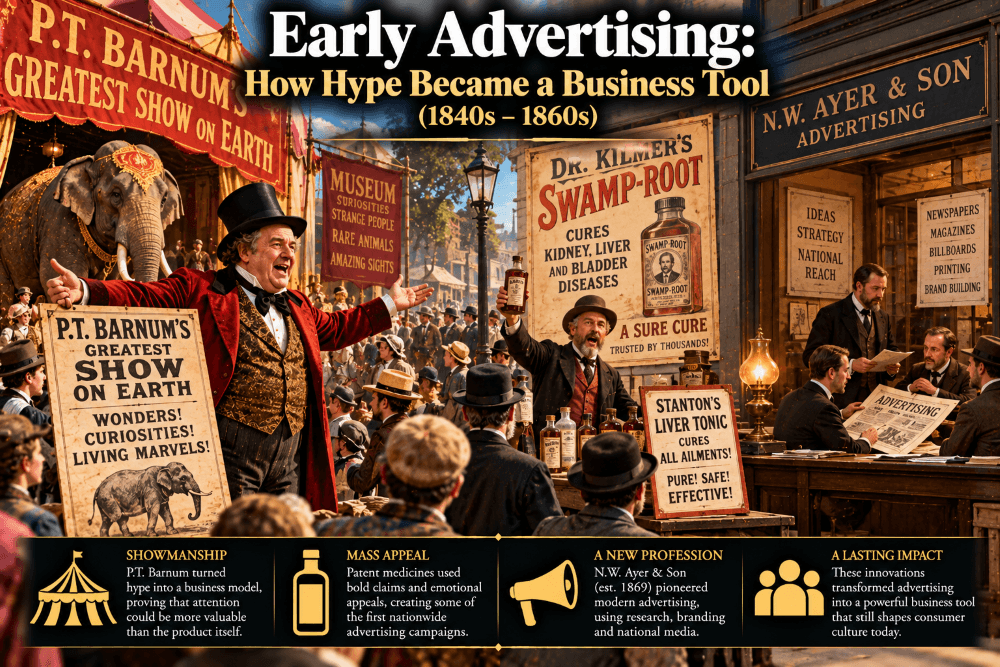
Early advertising in America wasn’t born in a boardroom. It was born on a circus stage, in a medicine bottle, and eventually in the office of a company built specifically to buy and place newspaper space for other businesses. Between the 1840s and 1860s, a handful of unrelated entrepreneurs independently discovered that attention itself could be manufactured, packaged, and sold, laying the groundwork for an entire industry that didn’t yet have a name.
P.T. Barnum and the Art of Manufactured Attention
Promotion as the Product
Phineas Taylor Barnum (July 5, 1810 – April 7, 1891) built his career less on any single product and more on his genuine mastery of generating public attention.
- He understood that curiosity itself could be monetized, using exaggerated claims, elaborate publicity stunts, and carefully built anticipation to drive paying crowds toward his exhibitions.
- He frequently blurred the line between genuine curiosity and outright deception, a pattern that drew both enormous commercial success and persistent ethical criticism.
- His approach demonstrated that the story surrounding a product or experience could matter just as much as the product itself in driving commercial demand.
Lessons in Spectacle and Scale
Barnum’s promotional techniques offered genuinely useful lessons for commerce well beyond the entertainment industry he operated within.
- He recognized that bold, attention-grabbing claims generated far more public interest than modest, accurate ones.
- He used newspapers extensively to build anticipation before an exhibition ever opened, an early example of coordinated promotional campaigns.
- His career illustrates how aggressive self-promotion, for better and for worse, became a recognized and replicable business strategy during this period.
Patent Medicine and the Birth of Mass-Market Claims
A Booming, Unregulated Industry
The patent medicine industry exploded during this period, built almost entirely on bold advertising claims rather than genuine medical evidence.
- Manufacturers sold tonics, elixirs, and remedies claiming to cure an enormous range of ailments, often with little to no legitimate medical basis behind these claims.
- These products were marketed aggressively through newspaper advertisements, colorful packaging, and elaborate promotional pamphlets distributed widely across the country.
- Because meaningful regulation of medical claims essentially didn’t exist during this era, manufacturers faced few constraints on how extravagant their advertising promises could become.
It’s important to be direct about this: many patent medicines were not just ineffective but potentially harmful, and the bold claims sold alongside them represent a genuinely troubling chapter in advertising history, not simply colorful marketing innovation.
Innovating Despite Deception
Even acknowledging this troubling context, the patent medicine industry contributed real, lasting techniques to how advertising would later develop.
- These companies were early adopters of repetitive brand messaging, ensuring their product names appeared constantly across newspapers and public spaces.
- They frequently used testimonials, real or fabricated, to build a sense of credibility and trust around their products.
- They demonstrated, however problematically, that sustained, large-scale advertising could build genuinely powerful brand recognition across a widely dispersed national market.
This uncomfortable mix, genuine marketing innovation built on frequently dishonest claims, shaped early public skepticism toward advertising that persists in various forms today.
N.W. Ayer and the Birth of the Advertising Agency
Organizing Advertising as a Service
N.W. Ayer & Son, founded in Philadelphia in 1869 by 21-year-old Francis Ayerfounded in the years following this earlier period, represented a significant structural shift in how advertising itself was organized and sold as a business service.
- Rather than businesses negotiating directly and informally with individual newspapers, N.W. Ayer positioned itself as a dedicated intermediary managing advertising placement on behalf of clients.
- This agency model introduced more systematic, professional approaches to planning and purchasing advertising space.
- It represented an important evolutionary step from the more chaotic, individually negotiated promotional efforts common during the Barnum and patent medicine era.
From Space-Selling to Strategy
Over time, agencies like N.W. Ayer expanded their role considerably beyond simply purchasing newspaper space on a client’s behalf.
- They began offering more comprehensive services, including assistance in crafting the advertising messages themselves.
- This evolution gradually transformed advertising from purely tactical newspaper placement into something resembling modern marketing strategy.
- This shift laid essential groundwork for the far more sophisticated advertising industry that would develop over subsequent decades.
Why Early Advertising Matters to Entrepreneurship History
A New Business Function Emerges
This period marked a genuine turning point: advertising evolved from an occasional tactic into a recognized, systematic business function in its own right.
- Entrepreneurs increasingly recognized that effective promotion required dedicated attention, skill, and resources, not just an afterthought following product development.
- The intermixing of legitimate innovation and outright deception during this era created lasting tension around advertising’s role and ethical boundaries.
- This tension between persuasion and honesty remains directly relevant to advertising and marketing practices today.
Setting the Stage for Modern Marketing
The techniques pioneered, however imperfectly, during this period directly influenced the development of modern marketing and brand-building practices.
- Repetition, emotional appeal, testimonials, and strategic media placement all trace meaningful roots back to this formative period.
- The eventual development of the dedicated advertising agency model created an entirely new commercial industry supporting businesses across every sector.
- Understanding this history helps explain both the genuine power and the persistent ethical complexity surrounding modern advertising practices.
Lessons from Early Advertising
- Attention itself can be a commercial asset. Barnum demonstrated that manufactured curiosity could drive genuine paying demand.
- Innovation and deception sometimes developed together. Patent medicine advertising shows how genuinely useful techniques emerged alongside deeply troubling practices.
- Specialization creates new industries. N.W. Ayer’s agency model shows how organizing an existing function more systematically can itself become a significant business opportunity.
Frequently Asked Questions
How did P.T. Barnum influence early advertising? Barnum demonstrated that bold claims, publicity stunts, and sustained public anticipation could generate significant commercial demand, showing that promotion itself could function as a powerful business tool.
Were patent medicine advertising claims accurate? No, many patent medicine claims lacked legitimate medical evidence and were often misleading or outright false, reflecting a largely unregulated advertising environment during this period.
What was N.W. Ayer’s role in advertising history? N.W. Ayer & Son helped pioneer the advertising agency model, acting as an intermediary that purchased newspaper advertising space on behalf of client businesses and eventually assisted with crafting advertising messages.
Why is this period considered important to advertising history? It marked advertising’s shift from occasional, informal promotion into a recognized, systematic business function, establishing techniques and structures that shaped the development of modern marketing.
Related Articles
- Singer Sewing Machine: Selling What No One Could Afford
- The Suez and Panama Canals: One Man, Two Fates
- Limited Liability: The Law That Democratized Business
- Wells Fargo: Banking Built on the Gold Rush
- Sam Brannan: California’s First Gold Rush Millionaire
- Levi Strauss: The Immigrant Who Invented Denim
- The California Gold Rush: Where Merchants Beat Miners
About The History of Entrepreneurship
This article is part of The History of Entrepreneurship, an ongoing series exploring how entrepreneurs, civilizations, technologies, financial institutions, and business innovations gradually created the modern economy.
Leave a Reply