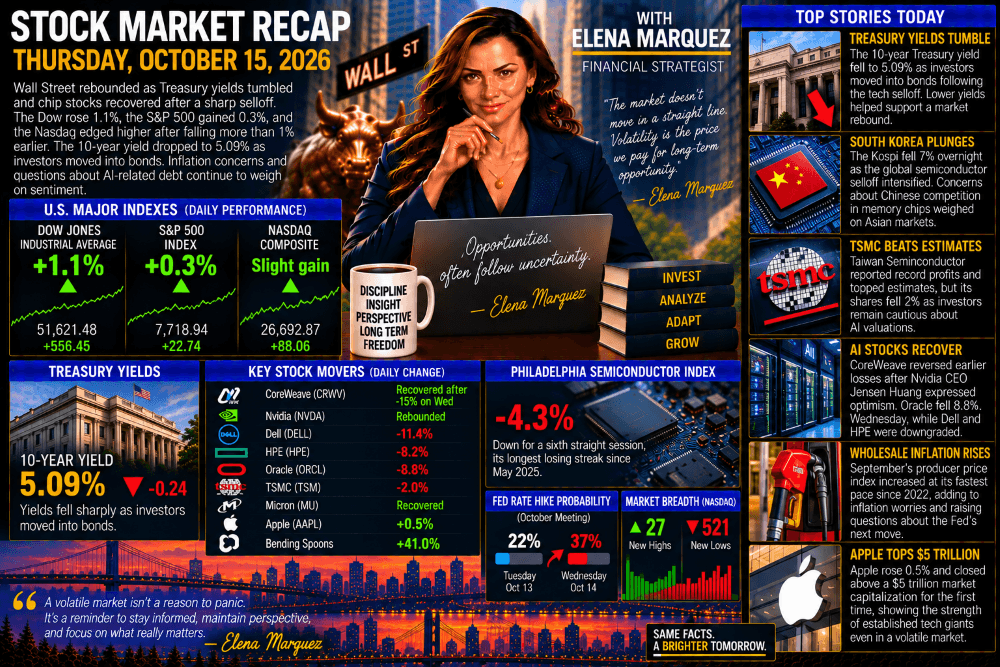
Thursday | Wall Street rebounds as Treasury yields tumble and AI stocks recover
Wall Street staged an impressive recovery Thursday as falling Treasury yields helped stabilize a stock market shaken by concerns about inflation, artificial intelligence and the enormous debt required to finance new data centers.
The Dow Jones Industrial Average climbed approximately 1.1%, the S&P 500 gained 0.3%, and the Nasdaq recovered from an earlier decline of more than 1% to finish modestly higher, according to the market figures provided.
But the recovery came with an important warning.
Investors are beginning to question whether the AI boom can generate enough profits to justify the extraordinary amount of money being borrowed to finance it.
Market performance
Dow Jones
+1.1%
Led the rebound
S&P 500
+0.3%
Recovered earlier losses
Nasdaq
Slight gain
Down over 1% intraday
Approximate Thursday market performance based on the supplied report; exact final closing values have not been independently verified.
1. Treasury Yields Fall Sharply
One of Thursday’s most important developments occurred in the bond market.
The yield on the 10-year US Treasury fell to approximately 5.09%, a significant retreat from the levels above 5.3% reached earlier in October.
10-year US Treasury yield
5.09%
Yields falling
Reported October 15 yield
Why does this matter?
Treasury yields influence borrowing costs throughout the economy.
When yields decline, financing conditions can improve for businesses, homeowners and investors.
Lower yields are particularly helpful for technology companies whose valuations depend heavily on profits expected many years into the future.
But Thursday’s decline in yields was not necessarily a sign of economic optimism.
The recent technology selloff encouraged investors to move money into US government bonds, which are generally considered safer than stocks.
As investors buy Treasury bonds, their prices rise and their yields fall.
In other words, the same fear that hurt technology stocks helped push bond yields lower.
Falling interest rates can support stock valuations, but the reason rates are falling matters.
2. The AI Selloff Spreads to South Korea

The global semiconductor selloff intensified overnight.
South Korea’s Kospi Index plunged approximately 7%, reflecting heavy selling in companies exposed to AI chips and memory technology.
The decline demonstrated how deeply the global AI investment cycle connects American technology companies with Asian semiconductor manufacturers.
South Korea is home to Samsung Electronics and SK Hynix, two major suppliers of advanced memory chips.
These companies are important to the AI supply chain because powerful processors require high-bandwidth memory to handle enormous quantities of data.
However, investors are becoming concerned about two developments.
First, Chinese competitors are making technological progress that could eventually challenge established manufacturers.
Second, investors are questioning whether the companies building AI infrastructure can afford to maintain their extraordinary spending plans.
These concerns can affect chip manufacturers even when demand for their products remains strong.
3. Taiwan Semiconductor Reports Record Profits—But Its Stock Falls
One of Thursday’s most revealing developments came from Taiwan Semiconductor Manufacturing Company (TSMC).
The company reported record profits and exceeded analyst expectations, supported by strong demand for advanced chips used in artificial intelligence.
Yet its US-listed shares declined approximately 2%.
That contrast is important.
A company can report excellent financial results and still see its stock price fall.
Why?
Because stock prices reflect expectations about the future, not simply the performance of the past quarter.
If investors already expect extraordinary growth, even record earnings may not be enough to push shares higher.
TSMC remains one of the most important companies in the global semiconductor industry.
It manufactures advanced chips for leading technology businesses and occupies a critical position in the AI supply chain.
But Thursday demonstrated that strong earnings do not guarantee rising stock prices when investor sentiment deteriorates.
4. CoreWeave Exposes the Debt Problem Behind AI

CoreWeave became one of the most closely watched stocks of the week.
The AI cloud-computing company plunged approximately 15% Wednesday, as investors worried about its debt-heavy balance sheet.
On Thursday, shares recovered from earlier losses after Nvidia CEO Jensen Huang expressed confidence in the company.
CoreWeave is part of a growing group of specialized cloud providers sometimes called neoclouds.
These companies build and operate computing infrastructure designed specifically for artificial intelligence.
Their business model can be extremely capital-intensive.
They must purchase expensive AI processors, construct data centers, secure electricity supplies and finance large infrastructure projects.
Much of that investment occurs before the companies collect the revenue needed to pay for it.
This creates financial risk.
If AI demand grows rapidly and customers continue signing profitable long-term contracts, these investments may generate attractive returns.
But if growth slows, financing costs increase or customers reduce spending, highly indebted operators could face serious pressure.
The central question: Can AI revenue keep up with AI debt?
Imagine a company borrows billions of dollars to build AI data centers.
Its investment makes sense only if future customer revenue covers operating expenses, interest payments, equipment replacement and ultimately produces an attractive profit.
Even a fast-growing company can run into trouble if cash flows don’t arrive quickly enough.
And AI infrastructure has another complication.
Computer chips become technologically obsolete.
A data center operator may need to replace expensive equipment long before the buildings themselves wear out.
That makes the economics more challenging than simply building infrastructure and collecting rent indefinitely.
The AI boom isn’t just a technology story anymore. It’s increasingly a financing story.
5. Nvidia’s Jensen Huang Helps Restore Confidence
Nvidia CEO Jensen Huang’s optimistic comments about CoreWeave helped improve sentiment Thursday.
Nvidia occupies a central position in the AI ecosystem.
Its processors power many of the world’s most advanced AI systems, and its customers include large cloud providers and specialized computing companies.
When Nvidia’s leadership expresses confidence in an important partner, investors pay attention.
However, executive optimism doesn’t eliminate financial risk.
CoreWeave still needs to demonstrate that its investments can produce sustainable cash flows and that its balance sheet can support continued expansion.
The distinction matters.
A company can operate in a fast-growing industry while still facing significant financial challenges.
6. Wholesale Inflation Adds Another Complication
Thursday also brought another unwelcome inflation report.
The Producer Price Index, which measures prices received by domestic producers, showed September wholesale inflation accelerating at its fastest pace since 2022, according to the information supplied.
This followed Wednesday’s hotter-than-expected consumer inflation report.
Together, the reports suggest price pressures are not yet fully under control.
Producer inflation matters because higher costs for manufacturers and other businesses can eventually be passed along to customers.
Not every increase in producer prices becomes consumer inflation.
Companies may absorb some costs through lower profit margins.
But persistent increases can create pressure throughout the economy.
The Federal Reserve’s difficult choice
The Fed faces conflicting signals.
Inflation remains elevated, arguing for tighter monetary policy.
At the same time, the labor market has shown signs of slowing, and technology stocks are becoming increasingly sensitive to borrowing costs.
Raising interest rates could help control inflation.
But it would also make financing more expensive for companies already borrowing heavily to fund AI infrastructure.
And keeping rates elevated for longer could pressure housing, consumer spending and corporate profitability.
This helps explain why markets have become so volatile.
7. Why the Dow Outperformed the Nasdaq
Thursday’s performance revealed another important market trend.
The Dow gained approximately 1.1%, while the Nasdaq barely finished in positive territory.
The difference reflects the market’s changing appetite for risk.
The Nasdaq has substantial exposure to technology and growth companies.
Those businesses are particularly sensitive to changing expectations about interest rates, future earnings and AI investment.
The Dow has a different composition, with greater representation from established industrial, financial and consumer businesses.
That doesn’t mean Dow companies are immune to higher borrowing costs or economic weakness.
But on Thursday, investors appeared more willing to own established businesses than highly valued technology stocks.
The result was a market rebound that was far stronger in the Dow than in the Nasdaq.
8. What Investors Should Watch Next
The coming sessions could reveal whether Thursday’s recovery marks the beginning of a more sustained rebound or simply a temporary pause in the AI selloff.
Three developments deserve particular attention.
Treasury yields: Will the 10-year yield continue declining, providing relief for borrowing costs, or rebound as investors digest inflation data?
AI infrastructure financing: Will companies such as CoreWeave demonstrate that their revenue and cash flow can support rising capital expenditures and debt obligations?
Corporate earnings: Will strong results from major technology companies and their suppliers be enough to restore investor confidence?
Investors should also watch whether selling pressure spreads beyond technology into other sectors.
A correction concentrated in AI-related stocks is different from a broad market decline driven by deteriorating economic conditions.
The Bottom Line
| Indicator | October 15 |
|---|---|
| Dow Jones | Approximately +1.1% |
| S&P 500 | Approximately +0.3% |
| Nasdaq | Slightly positive |
| 10-year Treasury yield | ~5.09% |
| South Korea’s Kospi | ~−7% |
| TSMC shares | ~−2% |
| CoreWeave | Recovered from earlier losses |
| Wholesale inflation | Fastest reported pace since 2022 |
Thursday brought some welcome relief after several difficult sessions for technology investors.
Treasury yields fell, the Dow rallied, and semiconductor stocks recovered from their worst levels.
But the underlying concerns remain.
Inflation is proving stubborn.
AI infrastructure is extraordinarily expensive.
And companies are borrowing substantial amounts of money to finance investments whose ultimate profitability remains uncertain.
The next stage of the AI boom will require more than technological breakthroughs and ambitious spending plans.
It will require financial discipline.
The biggest winners may not be the companies that build the most AI infrastructure, but those that generate the strongest returns on the money invested.
Other Stock Market blog posts
Leave a Reply