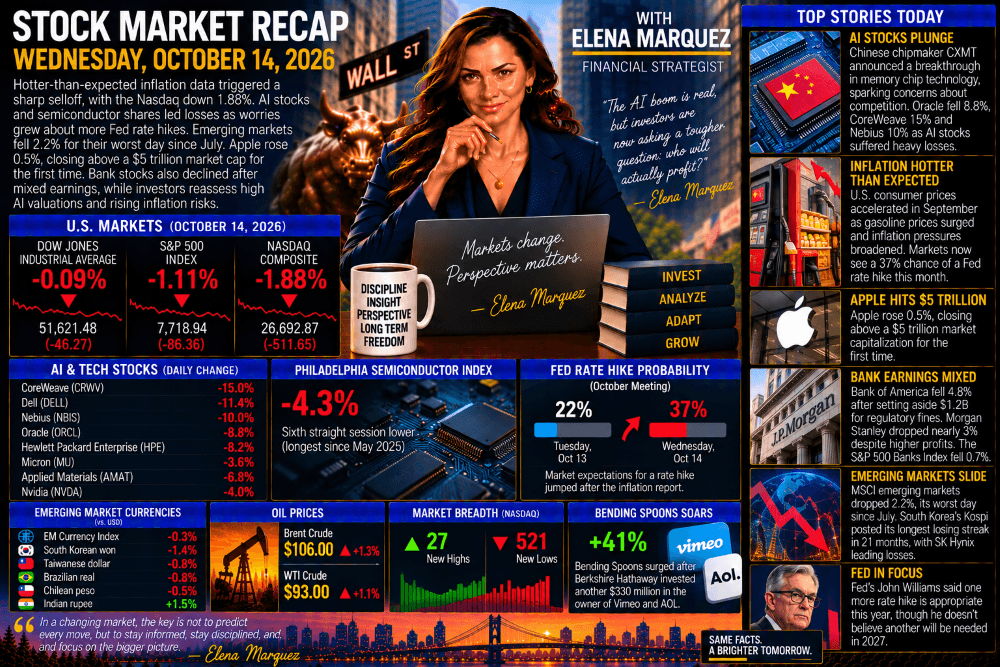
Wednesday | Inflation shocks Wall Street as AI stocks suffer their steepest selloff in months
Wall Street suffered a sharp selloff Wednesday after hotter-than-expected inflation data revived fears that the Federal Reserve will need to raise interest rates again.
The Nasdaq plunged nearly 2%, the S&P 500 recorded its biggest daily decline since July, and some of the biggest beneficiaries of the artificial intelligence boom suffered double-digit losses.
Oracle, CoreWeave, Nebius, Dell and Hewlett Packard Enterprise were among the hardest-hit stocks.
There was one notable exception: Apple rose to a closing market capitalization above $5 trillion for the first time.
Market performance
Dow Jones
−0.09%
51,621.48 points
S&P 500
−1.11%
7,718.94 points
Nasdaq
−1.88%
26,692.87 points
October 14 closing figures from the Reuters report supplied.
The S&P 500’s 1.11% decline was its largest one-day drop since July 29.
The Nasdaq’s 1.88% loss was its biggest since July 23.
The Dow held up relatively well, declining just 0.09%, highlighting how much of Wednesday’s selling was concentrated in technology and AI-related stocks.
1. Inflation Returns as Wall Street’s Biggest Fear
The immediate catalyst was September’s Consumer Price Index report.
Consumer prices accelerated as gasoline became more expensive and inflation pressures spread beyond energy.
This is particularly troubling because the Federal Reserve has already been struggling to bring inflation under control.
The central bank raised interest rates in September, and investors had been hoping that policymakers might soon pause.
Wednesday’s inflation report challenged that expectation.
According to CME’s FedWatch tool, the probability of another rate increase in October jumped sharply.
Market-implied probability of an October Fed rate hike
Tuesday, October 13
22%
Wednesday, October 14
37%
Up 15 percentage points in one day, according to the figures provided.
That change helps explain the market reaction.
Investors are increasingly concerned that inflation will force the Fed to keep borrowing costs elevated for longer than expected.
Higher interest rates make loans more expensive for households and businesses.
They also reduce the present value of future corporate earnings, which is especially damaging to highly valued growth stocks.
Inflation isn’t simply an economic statistic. It directly affects how much investors are willing to pay for stocks.
2. AI Stocks Suffer a Brutal Selloff

The biggest losses occurred among companies involved in AI infrastructure.
These businesses have benefited from extraordinary demand for data centers, cloud computing and advanced servers.
But many require substantial investment and financing, making them particularly sensitive to higher borrowing costs.
AI infrastructure stocks — October 14
-16%-12%-8%-4%0%CoreWeaveDellNebiusOracleHPE
CoreWeave plunged 15%.
Dell declined 11.4%.
Nebius fell 10%.
Oracle lost 8.8%.
Hewlett Packard Enterprise dropped 8.2%.
Dell and HPE faced additional pressure after Barclays downgraded both companies from overweight to equal-weight.
These declines demonstrate how quickly investor sentiment can change when a popular investment theme encounters unexpected risks.
The AI industry may continue expanding rapidly.
But the companies building that infrastructure must still generate enough revenue and profit to justify their investments.
3. Semiconductor Stocks Extend Their Losing Streak
The Philadelphia Semiconductor Index declined 4.3% Wednesday.
That marked its sixth consecutive losing session, the longest streak since May 2025.
The semiconductor industry has been at the center of the AI investment boom.
Companies producing advanced processors, memory chips and manufacturing equipment have enjoyed tremendous investor enthusiasm.
But recent developments have created new uncertainty.
Chinese memory-chip manufacturer CXMT has reported technological progress that could intensify competition with established producers.
Questions have also emerged about whether AI developers can generate enough revenue to support their enormous infrastructure commitments.
Now rising inflation is adding another problem.
Higher interest rates make financing data centers more expensive and put pressure on the valuations of companies whose profits are expected to grow far into the future.
AI spending may continue growing, but investors are becoming less willing to pay any price for that growth.
4. Apple Breaks the $5 Trillion Barrier

One of Wednesday’s most remarkable developments was Apple’s resilience.
Apple shares rose approximately 0.5%, lifting the company’s closing market capitalization above $5 trillion for the first time.
That milestone came during a session when many other technology companies suffered steep losses.
Apple’s performance illustrates that technology stocks aren’t all responding identically to the current market environment.
While some AI infrastructure companies depend on massive capital expenditures and future revenue growth, Apple has an established ecosystem of products, services and recurring customer spending.
That doesn’t make Apple immune to economic weakness.
But investors may view its business model differently from companies whose valuations depend heavily on the next phase of AI infrastructure spending.
5. The Market Rally Is More Fragile Than It Looks
Despite Wednesday’s selloff, the S&P 500 remained up almost 13% for 2026.
That sounds impressive.
But the gains have been highly concentrated.
According to the Reuters figures supplied:
- The S&P 500 has gained nearly 13% this year.
- The median stock in the index has gained only about 4%.
- More than 200 S&P 500 companies are trading below their year-end 2025 levels.
This is a crucial distinction.
A market-capitalization-weighted index can rise substantially even when many of its components are struggling.
A handful of enormous companies can drive the index higher while smaller constituents fall behind.
And when those market leaders begin declining, the index becomes vulnerable.
Wednesday’s trading demonstrated that risk.
The Nasdaq recorded 521 new 52-week lows, compared with just 27 new highs.
That is a striking sign of weakness beneath the surface.
6. Bank Earnings Disappoint Investors
Technology wasn’t the only sector under pressure.
Bank of America shares declined 4.8% after the company reported lower third-quarter profits.
The bank set aside approximately $1.2 billion to cover regulatory fines related to failures to detect potential money laundering.
Morgan Stanley declined nearly 3%, despite reporting an increase in quarterly profit.
The S&P 500 Banks Index fell 0.7%, reaching its lowest closing level since June.
The results illustrate another challenge facing the market.
Even when a company reports profit growth, investors may react negatively if the results fall short of expectations or reveal new risks.
For banks, regulatory expenses, credit quality and borrowing costs remain particularly important.
7. Berkshire Hathaway Investment Sends Bending Spoons Soaring
One of the day’s most dramatic gainers was Bending Spoons.
Shares rallied approximately 41% after Berkshire Hathaway invested an additional $330 million in the owner of Vimeo and AOL, according to the supplied Reuters report.
The investment attracted attention because Berkshire Hathaway’s decisions are closely followed by investors worldwide.
A major investment from such a prominent institution can increase market confidence and attract additional buyers.
However, a sharp one-day rally doesn’t automatically establish that a stock is attractively valued.
Investors still need to examine the underlying business, earnings potential and price.
8. What the Federal Reserve Does Next Matters
Before the inflation report, Federal Reserve Vice Chair for Supervision Michelle Bowman suggested policymakers had time to observe economic and financial developments following September’s rate increase.
But Wednesday’s stronger inflation reading complicated that outlook.
The Fed is trying to balance two competing risks.
Raise interest rates too aggressively, and economic growth could weaken further.
Keep rates too low, and inflation could remain elevated.
The problem is that energy prices are being influenced by geopolitical conflicts and supply disruptions.
Higher interest rates cannot directly increase oil production or repair damaged energy infrastructure.
Yet the Fed may still need to respond if higher energy costs spread into broader inflation.
That uncertainty is likely to remain an important source of stock-market volatility.
9. What I’m Watching Next
Thursday’s retail sales report will provide another important clue about the economy.
If consumer spending remains strong, investors may conclude that the economy can withstand higher interest rates.
But strong spending could also reinforce concerns about inflation.
If retail sales disappoint, the market may become more concerned about economic slowing.
Investors will also be watching Treasury yields, semiconductor stocks and corporate earnings.
The most important question is whether Wednesday’s selloff remains concentrated in AI-related companies or begins spreading across the broader market.
The Bottom Line
| Indicator | October 14 |
|---|---|
| Dow Jones | −0.09% |
| S&P 500 | −1.11% |
| Nasdaq | −1.88% |
| Philadelphia Semiconductor Index | −4.3% |
| CoreWeave | −15.0% |
| Oracle | −8.8% |
| Dell | −11.4% |
| Apple | +0.5% |
| October Fed hike probability | 37% |
Wednesday was a reminder that even the strongest investment trends are vulnerable to changes in interest rates and investor expectations.
AI remains a powerful technological transformation.
But investors are beginning to distinguish between companies with established profits and those dependent on enormous future spending.
Higher inflation makes that distinction more important.
The market isn’t necessarily abandoning artificial intelligence.
It’s becoming more demanding about how much investors should pay for its future profits.
Other Stock Market blog posts
Leave a Reply