The bull market turns four, AI debt rattles Wall Street, and Apple joins the $5 trillion club
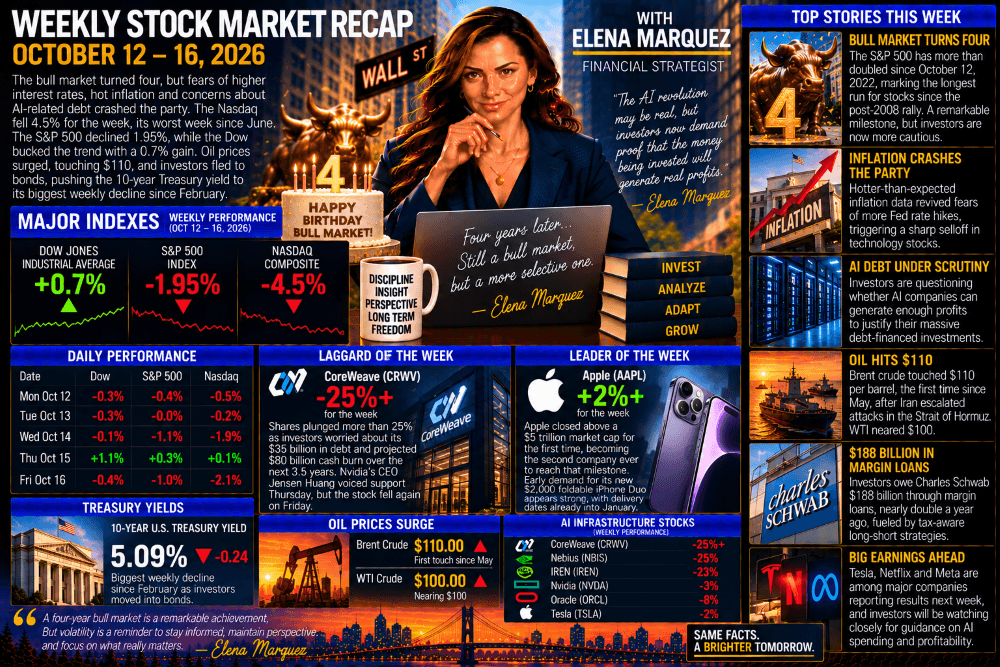
The American bull market celebrated its fourth birthday this week. Unfortunately, Wall Street wasn’t in much of a party mood.
The rally that began on October 12, 2022, has more than doubled the S&P 500 over four years. But this week’s hotter-than-expected inflation report revived fears of additional Federal Reserve interest-rate increases, triggering a sharp selloff in technology stocks.
Investors began questioning the enormous debt being accumulated to finance the artificial intelligence boom. AI infrastructure companies suffered some of the week’s largest losses, while money flowed into US Treasury bonds.
The Nasdaq recorded its worst week since late June, falling approximately 4.5%. The S&P 500 declined nearly 2%, while the Dow Jones Industrial Average managed a modest gain.
Meanwhile, Apple reached a remarkable milestone: a closing market capitalization above $5 trillion.
The week’s central theme: Investors still believe in AI, but they’re becoming much more selective about which companies deserve their money.
1. The week in numbers
Dow Jones
+0.7%
Weekly return
S&P 500
−1.95%
Weekly return
Nasdaq
−4.5%
Weekly return
-5%-3.5%-2%-0.5%1%DowS&P 500Nasdaq
Weekly index figures based on the supplied market recap.
The contrast between the Nasdaq and the Dow was striking.
The Nasdaq, which has substantial exposure to technology and growth companies, suffered a 4.5% decline.
The Dow, with a different sector composition, gained 0.7%.
That divergence suggests investors weren’t simply abandoning the stock market.
They were moving money away from expensive technology stocks and toward other sectors.
This process is known as sector rotation.
It can occur when investors believe one part of the market has become overvalued or particularly vulnerable to changing economic conditions.
2. The Bull Market Celebrates Its Fourth Birthday

October 12 marked four years since the beginning of the current bull market.
Since its October 2022 low, the S&P 500 has more than doubled.
According to the supplied market commentary, this has become the longest sustained bull-market run since the expansion following the 2008 financial crisis, which ended in 2020.
That’s a remarkable achievement considering what investors have endured.
The past four years included persistent inflation, aggressive interest-rate increases, geopolitical conflicts, banking concerns and repeated warnings about recession.
Yet the stock market continued advancing.
Much of that growth came from the extraordinary enthusiasm surrounding artificial intelligence.
Companies such as Nvidia, Microsoft, Apple and other major technology businesses helped propel indexes to record levels.
But the anniversary also raises an important question.
How much longer can the rally continue?
A bull market doesn’t end simply because it becomes old.
However, as stock prices rise, future returns depend increasingly on whether corporate earnings can justify those valuations.
This week’s selloff reminded investors that even a powerful long-term rally can experience sharp corrections.
3. Inflation Crashes the Party
The turning point came Wednesday.
September’s inflation report showed consumer prices rising faster than economists expected.
Higher gasoline prices contributed to the increase, but inflation pressures also spread beyond energy.
Investors immediately began reassessing the Federal Reserve’s next move.
Before the report, markets had assigned approximately a 22% probability to another interest-rate increase in October.
After the report, that probability jumped to approximately 37%.
The change was enough to trigger heavy selling in technology stocks.
Why are growth companies so sensitive to interest rates?
Because much of their value depends on profits expected many years into the future.
Higher interest rates reduce the present value of those future profits.
They also increase borrowing costs for companies financing large expansion projects.
That’s especially important for the AI industry.
Building the infrastructure required for artificial intelligence involves enormous investments in chips, servers, data centers, electricity and networking equipment.
Many companies are borrowing heavily to finance that growth.
The higher interest rates remain, the harder it becomes to justify expensive investments that may take years to become profitable.
4. Investors Flee Into Treasury Bonds
While stocks were falling, US Treasury bonds attracted buyers.
The benchmark 10-year Treasury yield recorded its biggest weekly decline since February.
Earlier in October, the yield had climbed above 5.3%.
By Thursday, it had fallen to approximately 5.09%.
The relationship is straightforward.
When investors buy bonds, bond prices rise and yields fall.
Government bonds are generally considered safer than stocks, so investors often increase their Treasury holdings during periods of market uncertainty.
But falling yields aren’t always a sign of improving economic conditions.
Sometimes they reflect fear.
This week’s decline appears to have been driven partly by investors seeking protection from the technology selloff.
Lower yields may eventually help support stock valuations.
However, they don’t eliminate the underlying concerns about inflation, AI spending and corporate debt.
5. Laggard of the Week: CoreWeave

Weekly performance: More than −25%
CoreWeave became one of the clearest examples of the risks associated with financing the AI boom.
The company, which originally operated in cryptocurrency mining, now rents powerful computing infrastructure to AI developers.
Demand for those services has grown rapidly.
But so has the company’s need for capital.
According to the figures provided, CoreWeave has accumulated at least $35 billion in debt to support its expansion.
One analysis also projects approximately $80 billion in cumulative cash consumption over the next three and a half years.
These figures illustrate the enormous financial commitments required to compete in AI infrastructure.
CoreWeave needs to purchase expensive Nvidia processors, build data centers, secure electricity supplies and expand its computing capacity.
Those investments can generate substantial revenue.
But they also create major financial obligations.
If customer demand grows as expected, CoreWeave could benefit enormously.
If demand disappoints, financing becomes more expensive or customers reduce spending, the company’s debt could become a serious problem.
Nvidia Comes to CoreWeave’s Defense
Nvidia CEO Jensen Huang expressed confidence in CoreWeave Thursday, saying the company’s strength was improving.
His comments helped stabilize the stock temporarily.
But investors resumed selling Friday.
The market appears increasingly focused on CoreWeave’s ability to generate sufficient cash flow to support its expansion.
And CoreWeave wasn’t alone.
Other AI infrastructure companies also suffered heavy weekly losses.
AI infrastructure — weekly losses
-30%-22.5%-15%-7.5%0%CoreWeaveNebiusIREN
CoreWeave fell more than 25%; its bar is shown at −25% as a conservative approximation.
The broader lesson is that a fast-growing industry can still produce financially vulnerable companies.
The AI revolution may be real, but debt still has to be repaid.
6. Leader of the Week: Apple

Weekly performance: More than +2%
While AI infrastructure companies suffered, Apple stood out as one of the week’s strongest major technology stocks.
On Wednesday, Apple closed above $5 trillion in market capitalization for the first time.
That made it the second company after Nvidia to reach the milestone, according to the supplied report.
Apple had approached the $5 trillion threshold several times since July but had previously failed to maintain that valuation through the closing bell.
This week, it finally succeeded.
One reason for the renewed enthusiasm was Apple’s new foldable smartphone, the $2,000 iPhone Duo.
Preorders opened Friday, and early indications suggested strong demand.
According to Barron’s reporting described in the supplied notes, estimated delivery dates had already extended into late January.
That could indicate stronger-than-expected interest in Apple’s premium new device.
Investors are hoping the foldable phone will help stimulate iPhone sales, particularly after signs of more modest demand for some existing models.
Analysts had observed shorter waiting times for the iPhone 18 Pro, raising questions about consumer enthusiasm.
The iPhone Duo could help Apple attract customers willing to pay premium prices for new technology.
However, early delivery delays don’t necessarily prove extraordinary demand.
They can also reflect limited initial supply.
Investors will need to see actual sales, production volumes and profit margins before determining how successful the new device becomes.
Nevertheless, Apple’s performance provided an important contrast to the broader AI selloff.
The company has a large, established customer base and a diversified business built around hardware, software and services.
That business model may appear more attractive to investors than companies requiring enormous debt-financed infrastructure investments.
7. Number of the Week: $188 Billion
Charles Schwab margin loan balances — end of September
$188 billion
Nearly double the balance from a year earlier
One of the week’s most revealing statistics came from Charles Schwab.
According to the supplied figures, clients owed the brokerage approximately $188 billion through margin loans at the end of September.
That was nearly twice the amount outstanding a year earlier.
Margin loans allow investors to borrow against securities they already own.
The borrowed money can be used to purchase additional investments, increasing their exposure to the market.
This is known as leverage.
Leverage can magnify gains when investments rise.
But it can also magnify losses when markets fall.
If the value of pledged investments declines too far, the brokerage may demand additional collateral or liquidate positions.
That’s why rapid growth in margin borrowing deserves attention.
It can increase financial vulnerability during market corrections.
8. The Rise of Tax-Aware Long-Short Investing
One of the drivers of Schwab’s rising margin balances is a strategy called tax-aware long-short investing.
The idea combines portfolio management with tax planning.
Investors establish long positions in stocks they expect to rise and short positions in stocks they expect to decline.
The strategy can generate realized losses that offset taxable investment gains, subject to applicable tax rules.
For wealthy investors, this can be attractive.
But it introduces complexity and risk.
Short positions can generate losses if stock prices rise.
Borrowing creates interest expenses.
And leveraged portfolios can become difficult to manage during periods of sharp volatility.
The strategy has become popular enough that major brokerages are reconsidering how quickly they want to expand it.
According to the supplied commentary, Schwab increased the minimum investment requirement for certain new accounts from $1 million to $10 million.
Fidelity reportedly stopped opening new accounts for a comparable strategy.
Schwab is also developing an alternative structure designed to be easier to manage.
The demand for tax-efficient investing remains strong.
But the rapid expansion of leverage raises questions about how these strategies might behave during a sustained market downturn.
Tax savings can be valuable, but they don’t eliminate investment risk.
9. Oil Prices Add Another Threat

Energy markets added to the week’s uncertainty.
Brent crude touched approximately $110 per barrel Friday as escalating attacks in the Strait of Hormuz threatened global oil shipments.
West Texas Intermediate crude approached $100.
The Strait of Hormuz is one of the world’s most important oil transportation routes.
Disruptions there can have significant consequences for global energy prices.
Higher oil prices raise costs for transportation, manufacturing and consumers.
They can also complicate the Federal Reserve’s efforts to reduce inflation.
This creates an uncomfortable combination for investors.
Technology companies face higher financing costs.
Consumers face higher energy bills.
And the Fed may have less flexibility to lower interest rates if economic growth slows.
10. What to Watch Next Week
The coming week will bring another round of major corporate earnings reports.
Tesla, Netflix and Meta are among the companies investors will be watching.
Each provides a different perspective on the economy and the technology sector.
Tesla’s results will offer insight into electric vehicle demand, profit margins and spending on autonomous-driving technology.
Netflix will provide a view of consumer entertainment spending, advertising revenue and streaming profitability.
Meta’s results may be especially important because the company is investing heavily in AI infrastructure.
Investors will want to know whether those investments are improving advertising performance, user engagement and profitability.
Beyond earnings, investors will continue monitoring oil prices, Treasury yields and Federal Reserve expectations.
And they’ll be watching whether the technology selloff begins spreading to other sectors.
The Bottom Line
| Indicator | Week of Oct. 12–16 |
|---|---|
| Dow Jones | +0.7% |
| S&P 500 | −1.95% |
| Nasdaq | −4.5% |
| CoreWeave | More than −25% |
| Nebius | Approximately −25% |
| IREN | Approximately −23% |
| Apple | More than +2% |
| Apple market capitalization | Above $5 trillion |
| Schwab margin loans | $188 billion |
| Brent crude | Touched ~$110 |
This week highlighted three important developments.
First, the four-year-old bull market remains vulnerable to inflation and higher interest rates.
Second, investors are becoming more skeptical about debt-financed AI infrastructure expansion.
Third, market leadership may be shifting as investors favor companies with established cash flows and more sustainable business models.
The rise in margin borrowing also suggests that leverage has become an increasingly important part of the investment landscape.
That can amplify market volatility when sentiment changes.
The AI boom isn’t necessarily ending. But investors are beginning to demand something more than ambitious promises and impressive growth projections.
They want profits, cash flow and evidence that the money being invested will generate attractive returns.
Other Stock Market blog posts
Leave a Reply