Friday | Technology stocks tumble, oil approaches $110, and the Nasdaq suffers its worst week since June
Wall Street ended the week under pressure as investors continued questioning the enormous investments supporting the artificial intelligence boom.
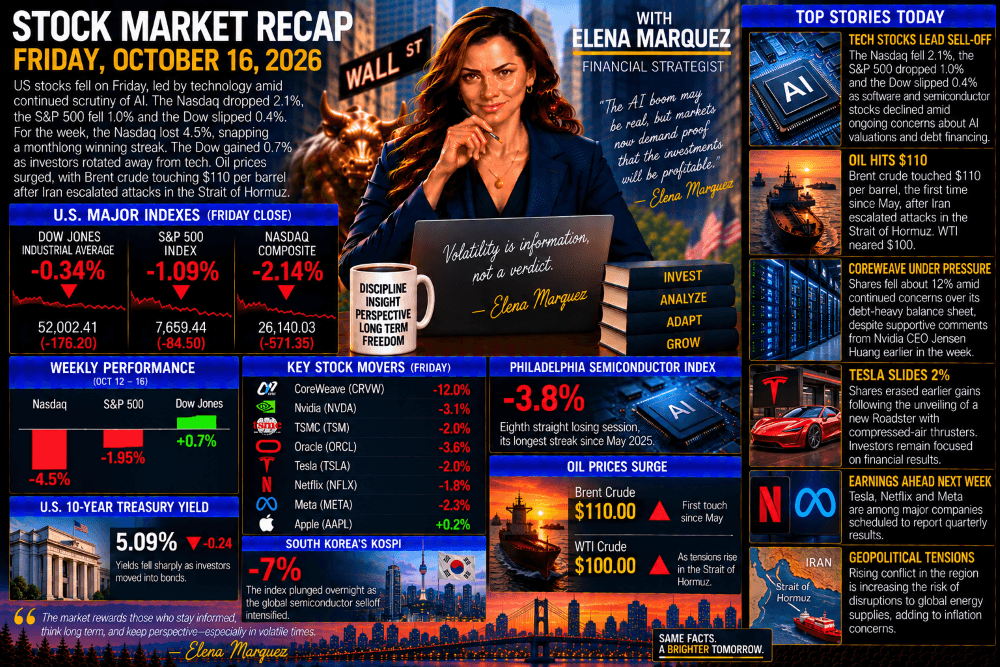
The Nasdaq Composite plunged 2.1% Friday, while the S&P 500 declined 1% and the Dow Jones Industrial Average slipped 0.4%.
Technology stocks led the selloff, with semiconductor and software companies facing renewed pressure. Meanwhile, escalating attacks in the Strait of Hormuz pushed Brent crude toward $110 per barrel, adding another layer of inflation concerns.
The most important development, however, wasn’t simply Friday’s decline.
For the first time in more than a month, investors are seriously questioning whether the AI trade has become too expensive.
Market performance
Dow Jones
−0.4%
Friday
S&P 500
−1.0%
Friday
Nasdaq
−2.1%
Friday
Performance for the week of October 12–16
-5%-3.5%-2%-0.5%1%NasdaqS&P 500Dow
Daily and weekly percentage changes are based on the figures supplied for October 16.
The Nasdaq lost 4.5% for the week, snapping a monthlong winning streak and recording its worst weekly performance since late June.
The S&P 500 declined 1.95%.
But the Dow actually finished the week up 0.7%, highlighting an important shift in investor behavior.
Money is moving away from technology and into other areas of the market.
1. The AI Trade Is Facing Its Biggest Test in Months
For much of 2026, artificial intelligence has dominated the stock market.
Investors have rewarded companies building AI processors, data centers, cloud infrastructure and software platforms.
The expectations have been extraordinary.
But this week, investors began focusing less on the potential of artificial intelligence and more on the financial risks involved in building it.
The concerns are increasingly familiar.
AI infrastructure requires enormous amounts of capital.
Data centers need expensive processors, memory chips, networking equipment and electricity.
Many companies are financing that expansion through borrowing.
And some businesses have not yet demonstrated that their future revenue will be sufficient to cover those investments.
The question is no longer simply how fast AI demand will grow.
It’s whether AI companies can earn enough money to justify what they’re spending.
2. CoreWeave Highlights the Risks of Borrowing to Build AI

CoreWeave, the Nvidia-backed AI cloud-computing company, came under renewed selling pressure Friday.
The company had already suffered a 15% decline Wednesday before recovering Thursday following supportive comments from Nvidia CEO Jensen Huang.
But investors remain concerned about CoreWeave’s debt-heavy balance sheet.
CoreWeave is part of a growing group of specialized cloud providers sometimes called neoclouds.
These companies build computing infrastructure designed for AI workloads.
Their business model requires substantial investment before revenue is fully realized.
That creates a potential mismatch between expenses and cash flow.
The company may need to pay interest on debt, purchase additional equipment and maintain its data centers while waiting for customer contracts to generate sufficient cash.
If demand grows as expected, the investments could become highly profitable.
But if growth disappoints, the financial risks could be significant.
This week’s selloff suggests investors are becoming less willing to overlook those risks.
3. Semiconductor Stocks Remain Under Pressure
Semiconductor companies also endured a difficult week.
Earlier in the week, concerns about competition from Chinese memory-chip manufacturer CXMT weighed on companies such as Micron, Samsung and SK Hynix.
Then Wednesday’s hotter-than-expected inflation report raised fears of additional Federal Reserve rate hikes.
Higher interest rates can be especially damaging to companies whose valuations depend on strong earnings growth many years into the future.
Even Taiwan Semiconductor Manufacturing Company, which reported record profits and exceeded expectations Thursday, saw its shares decline.
That reveals how demanding investor expectations have become.
A company can report excellent earnings and still see its stock fall if investors were expecting even better results.
4. Oil Approaches $110 as Middle East Tensions Escalate
Brent crude — intraday
~$110
Per barrel, first touch since May
WTI crude — intraday
~$100
Per barrel

While technology stocks were falling, oil prices were rising.
Brent crude touched $110 per barrel for the first time since May as attacks in the Strait of Hormuz raised concerns about global energy supplies.
West Texas Intermediate crude approached $100.
The Strait of Hormuz is one of the world’s most important oil-shipping routes.
A significant share of global petroleum trade passes through this narrow waterway connecting the Persian Gulf with the Gulf of Oman.
Any threat to shipping can increase the risk premium built into oil prices.
Higher oil prices are particularly troubling because they affect the broader economy.
Transportation becomes more expensive.
Manufacturing costs rise.
Airlines face higher fuel bills.
And households spend more on gasoline, leaving less money for other purchases.
This creates additional inflation pressure at a time when the Federal Reserve is already struggling to control rising prices.
5. The Federal Reserve Faces a Difficult Choice
This week’s inflation reports complicated the outlook for monetary policy.
Wednesday’s Consumer Price Index showed hotter-than-expected inflation.
Thursday’s Producer Price Index indicated that wholesale price pressures were also accelerating.
Together, the reports raised concerns that inflation could remain elevated for longer than expected.
The Fed now faces competing risks.
Higher interest rates may be necessary to control inflation.
But additional rate hikes would increase borrowing costs for businesses and consumers.
That could slow economic growth and make it more difficult for debt-heavy AI infrastructure companies to finance expansion.
The situation becomes even more complicated when inflation is driven by disruptions to global energy supplies.
Higher interest rates cannot directly increase oil production or protect shipping routes.
But the Fed may still need to respond if rising energy prices spread throughout the economy.
6. The Dow’s Strength Reveals a Market Rotation
One of the most interesting developments this week was the difference between the Nasdaq and Dow.
A market moving in two directions
Nasdaq — weekly
−4.5%
Technology-heavy index
Dow — weekly
+0.7%
More diversified sector exposure
The Nasdaq suffered its worst week since June.
Yet the Dow managed to advance.
That suggests investors are not necessarily abandoning stocks altogether.
Instead, they may be reducing exposure to highly valued technology companies and shifting toward businesses with more established earnings and less dependence on future AI investment.
This is known as sector rotation.
It can occur when investors become concerned that one part of the market has become too expensive relative to other opportunities.
The rotation could prove temporary.
But if it continues, market leadership may broaden beyond the handful of technology giants that have dominated recent years.
7. Tesla’s Roadster Announcement Fails to Sustain a Rally

Tesla unveiled a dramatic redesign of its Roadster sports car, including claims about compressed-air thrusters capable of enabling limited flight.
The announcement initially excited investors.
But Tesla shares reversed earlier gains and finished Friday down approximately 2%.
The market reaction illustrates an important distinction between product excitement and financial performance.
A spectacular product announcement can attract attention.
But investors still need to consider production costs, manufacturing feasibility, pricing, demand and profitability.
Tesla faces growing competition in electric vehicles while investing heavily in autonomous driving, robotics and other technologies.
The Roadster may generate enthusiasm for the brand.
But investors appear increasingly focused on financial results rather than promises alone.
8. Next Week: Tesla, Netflix and Meta Earnings
The coming week will bring another important test of investor confidence.
Tesla, Netflix and Meta are among the companies expected to report quarterly results.
Each represents a different part of the technology economy.
Tesla: Investors will examine vehicle sales, profit margins, pricing pressure and progress on autonomous-driving initiatives.
Netflix: Investors will focus on subscriber engagement, advertising revenue, pricing and profitability.
Meta: Investors will watch advertising growth, AI infrastructure spending and whether those investments are generating measurable business benefits.
Meta’s results may be particularly important given the market’s growing concerns about AI capital expenditures.
Investors want to know whether enormous investments in computing infrastructure are producing attractive returns.
9. What I’m Watching Next
The most important question is whether the technology selloff will continue spreading.
If semiconductor and software stocks stabilize, the broader market could recover.
But if investors begin reducing exposure to other highly valued companies, the correction could deepen.
Oil prices will also be critical.
A sustained move above $110 per barrel could increase inflation expectations and put additional pressure on the Federal Reserve.
And corporate earnings will provide the clearest evidence of whether current stock valuations are justified.
For now, the market is sending a message.
Investors still believe in the potential of AI, but they’re becoming less willing to ignore the cost of building it.
The Bottom Line
| Indicator | October 16 |
|---|---|
| Dow Jones | −0.4% |
| S&P 500 | −1.0% |
| Nasdaq | −2.1% |
| Nasdaq — weekly | −4.5% |
| S&P 500 — weekly | −1.95% |
| Dow — weekly | +0.7% |
| Brent crude | Touched ~$110 |
| WTI crude | Approached ~$100 |
| Tesla | −2.0% |
Friday brought a difficult end to an already volatile week.
Technology stocks declined sharply, oil prices surged, and investors became increasingly concerned about the financial risks of the AI infrastructure boom.
But the Dow’s positive weekly performance suggests investors haven’t completely abandoned equities.
They may simply be becoming more selective.
The next phase of the market could reward companies that demonstrate strong cash flow, sustainable profits and disciplined investment.
Artificial intelligence may transform the economy. But the stock market is beginning to demand proof that the transformation will be profitable.
Verified closing figures
Friday’s final results confirm the sharp selloff, with slightly more precise figures than the earlier market update.
| Index | October 16 close | Daily change |
|---|---|---|
| Dow Jones | 52,002.41 | −0.34% |
| S&P 500 | 7,659.44 | −1.09% |
| Nasdaq | 26,140.03 | −2.14% |
CoreWeave fell approximately 12%, while the Philadelphia Semiconductor Index lost 3.8%, extending its losing streak to eight sessions.
Other Stock Market blog posts
Leave a Reply