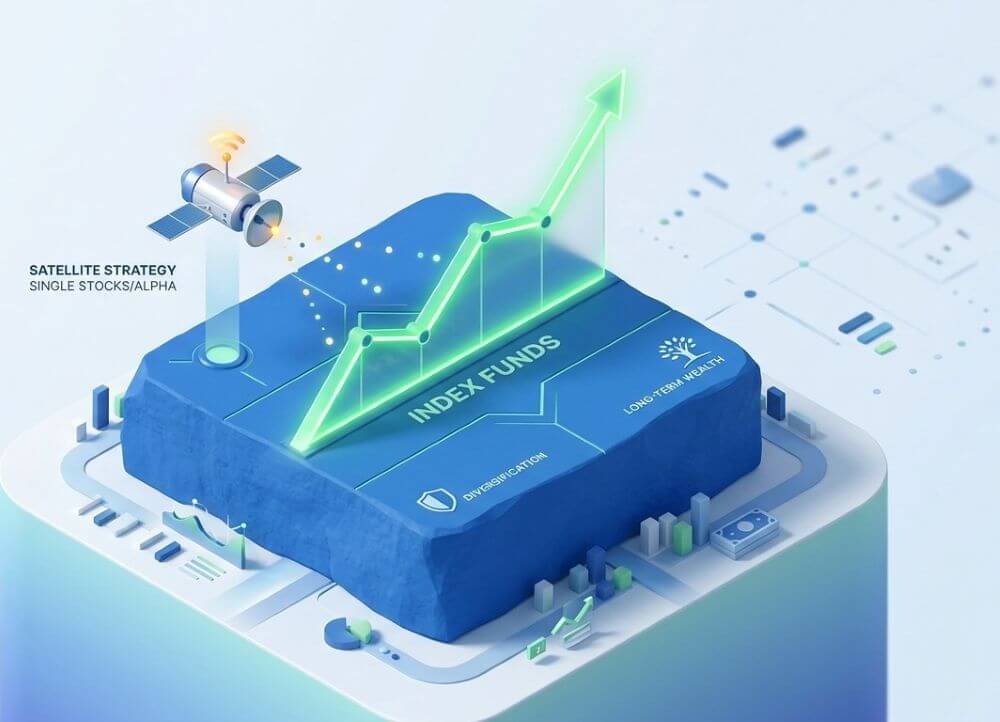
I will first find stocks to trade during the year 2027, and then invest a very small part of my portfolio, taking long or short position during the year.
The scenario that I expect is that I will earn less than the benchmark of S&P 500 if the market is up for 2027 or lose less than the S&P 500 if the market goes down.
It is a fun financial puzzle. But before diving into the mechanics, let me be clear about my overall strategy: This single-stock strategy represents a tiny fraction of my total investment portfolio.
Here is why I treat single-stock screening as a hobby, and why most everyday investors should stick to broad-market index funds.
1. Indexing Should Be the Foundation for Everyday Investors
For the vast majority of people building long-term wealth, broad-market index funds (such as low-cost S&P 500 or total market ETFs) are the most reliable, hands-off approach to growing capital.
- Built-in Diversification: Purchasing a broad index immediately distributes risk across hundreds of market leaders across all sectors.
- Self-Cleansing Mechanism: Index funds automatically phase out declining companies and increase allocation to growing ones over time without requiring active portfolio management.
- Consistent Long-Term Performance: Decades of market data demonstrate that passive broad market indexes outperform the majority of actively managed funds and individual stock pickers over long horizons, especially after factoring in management fees, taxes, and trading friction.
Trying to beat the market with individual stock picks introduces concentration risk and emotional stress that most investors simply do not need.
2. Why I Can Afford to Take This Risk
The only reason I allocate a small portion of capital to quantitative single-stock strategies is that my primary retirement plan is completely secured.
Because my core long-term financial goals and retirement needs are fully funded through safe, core holdings, I can treat this small side portfolio for what it is: an intellectual project and a speculative satellite strategy.
If this single-stock sub-portfolio outperforms, that is a welcome bonus. If it underperforms or experiences heightened volatility, it has zero impact on my lifestyle, security, or long-term financial health.
3. Characteristics of the stock
My initial pool of stocks will be the Nasdaq-100. There I can find fast growing companies with losts of volume and liquidity.
Some of ther characteristics that I will initially look for, but in the future I might change my mind are:
Step 1: Wall Street Consensus Upside
Filter the 100 components of the Nasdaq-100 for stocks where the average Wall Street analyst 12-month price target reflects significant upside ($\ge 20\%$), ensuring a minimum threshold of analyst coverage (e.g., at least 8–10 analysts) to avoid skewed estimates.
Step 2: High Fundamental Growth (EPS & Revenue)
Focus on underlying business growth. Filter for companies with consensus projected forward Earnings-Per-Share (EPS) growth of $\ge 20\%$ year-over-year and top-line revenue growth exceeding 15–20%.
Step 3: Valuation Efficiency (PEG Ratio)
Evaluate price relative to growth. A Price/Earnings-to-Growth (PEG) ratio close to or below 1.0 indicates that a high-growth company isn’t excessively overvalued relative to its expected earnings expansion.
Step 4: Technical Trend & Relative Momentum
Confirm institutional support using price action. Filter for companies trading above their 50-day and 200-day moving averages and demonstrating relative strength compared to the overall QQQ benchmark.
Final remark
If you are working toward retirement, stick to the time-tested foundation: low-cost, broad-market index funds. Treat individual stock picking as an optional, minor side project only when your primary financial future is already set in stone.
Pool of stocks to consider
Top 10 Holdings by Weight
The largest companies in the index command a significant portion of its total weight:
- Microsoft Corp. (MSFT)
- Apple Inc. (AAPL)
- NVIDIA Corp. (NVDA)
- Amazon.com Inc. (AMZN)
- Meta Platforms Inc. (META)
- Alphabet Inc. (GOOGL / GOOG)
- Tesla Inc. (TSLA)
- Broadcom Inc. (AVGO)
- Costco Wholesale Corp. (COST)
- Netflix Inc. (NFLX)
Major Nasdaq-100 Stocks by Sector
Information Technology
- Apple (AAPL)
- Microsoft (MSFT)
- NVIDIA (NVDA)
- Broadcom (AVGO)
- Adobe (ADBE)
- Advanced Micro Devices (AMD)
- Qualcomm (QCOM)
- Texas Instruments (TXN)
- Applied Materials (AMAT)
- Intel (INTC)
- Micron Technology (MU)
- Lam Research (LRCX)
- KLA Corp (KLAC)
- Analog Devices (ADI)
- Marvell Technology (MRVL)
- Microchip Technology (MCHP)
- GlobalFoundries (GFS)
- ON Semiconductor (ON)
- Skyworks Solutions (SWKS)
- CDW Corp (CDW)
- Zebra Technologies (ZBRA)
Communication Services
- Alphabet – Class A & C (GOOGL, GOOG)
- Meta Platforms (META)
- Netflix (NFLX)
- Comcast (CMCSA)
- Charter Communications (CHTR)
- T-Mobile US (TMUS)
- Electronic Arts (EA)
- The Trade Desk (TTD)
- Match Group (MTCH)
- Sirius XM Holdings (SIRI)
Consumer Discretionary
- Amazon.com (AMZN)
- Tesla (TSLA)
- Airbnb (ABNB)
- Booking Holdings (BKNG)
- Marriott International (MAR)
- Lululemon Athletica (LULU)
- O’Reilly Automotive (ORLY)
- Autozone (AZO)
- Monster Beverage (MNST)
- Ross Stores (ROST)
- Starbucks (SBUX)
- JD.com (JD)
- PDD Holdings (PDD)
- MercadoLibre (MELI)
- DoorDash (DASH)
- Trip.com Group (TCOM)
Consumer Staples
- Costco Wholesale (COST)
- PepsiCo (PEP)
- Mondelez International (MDLZ)
- Kraft Heinz (KHC)
- Keurig Dr Pepper (KDP)
- Walgreens Boots Alliance (WBA)
- Coca-Cola Europacific Partners (CCEP)
Health Care
- Amgen (AMGN)
- Gilead Sciences (GILD)
- Intuitive Surgical (ISRG)
- Regeneron Pharmaceuticals (REGN)
- Vertex Pharmaceuticals (VRTX)
- Moderna (MRNA)
- Illumina (ILMN)
- Biogen (BIIB)
- Align Technology (ALGN)
- IDEXX Laboratories (IDXX)
- DexCom (DXCM)
- Zimmer Biomet (ZBH)
Industrials & Business Services
- Honeywell International (HON)
- CSX Corp (CSX)
- PACCAR (PCAR)
- Old Dominion Freight Line (ODFL)
- Fastenal (FAST)
- Copart (CPRT)
- Cintas (CTAS)
- Air Products and Chemicals (APD)
- Expeditors International (EXPD)
- Verisk Analytics (VRSK)
Utilities & Energy
- Constellation Energy (CEG)
- Exelon (EXC)
- Xcel Energy (XEL)
- Baker Hughes (BKR)
Financials & Real Estate (Specialized Non-Banking)
Note: Traditional banks and financial institutions are excluded from the Nasdaq-100, but specialized financial services and fintech/real estate firms are included.
- Intuit (INTU) — Financial software
- Automatic Data Processing (ADP) — Payroll & HR services
- Paychex (PAYX) — Payroll services
- CoStar Group (CSGP) — Commercial real estate info
- PayPal Holdings (PYPL) — Digital payments
Leave a Reply