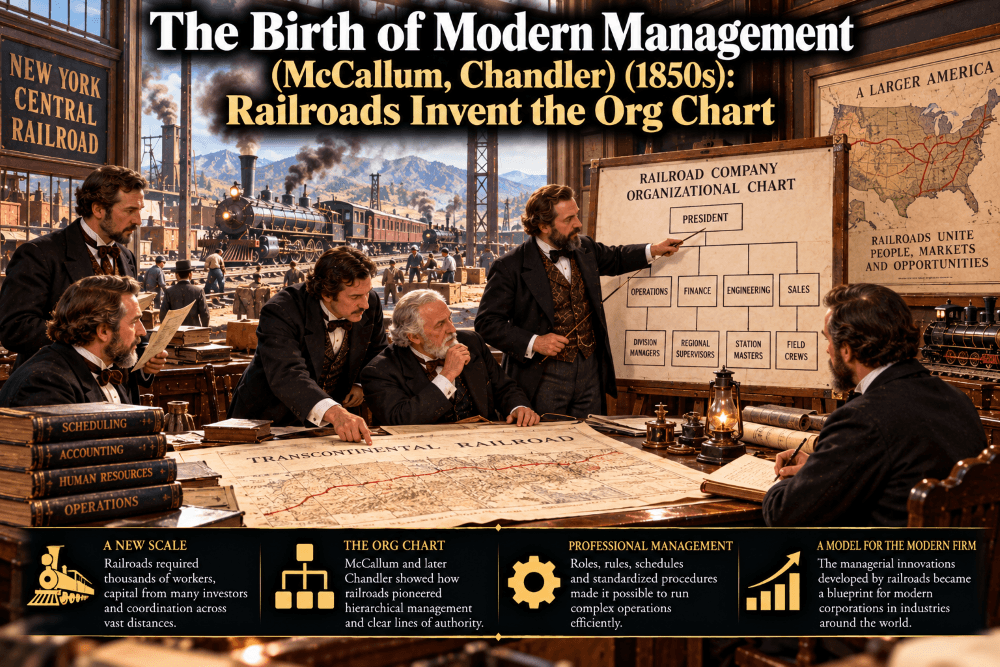
The birth of modern management didn’t happen in a boardroom or a business school. It happened on the Erie Railroad in the 1850s, when a railroad superintendent named Daniel McCallum (January 21, 1815 – December 27, 1878) faced a problem no business owner had really confronted before: an enterprise too large, too complex, and too geographically spread out for any single person to personally oversee. His solution became one of the most important, and least celebrated, innovations in business history.
Why Railroads Needed Something New
A Scale Never Seen Before
Railroads in the 1850s presented organizational challenges that earlier businesses simply hadn’t faced.
- A single railroad line could stretch hundreds of miles, employing workers scattered across dozens of stations, depots, and maintenance points.
- Operations required careful coordination of schedules, freight, safety, and equipment across this entire distributed network simultaneously.
- Earlier businesses, even large merchant operations and factories, rarely required this degree of coordination across such enormous physical distance.
Existing management approaches, often built around a single owner directly overseeing operations, simply couldn’t scale to meet these demands.
The Erie Railroad’s Breaking Point
Daniel McCallum became general superintendent of the Erie Railroad during a period when the company’s rapid growth had outpaced its organizational capacity to manage it effectively.
- The railroad was experiencing operational inefficiencies, accidents, and coordination failures tied directly to its sheer scale and complexity.
- Existing informal management practices, often based on personal relationships and direct oversight, broke down across such a large and dispersed operation.
- McCallum recognized that solving this problem required a fundamentally new approach to organizing authority, information, and responsibility.
Daniel McCallum’s Organizational Innovation
Creating the First Formal Org Chart
In 1854, Daniel McCallum developed what’s widely considered one of the first formal organizational charts in American business history.
- This diagram visually mapped out clear lines of authority and responsibility across the railroad’s various departments and divisions.
- It established defined reporting relationships, ensuring that every employee understood exactly who they answered to and what their specific responsibilities covered.
- This visual approach to organizational structure represented a genuinely new way of thinking about how a large enterprise should actually be organized.
Principles Behind the Structure
McCallum didn’t simply create a chart. He articulated broader management principles intended to address the railroad’s specific coordination challenges.
- He emphasized clear division of responsibility, ensuring accountability could be traced to specific individuals rather than remaining diffuse across the organization.
- He promoted systematic reporting, requiring regular data and information to flow upward through the organization so leadership could monitor operations across the entire network.
- He argued that a large, complex enterprise needed deliberate organizational design rather than simply scaling up informal practices that worked for smaller operations.
These principles directly addressed problems that railroads, more than almost any other business of the era, urgently needed to solve.
Data-Driven Oversight
McCallum’s approach also incorporated an early emphasis on using information systematically to manage operations.
- He implemented reporting systems that tracked performance data across different parts of the railroad network.
- This data allowed leadership to identify problems and inefficiencies that would have been invisible under less structured reporting practices.
- This emphasis on systematic information flow represented an important precursor to data-driven management practices that would become standard much later.
Alfred Chandler and Understanding the Larger Shift
The Historian Who Explained What Happened
Decades later, business historian Alfred Chandler (September 15, 1918 – May 9, 2007) studied this period extensively, helping later generations understand just how significant this organizational shift truly was.
- Chandler’s influential research examined how American businesses, particularly railroads, pioneered modern management hierarchies out of genuine operational necessity.
- He described this shift as part of the rise of what he termed managerial capitalism, where professional managers, rather than owners alone, increasingly directed complex business operations.
- His work helped establish railroads as the genuine birthplace of many organizational structures that later became standard across modern business.
The “Visible Hand” of Management
Chandler’s research is often associated with the concept of a “visible hand” guiding complex business coordination, a deliberate contrast to the traditional economic idea of markets being guided by an “invisible hand.”
- His analysis argued that as businesses grew larger and more complex, deliberate internal management coordination became just as important as external market forces in determining business success.
- This perspective helped reframe how historians and economists understood the growing role formal management would play throughout the following century.
- Chandler’s work remains foundational to understanding how the organizational innovations pioneered by figures like McCallum evolved into modern corporate management practice.
Why This Shift Mattered for Entrepreneurship
Management as Its Own Discipline
The developments pioneered on railroads like the Erie helped establish management itself as a distinct, serious business discipline rather than simply an extension of ownership.
- This shift recognized that running a large, complex organization required specific skills and systematic approaches distinct from the entrepreneurial skills needed to start a business.
- It helped create space for professional managers, people who hadn’t necessarily founded or owned a business, to take on significant organizational leadership roles.
- This distinction between founding a venture and managing its ongoing complexity remains highly relevant to how large organizations operate today.
A Template for Complex Organizations
The organizational principles developed during this period extended well beyond railroads into countless other industries as businesses grew larger and more complex.
- Clear reporting structures, defined responsibilities, and systematic information flow became standard practice across numerous industries throughout the following decades.
- This organizational template proved essential as manufacturing, retail, and eventually countless other sectors confronted similar scale and coordination challenges.
- The basic organizational logic pioneered by figures like McCallum remains recognizable within modern corporate structures today.
Lessons from the Birth of Modern Management
- Scale creates genuinely new problems. Railroads faced coordination challenges earlier businesses simply hadn’t encountered, requiring fundamentally new solutions.
- Clear structure enables accountability. McCallum’s org chart made responsibility traceable across a large, complex organization for the first time.
- Management itself became a discipline. This period helped establish that running a complex enterprise required distinct skills separate from the entrepreneurial act of founding one.
Frequently Asked Questions
Who created the first organizational chart? Daniel McCallum, superintendent of the Erie Railroad, developed one of the first widely recognized formal organizational charts in American business in 1854, mapping clear lines of authority and responsibility.
Why did railroads pioneer modern management practices? Railroads operated across enormous geographic distances with complex coordination needs that earlier businesses hadn’t faced, forcing the development of formal structures, reporting systems, and clear accountability.
Who was Alfred Chandler? Alfred Chandler was a business historian whose influential research, conducted decades after this period, analyzed how railroads and other large American businesses pioneered modern management hierarchies out of operational necessity.
What is meant by the “visible hand” in business history? This concept, associated with Chandler’s research, describes how deliberate internal management coordination became essential to large business success, contrasting with the traditional economic idea of markets guided purely by an “invisible hand.”
Related Articles
- Early Advertising: How Hype Became a Business Tool
- Singer Sewing Machine: Selling What No One Could Afford
- The Suez and Panama Canals: One Man, Two Fates
- Limited Liability: The Law That Democratized Business
- Wells Fargo: Banking Built on the Gold Rush
- Sam Brannan: California’s First Gold Rush Millionaire
- Levi Strauss: The Immigrant Who Invented Denim
About The History of Entrepreneurship
This article is part of The History of Entrepreneurship, an ongoing series exploring how entrepreneurs, civilizations, technologies, financial institutions, and business innovations gradually created the modern economy.
Leave a Reply