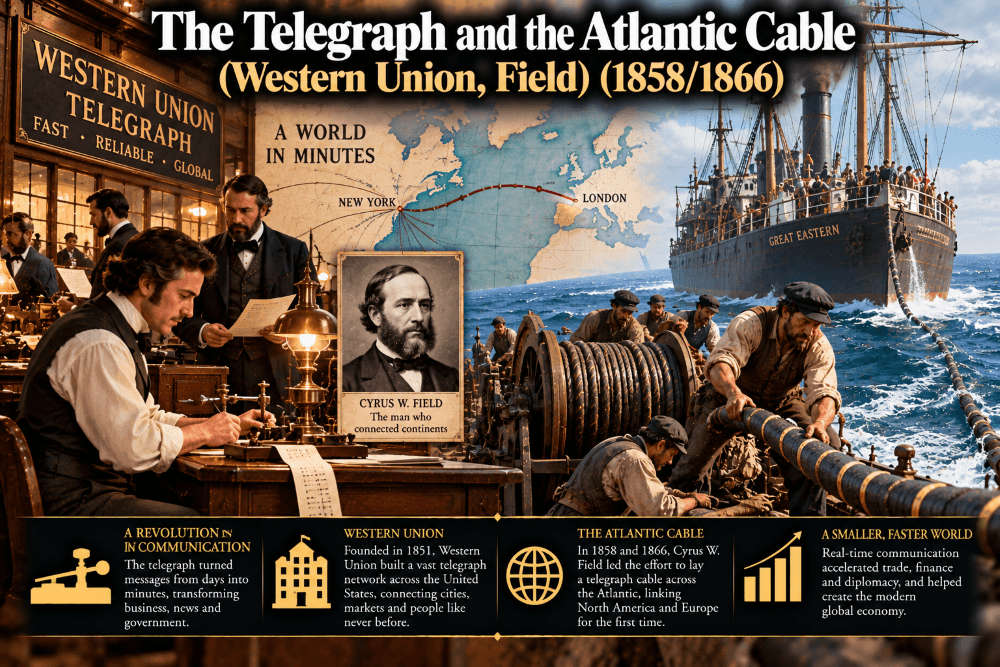
Before the Atlantic cable, a message sent from New York to London took roughly two weeks to arrive, carried by ship across the ocean. Cyrus Field spent over a decade, several fortunes, and endured repeated catastrophic failures trying to collapse that delay down to minutes. His story is as much about stubborn persistence through expensive failure as it is about the technology that finally connected two continents in real time.
Cyrus West Field was an American businessman and financier who, along with other entrepreneurs, created the Atlantic Telegraph Company and laid the first telegraph cable across the Atlantic Ocean in 1858.
The Problem the Atlantic Cable Needed to Solve
A World Still Limited by Ships
Before transatlantic telegraphy, communication between North America and Europe depended entirely on physical transportation.
- Letters and news traveled by ship, typically taking one to two weeks to cross the Atlantic depending on conditions.
- This delay created enormous friction for business, diplomacy, and virtually any activity requiring timely coordination between continents.
- Domestic telegraph networks had already proven telegraphy’s value on land, raising an obvious question: could the same technology bridge an ocean?
This gap between proven land-based telegraph success and the unproven challenge of an underwater transatlantic cable set the stage for one of the era’s most ambitious and risky ventures.
Cyrus Field and the Pursuit of a Transatlantic Connection
An Unlikely Champion
Cyrus Field was a successful paper merchant, not an engineer or telegraph specialist, when he became the driving entrepreneurial force behind the Atlantic cable project.
- He became convinced of the project’s feasibility and commercial importance after learning about the concept from engineers already exploring the idea.
- He took on the challenging task of raising substantial capital from investors in both the United States and Britain to fund the ambitious undertaking.
- His organizational and fundraising efforts, more than any personal technical expertise, became the driving force keeping the project moving forward through years of setbacks.
Repeated, Expensive Failures
The path toward a working Atlantic cable was marked by a painful string of costly failures before any lasting success was achieved.
- An 1857 attempt ended when the cable snapped and was lost at sea before the crossing could even be completed.
- A cable successfully laid in 1858 did briefly transmit messages between continents, generating enormous public celebration, but it failed entirely within weeks due to signal degradation and insulation problems.
- Further attempts throughout the 1860s faced significant technical setbacks, including a cable lost during a failed 1865 expedition.
Each failure represented not just a technical setback but a substantial financial loss, testing the patience of investors and Field’s own persistence.
Success in 1866
After years of costly failure, a new cable expedition in 1866 finally achieved lasting success.
- This cable used improved materials and manufacturing techniques developed from lessons learned during earlier failed attempts.
- It successfully established a reliable, lasting telegraph connection between North America and Europe.
- Remarkably, the expedition also managed to recover and complete the lost 1865 cable, effectively establishing two working transatlantic connections within the same year.
Messages that once took weeks to cross the ocean could now be transmitted in minutes, representing a genuinely historic communications breakthrough.
Western Union and the Domestic Telegraph Network
Consolidating a Fragmented Industry
While Cyrus Field pursued the transatlantic connection, a parallel transformation was occurring within America’s domestic telegraph industry through the rise of Western Union.
- Early domestic telegraph service had developed through numerous competing, often incompatible regional telegraph companies.
- Western Union grew by aggressively acquiring and consolidating many of these smaller, competing telegraph networks.
- This consolidation created a dominant national telegraph network capable of reliably connecting the growing domestic connections that the Atlantic cable would eventually link to Europe.
Building Toward a Connected World
Western Union’s domestic consolidation and the Atlantic cable’s international breakthrough represented complementary pieces of the same broader communications transformation.
- A reliable domestic network meant messages arriving via the Atlantic cable could be efficiently distributed throughout the United States.
- This combination of domestic consolidation and international connection helped establish telegraphy as genuinely global communication infrastructure.
- Western Union eventually became the dominant telegraph company in the United States, benefiting significantly from this broader expansion of telegraph infrastructure.
Why the Atlantic Cable Matters to Entrepreneurship History
Persistence Through Catastrophic Failure
Cyrus Field’s story stands out as a particularly extreme example of entrepreneurial persistence in the face of repeated, expensive failure.
- Multiple failed expeditions, representing substantial financial losses, didn’t deter Field from continuing to pursue the project.
- His ability to continue raising investor confidence despite repeated setbacks required genuine conviction and persuasive skill.
- This persistence ultimately paid off, but the story also illustrates the genuine financial risk involved in pursuing technically unproven, capital-intensive ventures.
Infrastructure as Competitive Advantage
The broader telegraph expansion, combining Western Union’s domestic consolidation with Field’s international breakthrough, demonstrates how communication infrastructure itself became a significant source of business advantage.
- Businesses with access to faster, more reliable information could make decisions, respond to markets, and coordinate operations far more effectively than competitors without this access.
- This infrastructure advantage extended well beyond the telegraph companies themselves, reshaping how commerce, journalism, and diplomacy operated more broadly.
- This pattern, infrastructure investment creating broad economic advantage beyond the infrastructure company itself, recurs throughout later communications technology history.
Lessons from the Atlantic Cable
- Persistence through failure can eventually pay off, but at real cost. Field’s repeated failures consumed years and substantial capital before success arrived.
- Infrastructure projects reshape entire industries. The Atlantic cable’s impact extended far beyond the telegraph business itself into global commerce and communication broadly.
- Consolidation can create reliable infrastructure. Western Union’s domestic network-building complemented Field’s international achievement, together enabling genuinely global communication.
Frequently Asked Questions
Who was responsible for the Atlantic cable? Cyrus Field was the primary entrepreneurial force behind the Atlantic cable project, raising investment capital and organizing the venture despite not being a telegraph engineer himself.
How many attempts did it take to successfully lay the Atlantic cable? Several attempts failed between 1857 and 1865 before a successful, lasting cable was established in 1866, following years of costly technical setbacks.
How long did transatlantic communication take before the cable existed? Messages typically took one to two weeks to cross the Atlantic by ship before the cable reduced this delay to just minutes.
What role did Western Union play in telegraph history? Western Union grew by consolidating numerous competing domestic telegraph companies, creating a dominant national network that complemented the Atlantic cable’s international connection.
Related Articles
- The Department Store: Retail’s Quiet Revolution
- The Birth of Modern Management: Railroads Invent the Org Chart
- Early Advertising: How Hype Became a Business Tool
- Singer Sewing Machine: Selling What No One Could Afford
- The Suez and Panama Canals: One Man, Two Fates
- Limited Liability: The Law That Democratized Business
- Wells Fargo: Banking Built on the Gold Rush
About The History of Entrepreneurship
This article is part of The History of Entrepreneurship, an ongoing series exploring how entrepreneurs, civilizations, technologies, financial institutions, and business innovations gradually created the modern economy.
Leave a Reply