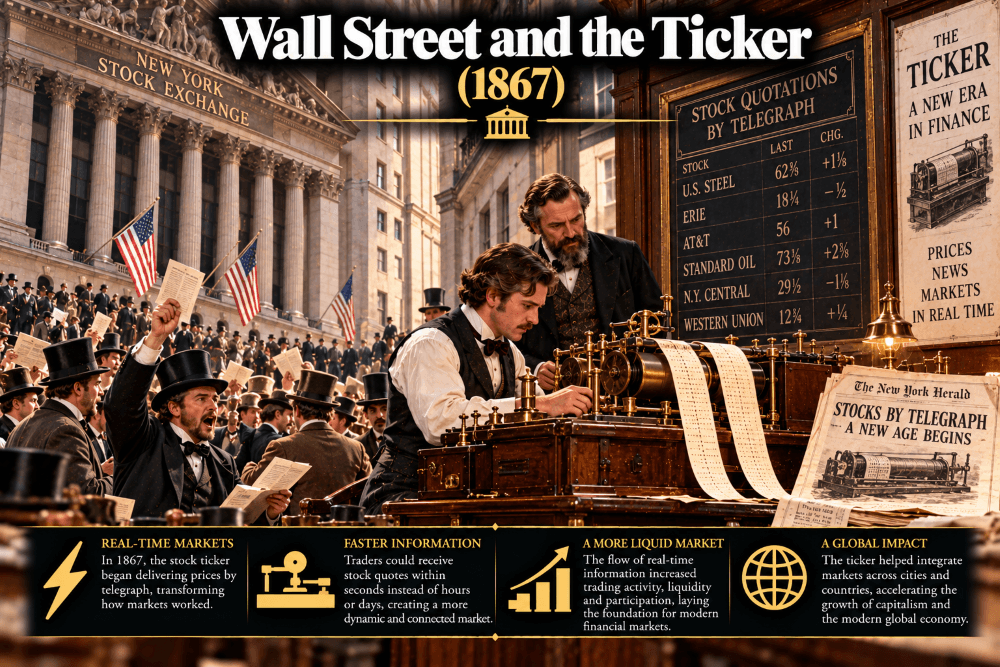
The story of Wall Street and the ticker begins with a simple problem. Before 1867, knowing a stock’s current price meant either standing on the exchange floor yourself or waiting for a runner to physically deliver that information to your office. The invention of the stock ticker collapsed that delay to nearly nothing, and in doing so, fundamentally changed who could participate in markets and how quickly information itself became a trading advantage.
The Problem Wall Street Faced Before the Ticker
Information Trapped on the Trading Floor
Before the stock ticker’s invention, price information generated on the New York Stock Exchange floor faced serious distribution challenges.
- Prices were determined through trading conducted in person on the exchange floor, visible only to those physically present.
- Brokers and firms located even a short distance away depended on messengers, often young boys working as runners, to physically carry price updates between the exchange and nearby offices.
- This delay meant that by the time price information reached someone outside the exchange floor, it could already be outdated.
This gap created genuine informational inequality: those physically present on the trading floor held a meaningful advantage over everyone else trying to trade based on current prices.
A Growing Need for Speed
As trading volume and the number of market participants grew throughout the 1860s, this information bottleneck became an increasingly serious operational problem.
- More brokers and investment firms needed reliable, timely access to accurate pricing information to conduct business effectively.
- The existing runner system struggled to scale alongside this growing demand for faster, more reliable information distribution.
- This mounting pressure created a clear business opportunity for anyone who could solve the problem of real-time price distribution.
Edward Calahan and the Birth of the Stock Ticker
A Telegraph-Based Solution
In 1867, Edward Calahan developed the stock ticker, an invention that directly applied existing telegraph technology to solve Wall Street’s information distribution problem.
- The device used telegraph signals to automatically print stock prices onto a continuous strip of paper tape, eliminating the need for a human messenger to physically carry information.
- This system allowed brokers’ offices to receive price updates almost immediately after trades occurred on the exchange floor.
- The device’s name came directly from the distinctive ticking sound it made while printing, a sound that became closely associated with Wall Street itself for generations afterward.
Expanding Access to Market Information
The ticker’s introduction significantly expanded who could access timely trading information.
- Brokerage firms throughout New York, and eventually across the country, could install ticker machines to receive live price updates.
- This access reduced the informational advantage previously held exclusively by those physically present on the exchange floor.
- It allowed a genuinely larger number of participants to engage in trading with confidence that their pricing information was current.
Thomas Edison’s Improvements
Refining the Technology
Just a couple of years after Calahan’s original invention, a young Thomas Edison made significant improvements to stock ticker technology.
- Edison developed an improved ticker design, known as the Universal Stock Ticker, which offered greater reliability and synchronization across multiple connected machines.
- This improved design helped standardize ticker technology, making it more practical to deploy at a larger commercial scale.
- Edison’s work on the ticker represented one of his early significant commercial successes, helping establish his broader reputation as an inventor capable of turning technical innovation into practical business value.
A Foundation for Edison’s Career
Edison’s success improving the stock ticker provided him with meaningful early capital and credibility that supported his later, even more significant inventive work.
- The financial proceeds from his ticker-related patents helped fund his subsequent research and invention activities.
- This early commercial success demonstrated Edison’s consistent pattern of identifying practical, profitable applications for emerging technology.
- It illustrates how infrastructure-level innovations, even relatively modest ones like ticker improvements, can provide crucial early momentum for a much larger inventive career.
Why the Stock Ticker Mattered for Wall Street
Democratizing Market Participation
The stock ticker’s most significant long-term impact was expanding meaningful market participation well beyond those physically present on the exchange floor.
- Brokers across the city, and eventually across the country, could trade with genuine confidence in their pricing information’s accuracy and timeliness.
- This expanded access helped fuel growing participation in American financial markets throughout the following decades.
- The ticker effectively extended the trading floor’s informational reach far beyond its physical walls.
Information Speed as Competitive Advantage
The stock ticker reinforced a pattern that appears repeatedly throughout financial history: access to faster, more reliable information consistently creates real competitive advantage.
- This dynamic echoes earlier financial innovations, including the information networks built by banking families and the broader communications infrastructure established through telegraph and cable systems during this same era.
- The ticker specifically applied this principle directly to securities trading, cementing information speed as a central competitive factor within financial markets.
- This fundamental dynamic, where faster information access creates trading advantage, continues to drive financial technology investment and innovation today.
Lessons from Wall Street and the Ticker
- Infrastructure gaps create genuine business opportunity. Calahan recognized that solving Wall Street’s information distribution problem had real commercial value.
- Improvement can be as valuable as original invention. Edison’s refinements made ticker technology significantly more commercially practical and reliable.
- Information speed remains a lasting competitive advantage. The ticker formalized a principle that continues shaping financial markets and technology investment today.
Frequently Asked Questions
Who invented the stock ticker? Edward Calahan invented the stock ticker in 1867, using telegraph technology to automatically print stock prices, allowing brokers outside the exchange floor to receive near real-time pricing information.
What role did Thomas Edison play in stock ticker history? Edison developed significant improvements to ticker technology shortly after its invention, creating the more reliable Universal Stock Ticker, an early commercial success that helped fund his later inventive career.
How did the stock ticker change Wall Street? It eliminated the need for runners physically carrying price information, allowing brokers throughout the city and eventually the country to access timely, accurate stock prices without being physically present on the exchange floor.
Why is the stock ticker considered historically significant? It demonstrated how information speed could become a genuine competitive advantage in financial markets, a principle that continues to drive financial technology development today.
Related Articles
- The Atlantic Cable: Cyrus Field’s Costly Persistence
- The Department Store: Retail’s Quiet Revolution
- The Birth of Modern Management: Railroads Invent the Org Chart
- Early Advertising: How Hype Became a Business Tool
- Singer Sewing Machine: Selling What No One Could Afford
- The Suez and Panama Canals: One Man, Two Fates
- Limited Liability: The Law That Democratized Business
About The History of Entrepreneurship
This article is part of The History of Entrepreneurship, an ongoing series exploring how entrepreneurs, civilizations, technologies, financial institutions, and business innovations gradually created the modern economy.
Leave a Reply