Monday | Technology stocks rebound, AI investors regain confidence, and major earnings approach
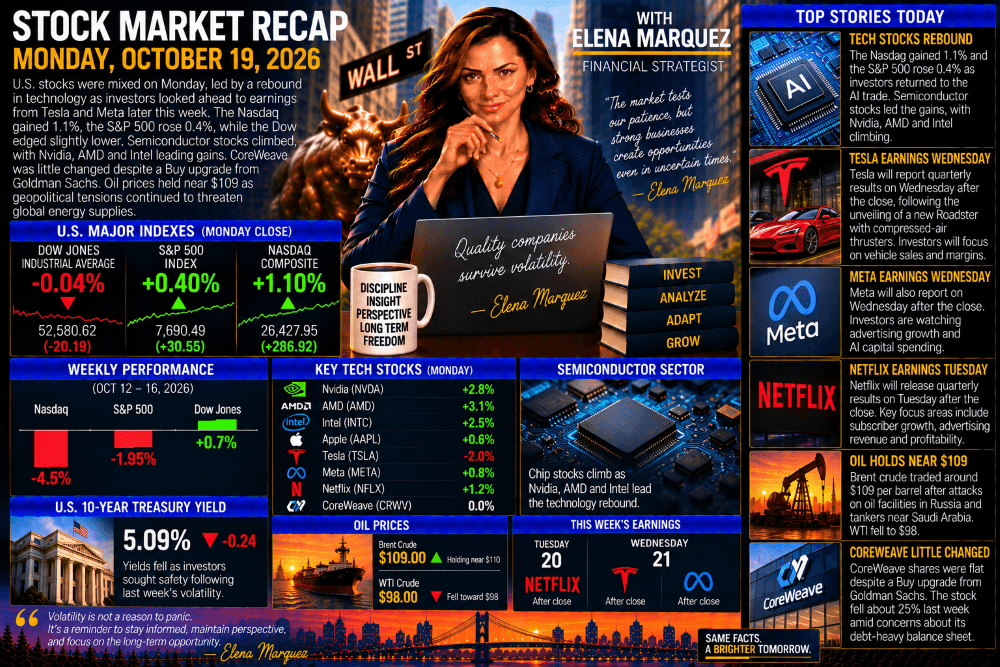
Wall Street started the week with a technology-led rebound as investors returned to artificial intelligence stocks following last week’s sharp selloff.
The Nasdaq Composite gained approximately 1.1%, while the S&P 500 advanced 0.4%. The Dow Jones Industrial Average finished slightly lower.
Semiconductor companies led the recovery, with Nvidia, AMD and Intel attracting renewed buying interest.
But the rally comes at a critical moment. Tesla, Netflix and Meta are preparing to release quarterly earnings, and investors want evidence that corporate profits can justify elevated technology valuations.
Meanwhile, oil prices remain near $109 per barrel as geopolitical tensions continue threatening global energy supplies.
The question for investors: Was last week’s AI selloff a temporary correction, or the beginning of a broader reassessment of technology valuations?
Market performance
Nasdaq
+1.1%
Monday, Oct. 19
S&P 500
+0.4%
Monday, Oct. 19
Dow Jones
Slight decline
Monday, Oct. 19
Approximate daily moves from the supplied market update.
1. Technology Stocks Lead the Recovery
Last week was particularly difficult for technology investors.
The Nasdaq lost approximately 4.5%, its worst weekly performance since late June, as concerns about inflation, interest rates and AI infrastructure debt triggered heavy selling.
Monday’s rebound suggests some investors believe the decline created buying opportunities.
The Nasdaq’s 1.1% advance significantly outpaced the broader market.
That is an encouraging development for technology investors, but one positive session doesn’t necessarily establish that the correction is over.
Markets often experience sharp rebounds during periods of elevated volatility.
The more important question is whether corporate earnings can support a sustained recovery.
2. Nvidia, AMD and Intel Lead Semiconductor Gains

Semiconductor stocks were among Monday’s strongest performers.
Nvidia, AMD and Intel climbed as investors returned to companies supplying the processors and computing infrastructure powering artificial intelligence.
The gains followed a difficult stretch for the sector, which had suffered from concerns about valuations and the enormous cost of building AI data centers.
The rebound is important because semiconductor companies sit at the center of the AI investment cycle.
Nvidia supplies advanced processors used to train and operate AI models.
AMD competes in processors and data-center computing.
Intel is working to strengthen its position in semiconductor manufacturing and advanced computing.
These companies have different business models and competitive positions, but all are influenced by expectations for technology investment.
Last week’s selling reflected concerns about whether AI infrastructure spending could continue growing at its current pace.
Monday’s rally suggests investors aren’t ready to abandon the sector.
The AI trade is becoming more volatile, but enthusiasm for its long-term potential remains strong.
3. CoreWeave Remains Under Scrutiny

CoreWeave, the Nvidia-backed AI cloud-computing company, was little changed Monday despite receiving a Buy upgrade from Goldman Sachs.
That muted reaction followed an extraordinary week in which CoreWeave shares lost approximately 25%.
CoreWeave has become one of the clearest examples of the financial risks associated with AI infrastructure.
The company rents powerful computing resources to AI developers.
Demand for those services has grown rapidly.
But building the infrastructure requires enormous capital expenditures.
CoreWeave must finance processors, data centers, networking equipment and electricity infrastructure before receiving the full benefit of future customer revenue.
Investors are concerned about the company’s substantial debt obligations and its ability to generate enough cash flow to support continued expansion.
Goldman Sachs’ upgrade suggests some analysts believe the stock’s recent decline has created an attractive opportunity.
But investors remain cautious.
A positive analyst recommendation doesn’t eliminate financing risks.
And Monday’s relatively flat performance indicates that confidence may take time to recover.
4. Tesla Earnings Could Test Investor Confidence

Tesla is scheduled to report quarterly earnings Wednesday after the market closes.
The results come shortly after the company unveiled an ambitious redesign of its Roadster sports car.
The announcement attracted attention because of claims that compressed-air thrusters could enable limited flight.
But investors will be looking beyond the excitement surrounding a new vehicle.
The financial questions are more important.
Can Tesla maintain its profit margins in an increasingly competitive electric vehicle market?
Are vehicle deliveries growing?
How much is the company spending on autonomous driving, robotics and other initiatives?
And when might those investments begin generating meaningful profits?
Tesla has long attracted investors willing to pay a premium for future growth.
But after last week’s technology selloff, markets may become less forgiving of disappointing earnings or overly ambitious forecasts.
5. Meta Faces Questions About AI Spending
Meta will also report quarterly results Wednesday after the closing bell.
The company has become one of the world’s largest investors in AI infrastructure.
It is spending heavily on data centers, computing equipment and advanced AI models.
Unlike some specialized AI infrastructure companies, Meta has a highly profitable advertising business that can help finance these investments.
That distinction is important.
Investors will be watching whether AI is improving advertising targeting, user engagement and revenue growth.
They will also examine Meta’s capital expenditure plans.
If spending continues rising rapidly, investors may demand clearer evidence that the investments are producing attractive returns.
Meta’s earnings could provide one of the week’s most important signals about the economics of AI.
6. Netflix Reports Tuesday
Netflix is scheduled to release quarterly earnings after Tuesday’s closing bell.
Investors will be watching revenue growth, advertising performance, subscription pricing and profitability.
Netflix provides a useful contrast to companies involved in AI infrastructure.
Its business is based primarily on delivering entertainment to paying customers and advertisers.
The company still invests heavily in content and technology, but its financial performance is less directly dependent on the expansion of AI data centers.
Strong results could help demonstrate that opportunities remain outside the semiconductor and AI infrastructure sectors.
7. Oil Holds Near $109
Brent crude
~$109
Per barrel
WTI crude
~$98
Per barrel

Oil prices remained elevated Monday amid continued geopolitical tensions.
Ukraine reportedly struck oil facilities in Russia, while tankers came under attack near Saudi Arabia.
Brent crude traded near $109 per barrel, while West Texas Intermediate fell toward $98.
These prices matter well beyond the energy sector.
Higher oil prices increase transportation and manufacturing costs.
They can also reduce household purchasing power by raising gasoline and heating expenses.
Most importantly for financial markets, sustained increases in energy prices can complicate the Federal Reserve’s efforts to bring inflation under control.
Last week’s hotter-than-expected inflation reports already raised concerns about additional interest-rate increases.
If oil prices remain elevated, those concerns may persist.
That creates a potential obstacle to a sustained technology rally.
8. This Week’s Earnings Calendar
TUE
20
Netflix (NFLX)
After market close — advertising, pricing and profitability
WED
21
Tesla (TSLA)
After market close — vehicle margins and future growth
WED
21
Meta Platforms (META)
After market close — advertising growth and AI capital spendingScheduled reporting dates from the supplied update; company announcements can change.
9. What I’m Watching Next
Three developments could determine whether Monday’s rebound continues.
Technology earnings: Tesla and Meta need to demonstrate that their businesses can support investor expectations. Meta’s AI spending guidance will be particularly important.
Semiconductor momentum: Nvidia, AMD and Intel rebounded Monday, but investors will want to see whether buying interest continues beyond a single session.
Oil and interest rates: Elevated energy prices could keep inflation expectations high, potentially limiting how much relief technology stocks receive from lower borrowing costs.
The interaction between these forces will likely shape market sentiment throughout the week.
The Bottom Line
| Indicator | October 19 |
|---|---|
| Nasdaq | Approximately +1.1% |
| S&P 500 | Approximately +0.4% |
| Dow Jones | Slightly negative |
| Nvidia, AMD, Intel | Higher |
| CoreWeave | Little changed |
| Brent crude | ~$109/barrel |
| WTI crude | ~$98/barrel |
| Netflix earnings | Tuesday, Oct. 20 |
| Tesla and Meta earnings | Wednesday, Oct. 21 |
Monday’s rebound was encouraging for technology investors following last week’s sharp losses.
But one positive session doesn’t resolve the questions surrounding AI infrastructure financing, high stock valuations and stubborn inflation.
The coming earnings reports will provide a better indication of whether corporate profits can support renewed optimism.
The market is willing to give the AI trade another chance. Now companies need to deliver the financial results to justify that confidence.
Other Stock Market blog posts
Leave a Reply