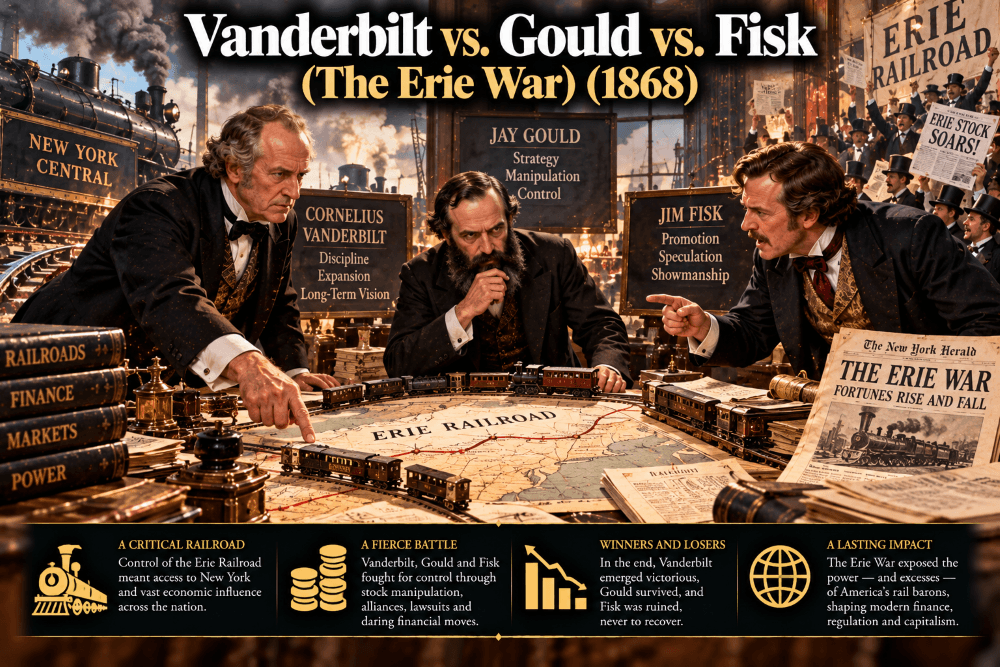
The Erie War of 1868 is one of the strangest corporate battles in American history. It featured a billionaire-equivalent tycoon trying to corner a railroad’s stock, a rival faction printing new shares to stop him, judges issuing dueling court orders, and company executives fleeing across the Hudson River with suitcases of cash. It also exposed just how thin the guardrails around American capitalism were in the Gilded Age.
The Stakes: Why the Erie Railroad Mattered
By the late 1860s, railroads were the backbone of the American economy, and control of key routes meant control over the flow of goods between the East Coast and the interior.
- Cornelius Vanderbilt had already built a commanding position in the New York Central Railroad, one of the era’s most important lines.
- The Erie Railroad was a major competitor, running a rival route connecting New York to the Great Lakes and the West.
- Vanderbilt saw a path to dominating the region’s rail traffic by gaining control of Erie as well.
For Vanderbilt, taking over Erie wasn’t merely a stock play. It was a way to eliminate a competitor and consolidate a regional monopoly.
The Players in the Erie War
Cornelius Vanderbilt
Vanderbilt, known as “the Commodore,” had built his fortune first in steamships and then in railroads.
- He was one of the wealthiest Americans of his time and was used to getting his way in business.
- His strategy was straightforward: buy enough Erie shares on the open market to take control of the company’s board.
- He expected that his financial muscle would make the outcome inevitable.
Daniel Drew, Jay Gould, and Jim Fisk
Opposing Vanderbilt was a faction inside Erie’s own leadership.
- Daniel Drew, a veteran speculator, served as Erie’s treasurer and had long used the company’s stock for his own trading purposes.
- Jay Gould, a sharp, secretive financier, joined the Erie board and became the faction’s strategic mind.
- Jim Fisk, a flamboyant showman and dealmaker, provided the public swagger and helped run the company’s operations.
Together, they were determined not to hand the railroad to Vanderbilt without a fight.
How the Erie War Unfolded
Printing Shares to Defeat a Takeover
The Erie faction’s central tactic was audacious and, by modern standards, plainly improper.
- Vanderbilt was buying up Erie stock, so the Erie leaders secretly issued large quantities of new shares by converting company bonds into stock.
- This flooded the market with additional shares, undermining Vanderbilt’s attempt to corner the supply and take control.
- Critics soon labeled the practice “stock watering,” since it diluted the value of existing shares.
Vanderbilt kept buying, unaware that the supply he was trying to absorb was effectively being manufactured behind his back.
Dueling Courts and a Dash to New Jersey
As the conflict escalated, it spilled out of the stock market and into the courtroom.
- Vanderbilt obtained court orders, including an injunction against the new share issuance and a warrant for the arrest of the Erie leaders.
- The Erie executives, warned of the arrest order, reportedly fled across the Hudson River to Jersey City, New Jersey, carrying a large sum of company cash with them.
- From a hotel there, they continued directing the fight outside the reach of New York authorities.
This episode became one of the most memorable images of the Gilded Age: railroad executives operating from hotel rooms in another state to dodge a court order.
Bribery in Albany
The fight then moved to the New York state capital.
- Jay Gould went to Albany to lobby legislators, reportedly with large sums of money.
- His goal was to push through a law that would legalize the Erie’s share issuance and shield the company from Vanderbilt’s legal attacks.
- Historians widely describe this as an episode of outright corruption, with both sides reportedly spending heavily to sway politicians.
The Outcome of the Erie War
A Settlement, Not a Clean Victory
The fighting eventually wound down in a negotiated settlement rather than a decisive win for either side.
- Vanderbilt, who had spent a fortune buying shares, ended up absorbing significant losses and reportedly decided it was cheaper to settle than to keep fighting.
- The Erie faction returned some funds, and Daniel Drew was pushed out of the company’s leadership.
- Gould and Fisk emerged in control of the Erie Railroad.
The war’s outcome was widely seen as a rare defeat for Vanderbilt, though he remained enormously wealthy.
The Aftermath for Gould and Fisk
The two men’s fortunes soon took different paths.
- Their control of Erie gave them power, but also drew increasing public and political scrutiny.
- In 1869, Gould and Fisk attempted a scheme to corner the gold market, which collapsed on a day known as Black Friday and ruined many investors.
- Fisk was shot and killed in 1872 by a rival in a dispute connected to a love triangle, ending his career abruptly.
Why the Erie War Matters to Business History
A Window Into an Unregulated Era
The Erie War shows what the business environment looked like when few rules governed corporate conduct.
- There were few effective securities laws, and share dilution, insider manipulation, and bribery went largely unpunished.
- Courts and legislatures were, in many cases, open to influence by well-funded parties.
- The public outcry that followed helped build momentum for later reforms in corporate governance and securities regulation.
Capital Versus Cleverness
The war also illustrates a recurring theme in business history: raw financial power does not always win.
- Vanderbilt had far more money, but his rivals used inside knowledge of the company’s mechanics to counter him.
- Control over how a company actually works can matter as much as owning its shares.
- This dynamic still echoes in modern takeover battles and shareholder disputes.
Lessons from the Erie War
- Rules matter. The Erie War was possible only because few rules existed to stop watering stock or bribing legislators.
- Insiders hold real advantages. Those who understand a company’s internal workings can outmaneuver those who simply own shares.
- Misconduct invites reform. Public disgust at episodes like this one helped fuel later efforts to regulate securities and corporate governance.
Frequently Asked Questions
What was the Erie War? It was a 1868 struggle over control of the Erie Railroad, in which Cornelius Vanderbilt tried to buy up the company’s shares while Daniel Drew, Jay Gould, and Jim Fisk issued new stock to block him.
How did Gould and Fisk defeat Vanderbilt’s takeover attempt? They issued large amounts of new shares by converting company bonds into stock, flooding the market and undermining Vanderbilt’s attempt to corner the supply.
Why did the Erie executives flee to New Jersey? After Vanderbilt obtained court orders, including an arrest warrant, the executives reportedly crossed the Hudson River to Jersey City to avoid New York authorities while continuing the fight.
Why is the Erie War historically significant? It exposed how weakly regulated corporate America was in the Gilded Age, with stock watering, bribery, and court manipulation going largely unchecked, and it contributed to later pressure for securities and governance reform.
Related Articles
- Wall Street and the Ticker: Speed Becomes the Edge
- The Atlantic Cable: Cyrus Field’s Costly Persistence
- The Department Store: Retail’s Quiet Revolution
- The Birth of Modern Management: Railroads Invent the Org Chart
- Early Advertising: How Hype Became a Business Tool
- Singer Sewing Machine: Selling What No One Could Afford
- The Suez and Panama Canals: One Man, Two Fates
About The History of Entrepreneurship
This article is part of The History of Entrepreneurship, an ongoing series exploring how entrepreneurs, civilizations, technologies, financial institutions, and business innovations gradually created the modern economy.
Leave a Reply