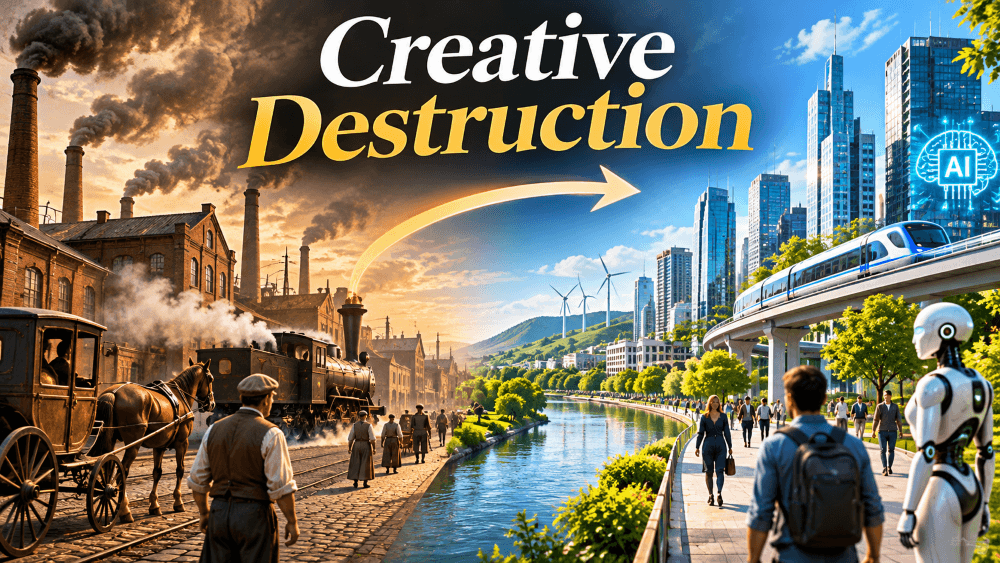
For most of human history, economic progress was painfully slow. Then, approximately 250 years ago, something extraordinary happened. Creative destruction, innovation, and the rise of modern capitalism helped transform humanity from a world of widespread poverty into one of unprecedented prosperity.
Today, we live longer, healthier, more comfortable lives than even the wealthiest kings could have imagined centuries ago.
Yet the economic system responsible for much of this progress is frequently criticized for one of its most important characteristics: its relentless tendency to destroy old ways of doing things.
This is the paradox of capitalism. To create a better future, we must be willing to let parts of the past disappear.
The Extraordinary Transformation of Human Life
For tens of thousands of years, Homo sapiens lived under conditions that the philosopher Thomas Hobbes famously characterized as “nasty, brutish, and short.”
Hobbes was describing life without political order, rather than providing a comprehensive account of prehistoric existence. Nevertheless, his phrase captures something important about the material insecurity that characterized much of human history.
Our ancestors struggled with disease, hunger, exposure to the elements, and the constant uncertainty of survival.
Agriculture, cities, writing, and trade brought important improvements. But for thousands of years, economic growth remained relatively slow, and most people lived close to subsistence.
Then, beginning in the late 18th century, the world experienced a remarkable transformation.
The Industrial Revolution began in Britain and spread through Europe, North America, and eventually much of the world.
Steam engines powered factories. Railroads connected distant markets. Scientific discoveries transformed medicine, agriculture, transportation, and communication.
Entrepreneurs developed new products, built businesses, and discovered more efficient ways to produce goods and services.
The results were extraordinary.
Over the following two centuries, average incomes increased dramatically, life expectancy rose, infant mortality declined, and billions of people gained access to goods and services that previous generations could scarcely imagine.
This transformation was neither immediate nor evenly distributed. Industrialization also brought dangerous working conditions, pollution, exploitation, and considerable social upheaval.
Nevertheless, the long-term improvement in material living standards represents one of the greatest transformations in human history.
What made this extraordinary progress possible?
Many forces contributed: scientific discovery, education, better institutions, public health, technological advances, and international trade.
But one of the most powerful engines was capitalism’s ability to encourage experimentation, competition, investment, and innovation.
And at the heart of that process lies an idea called creative destruction.
What Is Creative Destruction?
The Austrian-American economist Joseph Schumpeter popularized the concept of creative destruction in his influential 1942 book, Capitalism, Socialism and Democracy.
In Chapter 7, titled “The Process of Creative Destruction,” Schumpeter explained that capitalism is not a static economic system.
It is a dynamic process in which entrepreneurs constantly introduce new technologies, products, and business models that replace older ones.
Schumpeter described this process as:
“incessantly revolutionizes the economic structure from within”
This is the essence of creative destruction.
New businesses emerge. Existing businesses adapt or disappear. Entire industries are transformed.
The destruction is real, but so is the creation.
Consider a few historical examples.
The Automobile Replaced the Horse
At the beginning of the 20th century, millions of people depended on horses for transportation.
Entire industries supported this system: carriage manufacturers, blacksmiths, stable operators, and suppliers of horse feed.
Then automobiles arrived.
Companies such as Ford made cars increasingly affordable, and the automobile industry expanded rapidly.
Many horse-related businesses disappeared or became much smaller.
But entirely new industries emerged: automobile manufacturing, gasoline stations, mechanics, road construction, and eventually modern logistics.
The automobile did not simply replace the horse. It transformed the economy and expanded people’s possibilities.
Electricity Replaced Older Technologies
Before widespread electrification, factories relied heavily on steam engines and mechanical power systems.
Homes depended on candles, oil lamps, and gas lighting.
Electricity disrupted these industries.
But it also enabled refrigeration, electric appliances, telecommunications, modern manufacturing, and countless other innovations.
Today, we rarely think about the jobs lost in candle manufacturing.
We appreciate the extraordinary benefits of electricity.
The Internet Transformed Entire Industries
More recently, the internet disrupted newspapers, travel agencies, traditional retail stores, video rental businesses, and many other industries.
Companies such as Amazon, Google, and Netflix introduced new business models that transformed how people shop, communicate, work, and consume entertainment.
Some businesses disappeared.
Others adapted.
Entirely new industries emerged, creating opportunities that would have been difficult to imagine just a generation earlier.
This is creative destruction in action.
Why Creative Destruction Is Essential to Capitalism
One of capitalism’s defining strengths is its ability to encourage individuals to experiment with new ideas.
Entrepreneurs invest their time, money, and energy in creating something that consumers might find valuable.
Most ideas fail.
Some succeed.
A few transform entire industries.
When an entrepreneur develops a better product or a more efficient production method, consumers benefit through lower prices, improved quality, or entirely new possibilities.
Competitors must respond.
They can innovate, improve their products, reduce their costs, or risk losing customers.
This competitive pressure encourages continuous improvement.
Importantly, Schumpeter believed that capitalism’s most significant competition was not simply between businesses selling similar products.
It was competition from entirely new technologies and methods of production.
The automobile did not merely compete with a better horse carriage.
It made the horse carriage largely obsolete.
The smartphone did not simply improve the traditional telephone.
It combined communication, photography, navigation, entertainment, and computing into a single device.
Capitalism creates powerful incentives to challenge the status quo.
And challenging the status quo is often the first step toward improving it.
The Painful Side of Creative Destruction
Of course, creative destruction is not painless.
When an industry disappears, the people working in that industry do not automatically receive new jobs.
A factory worker who loses employment because of automation may not have the skills required to work in software development.
A small business owner whose customers migrate to online shopping may lose a business built over decades.
These losses are real.
It is easy to celebrate technological progress when we benefit from it.
It is considerably harder when our own livelihood is threatened.
This explains why creative destruction frequently encounters resistance.
Workers want to protect their jobs. Businesses want to protect their markets. Communities want to preserve the industries that sustain them.
These concerns deserve serious attention.
However, protecting every existing job or business indefinitely would come at an enormous economic cost.
Imagine if governments had prohibited automobiles to protect carriage manufacturers.
Or prevented electricity from spreading to protect candle makers.
Or restricted the internet to preserve traditional retail businesses.
We would have preserved some jobs temporarily, but at the cost of enormous improvements in productivity and living standards.
The challenge is not to eliminate economic change.
It is to help people adapt to it.
Education, retraining, geographic mobility, entrepreneurship, and effective social support can reduce the hardship associated with economic transitions.
A society can embrace innovation while recognizing its responsibility toward those who bear the costs.
Artificial Intelligence: The Next Great Wave of Creative Destruction
Today, we are witnessing another technological transformation.
Artificial intelligence has the potential to disrupt industries ranging from customer service and accounting to law, medicine, education, programming, and creative work.
Tasks that once required hours of human effort can increasingly be completed in minutes.
Some occupations will change dramatically.
Others may shrink or disappear.
New occupations and industries will emerge, although we cannot yet predict their scale or how quickly displaced workers will find new opportunities.
This uncertainty creates understandable anxiety.
But it also creates extraordinary possibilities.
Imagine a world where medical professionals use artificial intelligence to detect diseases earlier.
Where entrepreneurs can start businesses with fewer resources.
Where teachers can provide more personalized education.
Where scientific researchers can accelerate the discovery of new materials, medicines, and technologies.
Where small businesses can compete more effectively with large corporations.
Artificial intelligence could make many goods and services more affordable and accessible.
The potential gains are enormous, although they are not guaranteed.
Should We Resist Artificial Intelligence?
I believe resisting technological progress simply because it threatens existing jobs would be a mistake.
History demonstrates that technological innovation can generate tremendous improvements in living standards.
But history also teaches us that transitions can be difficult and that the benefits are not always distributed equally.
The right response is not to freeze the economy.
It is to create conditions in which innovation can flourish while individuals have opportunities to develop new skills and participate in the emerging economy.
Rather than asking how we can preserve every existing occupation, we should ask how we can prepare people for occupations and opportunities that do not yet exist.
That is a much more productive conversation.
Capitalism, Innovation, and Human Prosperity
Capitalism is not perfect.
Markets sometimes fail. Businesses can engage in anticompetitive behavior. Economic inequality can become excessive, and environmental damage can impose costs on society.
Nor can capitalism claim sole credit for humanity’s progress.
Public education, scientific research, sanitation, the rule of law, democratic institutions, and public health have also played essential roles.
Nevertheless, market economies have demonstrated a remarkable capacity to mobilize investment, coordinate economic activity, reward innovation, and improve productivity.
Countries that have combined competitive markets with effective institutions, education, infrastructure, and legal protections have often achieved substantial improvements in living standards.
I believe capitalism remains our most promising economic framework for encouraging the continuous innovation needed to improve human prosperity.
But successful capitalism requires more than simply allowing businesses to operate.
It requires competition, enforceable property rights, predictable laws, and institutions that prevent powerful interests from blocking new entrants.
Without genuine competition, established companies can become comfortable, inefficient, and resistant to change.
A healthy capitalist economy must remain open to newcomers who challenge existing businesses.
That is precisely what makes creative destruction so important.
The Greatest Danger Is Becoming Comfortable With the Status Quo
Human beings naturally become attached to familiar ways of doing things.
We develop skills, build careers, establish businesses, and organize our lives around existing technologies.
When something threatens those arrangements, our instinct is often to resist.
But economic progress requires us to accept that today’s successful methods may become tomorrow’s obsolete technologies.
The businesses that dominate today may disappear.
The most valuable professional skills may change.
Entire industries may emerge that we cannot currently imagine.
This uncertainty is uncomfortable.
But it is also the source of extraordinary opportunity.
A society that refuses to change risks stagnation.
A society that welcomes experimentation and innovation creates the possibility of continuous improvement.
Conclusion: We Should Embrace Creative Destruction
Two hundred and fifty years ago, most people could not have imagined the material comforts that ordinary citizens enjoy today.
Running water. Electricity. Refrigeration. Modern medicine. Affordable transportation. Instant communication. Access to almost unlimited information.
These achievements did not appear spontaneously.
They resulted from generations of scientists, inventors, entrepreneurs, investors, workers, and institutions willing to experiment with new ideas.
Many innovations replaced older technologies and disrupted established ways of life.
That process continues today.
Artificial intelligence will undoubtedly create difficult economic adjustments, just as previous technological revolutions did.
We should take those challenges seriously and help people navigate them.
But we should not confuse protecting people with protecting every existing business model.
The goal of an economy should not be to preserve yesterday’s jobs forever. It should be to improve human well-being and expand tomorrow’s opportunities.
That is why I believe we should embrace capitalism, encourage entrepreneurship, defend competition, and welcome creative destruction.
Our ancestors could scarcely have imagined the prosperity we enjoy today.
If we continue encouraging innovation, future generations may look back at our own living standards with the same sense of astonishment.
The future will not be created by preserving everything we have.
It will be created by discovering better ways to live.
Frequently Asked Questions About Creative Destruction
1. What is creative destruction in simple terms?
Creative destruction is the economic process through which new technologies, products, and business models replace older ones. It encourages innovation and productivity growth but can also eliminate existing jobs and businesses.
2. Who invented the concept of creative destruction?
Economist Joseph Schumpeter popularized the concept in his 1942 book Capitalism, Socialism and Democracy, particularly Chapter 7. The underlying idea that economic progress involves replacing older structures has earlier intellectual roots.
3. How does creative destruction benefit society?
Creative destruction can improve living standards by encouraging businesses to develop better products, lower costs, increase productivity, and create new industries. However, the benefits may take time to emerge, and displaced workers may need support during economic transitions.
4. Is artificial intelligence an example of creative destruction?
Yes. Artificial intelligence is a contemporary example because it can automate existing tasks, transform business models, and create new products and industries. Its ultimate effects on employment and prosperity will depend on technological development, business adoption, public policy, and how workers adapt.
Suggested sources and further reading
For additional credibility and useful outbound links in the published article:
- Capitalism, Socialism and Democracy — Joseph Schumpeter (1942), Chapter 7.
- Our World in Data — Economic Growth — Historical evidence on rising incomes and economic transformation.
- Our World in Data — Life Expectancy — Long-term improvements in human longevity.
- International Monetary Fund — Artificial Intelligence — Research on AI’s potential economic effects.
Leave a Reply