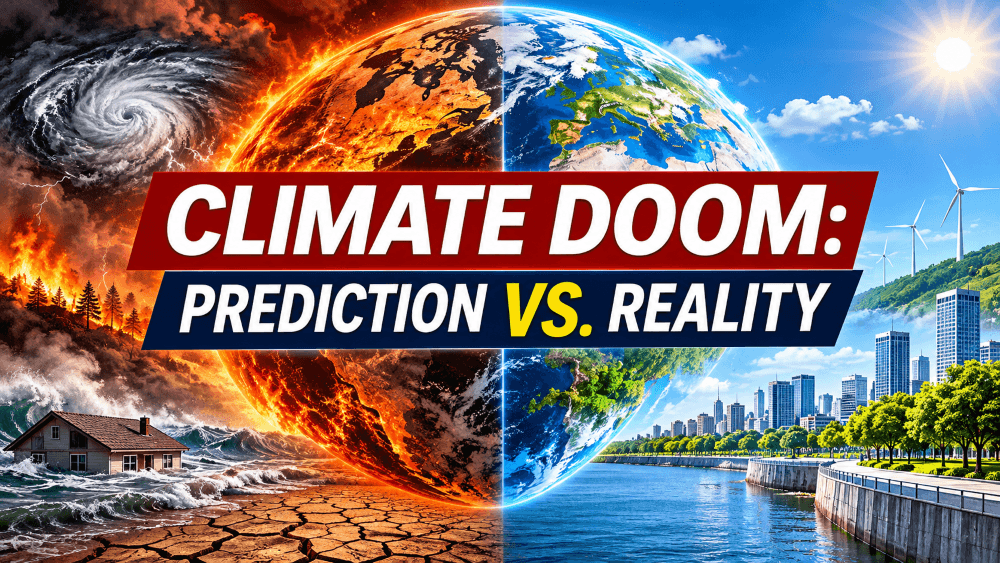
Twenty Years of Climate Catastrophe Predictions. Where Is the Apocalypse?
In 2006, former U.S. Vice President Al Gore released the documentary An Inconvenient Truth. It was an enormous success, winning two Academy Awards and bringing climate change into mainstream political conversation.
The movie featured dramatic graphics, scientific presentations, melting glaciers, rising oceans, and warnings about the consequences of humanity’s dependence on fossil fuels.
Twenty years later, I have a question: How much of the catastrophe we were warned about has actually materialized? NONE!
The planet has not warment. The Glaciesr are still there. Florida has not sunk. None of of the Al Gore and his hundreds of “experts” has materialized.
Have they come out and admit they were wrong. Of course not, they have extended the doom day.
So far we have not witnessed the collapse of human civilization, the disappearance of coastal cities, or the extinction of polar bears.
When politicians and environmental campaigners repeatedly present worst-case scenarios as near-certainties, frist of all, we should be skeptical and ask our selves the reason of their propaganda, and then hold them accountable for the accuracy of their claims.
Climate change is no real. It’s another income redistribution squeme.
1. Al Gore and the Business of Climate Alarm
Al Gore made millions of dollars with his movie, and he received plenty of additional benefits from the democratic party.
Audiences were shown enormous sea-level rises, devastating storms, and dramatic transformations of the planet.
One particularly memorable example involved the possibility of a roughly 20-foot rise in sea levels associated with major ice-sheet loss.
All his predictions were false.
Politicians, filmmakers, and journalists love to communicate catastrophic possibilities in order to gain more attention.
The result is that eventually some members of the public begin to see the lies and exagerations and lose complete trust on politicians and scientists.
Twenty years after An Inconvenient Truth, I believe we should evaluate climate messaging with the same skepticism we apply to financial forecasts, corporate promises, and political campaigns.
If a financial analyst repeatedly predicts an imminent stock market collapse that never occurs, investors eventually stop listening.
Why should climate campaigners be exempt from similar scrutiny?
2. Bernie Sanders and the Never-Ending Climate Deadline
Bernie Sanders and numerous other political figures have spent years describing climate change as an existential threat requiring immediate action.
The language frequently sounds familiar:
We have only a limited number of years to act. Failure to act now will create irreversible consequences. Future generations will suffer enormously.
Some of these statements refer to scientifically meaningful deadlines for limiting warming, rather than predictions that civilization will collapse on a specific date.
But political messaging often blurs that distinction.
In 2018, the Intergovernmental Panel on Climate Change discussed the need for rapid emissions reductions by 2030 to improve the chances of limiting warming to 1.5°C. That was a conditional emissions target, not a forecast that the world would end in 2030.
Nevertheless, I question whether repeatedly framing climate policy as an emergency encourages good decision-making.
Emergency rhetoric can make people more willing to accept enormous government expenditures without demanding rigorous cost-benefit analysis.
It can also discourage reasonable disagreement.
Someone who questions a particular environmental subsidy, regulation, or spending program should not automatically be accused of denying science.
Accepting climate science does not require accepting every climate policy.
3. The Economic Cost of Fighting Climate Change
Western governments have committed enormous sums of money to reducing greenhouse gas emissions.
Governments subsidize electric vehicles, renewable energy, battery manufacturing, energy-efficiency programs, and other initiatives.
Some of these investments produce valuable benefits. Others may be inefficient, excessively expensive, or poorly designed.
My concern is that the political conversation often emphasizes how much governments are spending rather than what taxpayers are receiving in return.
Consider the opportunity cost.
Money allocated to an expensive climate program cannot simultaneously be spent on healthcare, housing, education, infrastructure, or reducing public debt.
The relevant question is not whether reducing emissions is desirable.
It is whether a particular policy delivers enough environmental benefit to justify its economic cost.
For example, a program that costs billions while producing only a modest reduction in global temperatures should be compared with alternative uses of the same money.
4. China and India: The Global Emissions Dilemma
There is another uncomfortable reality.
While Western governments impose costly environmental regulations, China and India continue pursuing economic development, industrial expansion, and greater energy consumption.
According to the Global Carbon Budget, the approximate shares of worldwide fossil-fuel CO₂ emissions in 2024 were:
Share of Global Fossil CO₂ Emissions, 2024
Approximate percentage of worldwide emissions
| Region | Share of Global Emissions | Percent |
|---|---|---|
| China |
|
32% |
| United States |
|
13% |
| India |
|
8% |
| European Union |
|
6% |
Source: Global Carbon Budget 2025. Figures are approximate. Bar lengths are scaled relative to China’s 32% share. Selected regions only; percentages do not total 100%.
China alone accounts for approximately one-third of annual global fossil CO₂ emissions.
Does it make economic sense for Western countries to impose increasingly expensive restrictions on their industries while competing countries continue expanding their production? These restrictions in Europe and the U.S. cause unemployment, high cost of products such as carbon and still, and do nothing to reduce the emission of CO₂, because China and india will produce the same raw products and export them to the West.
This question deserves serious consideration.
Of course, the picture is more complicated. China is also a major manufacturer and installer of renewable-energy technologies, while Western countries have contributed disproportionately to historical accumulated emissions.
Nevertheless, the idea of climate is a global idea.
A policy that reduces emissions in one country while encouraging energy-intensive production to relocate elsewhere accomplish nothing more that lost of employment and economic growth in some countries, to give it to China.
The objective should be to reduce global emissions efficiently, not simply move them across national borders.
5. Population Decline: The Climate Factor We Rarely Discuss
One of the most interesting developments in global demographics is the rapid decline in fertility rates.
Countries throughout Europe and East Asia are experiencing birth rates below replacement levels. Many societies face aging populations, shrinking workforces, and eventual population decline.
The United Nations projected in 2024 that the world’s population would peak around the mid-2080s at approximately 10.3 billion people, before beginning a gradual decline.
This raises an important environmental question.
If human activity is the principal cause of anthropogenic climate change, shouldn’t declining population growth eventually reduce environmental pressure?
A child who is never born will never personally consume electricity, drive a car, purchase manufactured products, or produce household waste.
That is a simple observation, not an argument against having children.
Population growth, however, is only one part of the emissions equation. Energy sources, technology, consumption patterns, and economic development also matter enormously.
As populations get wealthier, they also figure out ways to produce fewer CO2 emissions. Our homes are more energy efficient. We drive Teslas and other Electric Vehicles. We use more solar panels and wind mills.
So negative population growth efficiency improvements makes the long-term environmental problem mute.
I believe demographic projections deserve a more prominent place in climate policy discussions.
We should also consider whether aggressive environmental policies such as carbon-taxes that raise housing, transportation, and energy costs could worsen the economic pressures facing young families by making every day living more expensive and by displacing jobs to China and India.
6. Bjørn Lomborg: Climate Change Is a Problem, Not the End of Civilization
One thinker whose arguments I find particularly persuasive is Bjørn Lomborg.
Lomborg is the author of The Skeptical Environmentalist and False Alarm.
His position is often misunderstood.
He does not argue that global warming is imaginary. He accepts that human activity contributes to climate change and that warming creates real costs.
Instead, he questions whether the most expensive and politically fashionable climate policies deliver sufficient benefits.
His approach can be summarized in five principles:
- Global warming is serious but does not necessarily threaten the survival of human civilization.
- Economic damages from climate change should be considered alongside future economic growth and adaptation.
- Climate policies should be evaluated according to measurable results, not good intentions.
- Humanity has become substantially more resilient to many natural disasters.
- Economic development and poverty reduction can protect people against climate-related dangers.
These principles seem reasonable to me.
They encourage us to think like economists rather than political activists.
Instead of asking how much money we can spend fighting climate change, we should ask how much benefit we can produce with each dollar.
7. Polar Bears: When the Popular Narrative Meets the Evidence


Polar bears have become one of the most recognizable symbols of climate change.
We have all seen photographs of polar bears standing on shrinking ice floes, accompanied by warnings that global warming threatens their survival.
But Lomborg raises an interesting challenge to the popular narrative.
In a 2019 interview, he cited estimates suggesting that the worldwide polar bear population had increased from approximately 5,000–10,000 in the 1960s to roughly 22,000–28,000.
He attributed much of the improvement to restrictions on hunting.
His argument is that if we care about the polar bear walfare, we should stop killing them.
There is an important qualification: historical global population estimates are highly uncertain, and comparisons with the 1960s do not establish a reliable worldwide population trend.
The IUCN Polar Bear Specialist Group’s published global estimate is approximately 22,000–31,000 bears, while its 2024 assessment shows considerable differences and data gaps among regional populations. Declining sea ice remains a recognized long-term threat.
Still, Lomborg’s broader question is worth asking.
Are we selecting environmental solutions because they are effective, or because they fit an emotionally compelling narrative?
Protecting wildlife requires understanding the specific threats facing individual species.
Sometimes the best solution may involve hunting restrictions, habitat protection, pollution control, or direct conservation programs.
Not every environmental problem has the same solution.
8. Natural Disasters: Are Things Really Getting Worse?
Every hurricane, flood, wildfire, or drought now seems to generate headlines connecting the event to climate change.
But we should distinguish between three different questions.
Is the physical frequency or intensity of certain extreme weather events changing? Are those events causing greater economic losses? And are humans becoming more or less vulnerable to them?
These questions do not necessarily have the same answer.
Some extremes, including heatwaves and heavy precipitation in many regions, have become more intense or frequent because of climate change.
Other trends, including certain regional flood and drought patterns, are more difficult to assess consistently.
Lomborg argues that the public often interprets increased disaster coverage as evidence that disasters themselves must be increasing.
He calls attention to what might be described as the CNN effect. And as we know CNN is a left wing news organization that promote everything that left wing politicians such as Bernie Sanders have to say.
A major storm that once received limited newspaper coverage can now dominate television broadcasts, social media feeds, and news websites around the world.
The same images may be repeated hundreds of times.
Greater media exposure does not necessarily mean greater underlying danger.
However, we should not use that observation to dismiss documented changes in extreme weather.
The proper response is to examine long-term data rather than rely exclusively on dramatic headlines.
9. The Remarkable Decline in Natural Disaster Deaths
One of Lomborg’s strongest arguments concerns humanity’s improving ability to survive natural disasters.
During his 2019 interview, he cited historical estimates suggesting that annual climate-related disaster deaths declined from approximately 500,000 in the 1920s to around 20,000 in more recent years.
Those figures depend on historical reporting methods and disaster classifications, so they should be treated as approximate rather than exact comparisons.
But the broader decline is supported by independent evidence.
The World Meteorological Organization reported that annual deaths from weather-, climate-, and water-related disasters declined from more than 50,000 in the 1970s to fewer than 20,000 in the 2010s.
Average Annual Weather-Related Disaster Deaths
Worldwide comparison: 1970s vs. 2010s
Source: World Meteorological Organization (WMO), Atlas of Mortality and Economic Losses from Weather, Climate and Water Extremes. Values are rounded thresholds, not exact decade averages. Bar lengths are illustrative.
Rounded reference thresholds: the actual reported values were above 50,000 and below 20,000, respectively.
This improvement is extraordinary, particularly considering the enormous increase in global population over the same period.
Why are fewer people dying?
Because humanity has become better at protecting itself.
Modern societies benefit from stronger buildings, better roads, improved weather forecasting, emergency communications, early-warning systems, and more effective disaster preparedness.
Economic development has also given more people access to safer housing, healthcare, transportation, and emergency services.
We should celebrate this achievement.
The decline in mortality demonstrates something enormously important:
Human beings are not passive victims of their environment. We adapt, innovate, and become more resilient.
10. Poverty Is Often More Dangerous Than Climate Change
Imagine a powerful hurricane striking two locations.
One is a wealthy American community with reinforced buildings, emergency shelters, sophisticated weather forecasts, insurance, hospitals, and reliable communications.
The other is an impoverished coastal community with fragile housing, limited infrastructure, and inadequate emergency services.
Even if both locations experience similar weather conditions, the human consequences can be dramatically different.
The difference is economic development.
A wealthy society has more resources to prepare for disasters and recover afterward.
A poor society may experience devastating losses from events that a wealthy society can withstand.
This is why I find Lomborg’s emphasis on poverty reduction particularly compelling.
If we genuinely care about protecting vulnerable populations, shouldn’t economic development be one of our highest priorities?
Providing affordable electricity, clean drinking water, reliable infrastructure, better healthcare, and access to education can improve millions of lives.
These investments can also help communities adapt to climate change.
A policy that makes energy unnecessarily expensive for poor populations (like carbon taxes) could impose immediate hardships, even if its long-term environmental intentions are admirable.
We should evaluate both sides of that equation.
11. The Opportunity Cost of Climate Policies
Economics teaches us that resources are scarce.
Every dollar spent on one objective is a dollar unavailable for something else.
Suppose a government has $10 billion to spend.
It could invest in emissions reductions, flood protection, public transportation, healthcare, education, poverty reduction, or scientific research.
Which investment would generate the greatest improvement in human well-being?
The answer requires evidence, not slogans.
Some climate investments may be extremely cost-effective. Others may offer limited benefits at enormous expense.
For example, reducing methane leaks, improving energy efficiency, investing in advanced nuclear technology, and developing cheaper clean energy could offer meaningful benefits.
Adaptation investments such as flood defenses, improved drainage systems, wildfire management, and heat-resistant infrastructure may also protect people directly.
The point is not that governments should abandon climate action.
The point is that climate spending should compete with other public priorities on the basis of measurable costs and benefits.
That is not climate denial.
It is responsible economic thinking.
12. The Danger of Treating Climate Change as a Religion
One of my greatest concerns is the way climate change has become a subject on which disagreement is sometimes treated as a moral failure.
Question a climate subsidy, and you may be accused of not caring about the planet.
Challenge an expensive regulation, and you may be accused of putting corporate profits ahead of human lives.
Ask whether an environmental forecast was exaggerated, and someone may label you a climate denier.
This approach discourages healthy debate.
Science advances through observation, evidence, criticism, and revision.
Economics advances through comparing alternatives and recognizing tradeoffs.
Neither discipline benefits when political rhetoric replaces careful analysis.
I do not need to believe that climate change is harmless to question whether a particular politician’s proposed solution is worthwhile.
Likewise, I do not need to believe that every alarming forecast will materialize to support sensible environmental protection.
We should be able to acknowledge the reality of climate change while questioning the credibility of those who continually present the worst possible outcomes as inevitable.
When Climate Activism Turns Into Destruction and Disruption
Another troubling aspect of the climate debate is the increasingly confrontational tactics adopted by some environmental activists. In recent years, protesters have thrown soup at protected paintings in museums, glued themselves to famous works of art, blocked major highways, disrupted traffic in busy cities, and targeted private property through vandalism and sabotage.
These actions have imposed real costs on ordinary citizens, businesses, museums, and public services. People trying to get to work, attend medical appointments, or simply go about their daily lives have found themselves caught in demonstrations they never agreed to participate in.
Activists argue that such disruption is necessary to draw attention to an urgent environmental crisis, but I question whether creating chaos is an effective way to build public support. There is an important distinction between peaceful protest, civil disobedience, and the deliberate destruction of property.
A movement that claims to be protecting humanity’s future should be prepared to explain why its methods sometimes impose immediate harm on the very people it hopes to persuade. If climate activists want the public to take their message seriously, they should recognize that the methods they choose can undermine the credibility of their cause.
13. What Would a More Rational Climate Policy Look Like?
I would prefer governments to adopt a more pragmatic approach to climate change.
Rather than focusing primarily on ambitious political declarations, they should emphasize policies that produce measurable improvements in human welfare.
That means prioritizing affordable and reliable energy, technological innovation, efficient emissions reductions, climate adaptation, and economic development.
It also means recognizing that different countries face different economic circumstances.
A wealthy European country and a poor developing nation cannot reasonably be expected to pursue identical energy policies.
The world’s poorest populations deserve the opportunity to improve their living standards.
At the same time, wealthier societies should continue developing cleaner technologies that become attractive because they are affordable and effective, not simply because governments mandate them.
Perhaps most importantly, policymakers should communicate uncertainty honestly.
If a prediction represents a worst-case scenario, say so.
If a climate target depends on numerous assumptions, explain them.
If a government program will have only a small effect on global temperatures, disclose that effect alongside its cost.
Citizens deserve transparency.
Conclusion: Climate Change Deserves Serious Thinking, Not Endless Panic
Twenty years after An Inconvenient Truth, I am not convinced that the constant rhetoric of imminent catastrophe has served society particularly well.
Humanity has become wealthier, healthier, more technologically advanced, and better equipped to protect itself against many natural hazards.
We should not ignore that progress.
I believe Bjørn Lomborg makes an important contribution to this debate by reminding us that environmental problems are also economic problems.
Resources are limited. Tradeoffs are unavoidable. Good intentions do not guarantee good results.
We should also remember that future generations will inherit more than a changing climate.
They will inherit the technologies we develop, the infrastructure we build, the economic opportunities we create, and the public debts we accumulate.
Our responsibility is to leave them a world that is both environmentally sustainable and economically prosperous.
The real question is not whether we should do something about climate change.
The real question is whether we are doing the right things, at the right cost, for the right reasons.
And after two decades of apocalyptic political rhetoric, I believe it is reasonable to demand better answers.
Sources and further reading
- IPCC — Sixth Assessment Report: Climate Change 2023
- World Meteorological Organization — Disaster Mortality and Economic Losses
- IUCN Polar Bear Specialist Group — Population Status
- United Nations — World Population Projections
- Global Carbon Budget 2025 — Fossil CO₂ Emissions
Leave a Reply