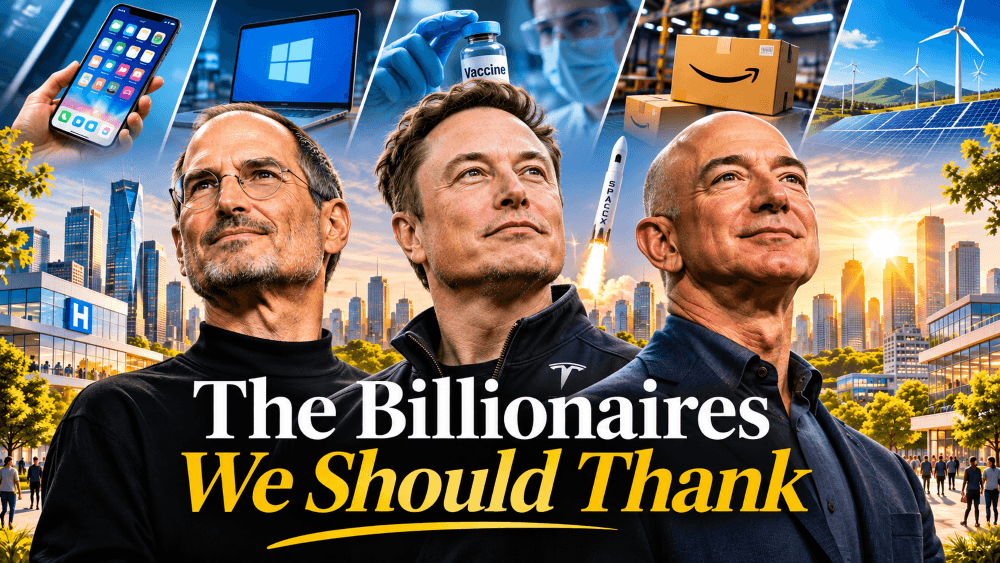
Why attacking the wealthy might make all of us poorer
There is a popular political slogan that goes something like this:
“Every billionaire is a policy failure.”
Politicians such as Bernie Sanders and Alexandria Ocasio-Cortez have helped popularize the idea that nobody should possess a billion dollars while others struggle to pay their bills.
It is an emotionally powerful argument. After all, why should one person have enough money to buy private jets, yachts, and mansions while another person struggles to afford groceries?
But I believe this argument misunderstands how wealth is created.
More importantly, it ignores something fundamental about our modern economy:
We owe an enormous amount of our prosperity to the entrepreneurs who became billionaires.
Instead of resenting their success, perhaps we should spend more time appreciating what they have contributed to our lives.
Billionaires Didn’t Become Rich by Taking Money From Us
One of the most persistent misconceptions about wealth is that the economy is a zero-sum game.
If someone becomes a billion dollars richer, the assumption is that everyone else must somehow become a billion dollars poorer.
But that’s not how a market economy works.
Consider Jeff Bezos.
Before Amazon existed, buying a book often meant traveling to a bookstore, hoping the book was in stock, and paying whatever price the store charged.
Today, we can order practically any book imaginable and have it delivered to our doorstep. We can also purchase millions of other products, compare prices, read customer reviews, and enjoy conveniences that would have been unimaginable a few decades ago.
Jeff Bezos became extraordinarily wealthy because millions of customers voluntarily chose to use the services his company created.
Nobody forced us to shop at Amazon.
We did it because Amazon made our lives easier.
And Bezos became wealthy because he owned a significant share of the company that delivered that value.
Now consider Steve Jobs.
Before the iPhone, we carried separate devices for making calls, taking photographs, listening to music, navigating unfamiliar cities, and accessing the internet.
Today, all those capabilities fit into our pockets.
Apple’s success generated enormous wealth for its shareholders, but it also transformed the daily lives of billions of people.
Or consider Bill Gates.
Microsoft helped make personal computing accessible to businesses and households around the world. Its software contributed to enormous improvements in productivity, communication, and information management.
Gates became one of the richest people in history.
But how much economic value did Microsoft create for the rest of us?
Almost certainly far more than the fortune Gates accumulated.
The important question isn’t how much money an entrepreneur has made. It’s how much value that entrepreneur has created for society.
The Billionaire Gets a Small Slice of the Value Created
Economist William Nordhaus, a Nobel Prize winner, studied how much of the economic value generated by technological innovation is captured by the innovators themselves.
His research estimated that innovators captured approximately 2.2% of the total social returns from technological advances in the American nonfarm economy over the period he examined.
Think about that.
For every $100 of social value generated by innovation, the innovator captured only about $2.20, according to that estimate.
The remaining benefits flowed to consumers, workers, and other businesses.
This doesn’t mean every billionaire captures exactly 2.2% of the value they create. Nordhaus was studying a particular historical period and a broad category of innovation.
Nevertheless, the underlying lesson is powerful.
Successful entrepreneurs can generate benefits for society that greatly exceed their personal fortunes.
When someone invents a better product, creates a more efficient distribution system, or develops a life-saving technology, the benefits can spread throughout the economy.
Customers enjoy better products.
Workers receive salaries.
Suppliers gain new business opportunities.
Governments collect taxes.
Other entrepreneurs build businesses on top of the original innovation.
And society becomes wealthier.
A billionaire’s fortune is not necessarily a measure of what society has lost. It can be evidence of the enormous value society has gained.
Why Are There So Many Billionaires Today?
Another argument against billionaires is that their growing numbers demonstrate something fundamentally wrong with capitalism.
But there is a simpler explanation.
The world has become a much larger marketplace.
Two hundred years ago, an entrepreneur might have served a few thousand customers in a particular city.
A century ago, a successful industrialist might have reached millions of customers across a country.
Today, a software entrepreneur can reach billions of people around the world.
Digital technology, globalization, modern transportation, and population growth have dramatically expanded the scale of business.
Imagine developing a product that generates just $10 of annual profit from each of 100 million customers.
That’s $1 billion in annual profit.
If you own a significant share of that business, becoming a billionaire is hardly surprising.
It doesn’t necessarily mean you cheated anyone.
It might simply mean you created something useful for an extraordinarily large number of people.
The billion-dollar threshold is arbitrary. There is no compelling economic reason why a fortune of $999 million should be acceptable while a fortune of $1.001 billion should suddenly become a moral problem.
Not All Billionaires Are Created Equal
Of course, defending billionaires doesn’t mean defending every billionaire.
There are important differences in how people accumulate enormous fortunes.
I would divide billionaires into four broad categories.
1. The Value Creators
These are entrepreneurs who become wealthy by creating products and services that people voluntarily purchase.
Think of entrepreneurs who develop new medicines, improve transportation, build useful software, or make clean energy more affordable.
Consider the founders of BioNTech, whose company helped develop one of the world’s first widely deployed mRNA COVID-19 vaccines.
Their work contributed to saving lives and advancing medical technology.
If the people behind such innovations become extraordinarily wealthy, should we consider that a failure of public policy?
I would argue the opposite.
We should want a society where solving enormous problems can produce enormous rewards.
Those rewards encourage talented people to take risks, invest capital, and pursue ideas that might otherwise never materialize.
2. The Inheritors
Some billionaires inherit their fortunes or became billionaires by diversion their wealthy husband. Examples are
They didn’t necessarily create the original wealth, but inheriting a successful business isn’t automatically harmful.
An inherited company might continue employing thousands of workers, producing valuable goods, and investing in new technologies.
Of course, inherited wealth raises legitimate questions about equality of opportunity and taxation.
But simply inheriting wealth doesn’t make someone an enemy of society.
The important question is whether that wealth continues to be used productively.
3. The Dovorcee from a Billionaire
Another distinct category of billionaire women acquired their massive wealth through high-profile divorce settlements from tech titans. A prominent example is MacKenzie Scott, who became one of the world’s richest women following her 2019 divorce from Amazon founder Jeff Bezos. As part of their settlement, she received a 25% share of the couple’s Amazon stock, which was valued at roughly $38 billion at the time.
Similarly, Melinda French Gates joined the rank of independent multi-billionaires after her 2021 divorce from Microsoft co-founder Bill Gates, securing billions in stock transfers alongside a multi-billion-dollar settlement to fund her independent philanthropic pursuits.
While these high-value settlements reflect the legal division of immense joint marital assets built over decades, they catapulted these women directly into the upper echelons of global wealth overnight, transforming them into some of the world’s most influential mega-donors.
3. The Rent Seekers
This is the category that deserves much more scrutiny.
Some people become extraordinarily wealthy not by creating value, but by obtaining special privileges from governments, restricting competition, exploiting political connections, or securing monopolistic advantages.
These fortunes may come from exclusive licenses, government favoritism, corruption, or regulations designed to protect established businesses from competition.
Here, I agree with critics of extreme wealth.
When people become rich by manipulating political power rather than serving customers, society has a legitimate problem.
But notice the distinction.
The problem isn’t that someone became a billionaire. The problem is how that person became a billionaire.
And that distinction should guide public policy.
Most Billionaires Built Their Fortunes
According to UBS’s 2025 billionaire research, roughly 70% of the 2,919 billionaires it tracked were classified as self-made.
That doesn’t mean every one of them started from poverty or succeeded without advantages.
Nor does it mean that all their business practices were admirable.
But it does challenge the popular image of billionaires as people who simply inherited vast fortunes and spent their lives collecting dividends.
Many built, expanded, or transformed businesses.
They took risks.
They invested capital.
They hired employees.
They competed against other businesses.
And in many cases, they spent years building companies before becoming extraordinarily wealthy.
There is something deeply misguided about treating this process as inherently harmful.
If a person creates a company that millions of customers love, employs thousands of people, and generates billions of dollars in economic activity, why should society regard that person’s financial success as a failure?
The Politics of Envy
So why do politicians spend so much time attacking billionaires?
I believe part of the answer is political incentives.
It is much easier to gain attention by pointing at someone who has more money than everyone else and declaring that the situation is unfair.
Envy is a powerful emotion.
And politicians know how to exploit it.
A politician who promises to punish billionaires can present himself as a defender of ordinary people.
But making the wealthy poorer doesn’t automatically make everyone else richer.
Suppose the government introduces a tax that reduces an entrepreneur’s fortune by several billion dollars.
Have we created a single new product?
Have we increased productivity?
Have we built another factory?
Have we discovered a new medicine?
Not necessarily.
Suppose a politician taxes $500 from a billionaire and give $100 to five people. That politician lost to vote of the billionaire, but gained the vote of five more people. Politically, it pays to take from billionaires, but as a society, we lose all.
The government may collect additional revenue and use it for valuable public services. That possibility deserves consideration.
But taxation also creates incentives, costs, and trade-offs.
If the policy discourages investment, entrepreneurship, or innovation, society may ultimately lose more than it gains.
And if the money is spent inefficiently, the promised benefits may never materialize.
A society should measure its success by how much opportunity and prosperity it creates, not by how effectively it reduces the fortunes of its richest citizens.
There is a big difference between wanting to eliminate poverty and wanting to eliminate billionaires.
The first is a worthy objective.
The second is not a substitute for the first.
The Hidden Problem With Wealth Taxes
One increasingly popular proposal is to impose annual or one-time taxes on billionaire wealth.
At first glance, this sounds simple.
If someone has $10 billion, why not take a small percentage each year?
But billionaire wealth is rarely sitting in a bank account.
Most of it consists of ownership stakes in businesses.
Jeff Bezos’s wealth, for example, has historically been tied largely to Amazon shares.
The same principle applies to founders of private companies whose businesses may be worth billions on paper but generate relatively little cash.
A wealth tax can force owners to sell shares, borrow money, or transfer ownership simply to pay a tax on assets they haven’t sold.
That can create difficulties, especially for privately held companies.
It can also encourage wealthy individuals to relocate their capital or tax residence, depending on the rules.
None of this proves that every wealth tax is economically disastrous. The consequences depend on how the tax is designed, enforced, and coordinated internationally.
But it does mean that taxing fortunes is much more complicated than political slogans suggest.
We should be particularly careful about policies that might discourage the next generation of entrepreneurs from building valuable companies.
The billionaire of tomorrow might be the person who develops a cure for a devastating disease, creates affordable clean energy, or invents a technology we cannot yet imagine.
Why would we want to make that person’s success less attractive?
Billionaires Are Not Above Criticism
None of this means billionaires deserve special treatment.
They should pay the taxes they legally owe.
They should compete fairly.
They should be held accountable when they break the law.
And they should not be able to purchase political privileges unavailable to ordinary citizens.
I support strong competition, transparent taxation, and eliminating government favoritism.
I also believe that tax loopholes deserve scrutiny, particularly when they allow extremely wealthy households to avoid taxes in ways unavailable to most workers.
But these problems should be addressed directly.
If a company abuses monopoly power, enforce competition laws.
If a billionaire buys political favors, fight corruption.
If a tax loophole unfairly favors the wealthy, reform the tax code.
If an entrepreneur commits fraud, prosecute the fraud.
What we shouldn’t do is condemn everyone who reaches a particular level of wealth.
That would be like blaming every successful athlete because some athletes cheat.
What About the Workers?
Critics often argue that billionaires accumulate their fortunes by exploiting workers.
There are certainly cases where employees have been mistreated, underpaid, or denied legal protections.
Those abuses should be addressed.
But employment isn’t automatically exploitation.
A successful business creates opportunities for people to earn income, develop skills, and improve their standard of living.
Amazon, Apple, Microsoft, and countless other companies provide employment to hundreds of thousands of people directly and support many more jobs through suppliers and business partners.
Employees contribute to these companies’ success and deserve fair treatment.
At the same time, the companies provide organizational structures, technology, capital, and access to customers that allow workers to be productive.
Both sides contribute value.
The relationship isn’t inherently a battle between winners and losers.
In a competitive market, business success can benefit entrepreneurs, employees, consumers, and investors simultaneously.
That is one of capitalism’s greatest strengths.
Billionaires as Wealth Generators: How Working for Musk Created Over 10,000 Millionaires
For example, working for Elon Musk, has created hundreds of millionaires. Across Elon Musk’s core ventures—primarily Tesla and SpaceX—it is estimated that at least 10,000 to 15,000 people have become millionaires. A massive portion of this wealth generation stems from early, equity-heavy compensation packages. For example, when SpaceX went public, it created over 4,400 employee millionaires virtually overnight—ranging from long-tenured aerospace engineers to factory floor welders and technicians who held onto their stock grants.
Similarly, during Tesla’s historic meteoric run between 2019 and 2021, thousands of early software engineers, factory managers, and line workers who opted into stock purchase plans saw their holdings cross the seven-figure mark.
When factoring in executives, early investors, and long-serving staff across Neuralink, Boring Company, and xAI, Musk’s broad practice of granting stock options across all employment levels has turned thousands of ordinary workers into self-made millionaires.
I Would Rather Live in a Country With More Billionaires
Imagine two countries.
In the first country, nobody is allowed to become a billionaire.
Entrepreneurs know that if their companies become too successful, the government will impose punitive taxes or restrict their ability to accumulate wealth.
In the second country, entrepreneurs are encouraged to build successful businesses, compete fairly, and become as wealthy as their customers’ demand and their ownership stakes allow.
Both countries enforce laws against fraud, corruption, and anticompetitive behavior.
Which country would you rather live in?
I would choose the second.
Not because I expect to become a billionaire.
But because I want to live in a society where ambitious people have powerful incentives to create new products, solve problems, and build successful enterprises.
I don’t resent the wealth of entrepreneurs whose innovations improve my life.
I appreciate their contributions.
When I use my smartphone, shop online, communicate through modern software, or benefit from medical advances, I am enjoying the results of investments, inventions, and entrepreneurial risks taken by people I will probably never meet.
Some of those people became billionaires.
Good for them.
Their wealth doesn’t diminish the value I receive.
The Real Policy Failure
There are genuine economic problems worth addressing.
Poverty is a problem.
Corruption is a problem.
Barriers to entrepreneurship are a problem.
Poor education, excessive bureaucracy, and regulations that protect politically connected businesses from competition are problems.
A tax system that unfairly favors certain people over others is a problem.
But the mere existence of billionaires is not.
If someone becomes extraordinarily wealthy by creating products that millions of people voluntarily purchase, that can be a sign of economic success rather than economic failure.
The proper objective of economic policy should not be to prevent people from becoming rich.
It should be to create a society in which more people have the opportunity to become prosperous.
I don’t want fewer billionaires. I want fewer poor people.
And those two objectives are not the same.
The next time a politician declares that every billionaire is a policy failure, I would ask a simple question:
Would the world really be better off if the businesses, inventions, and innovations that created those fortunes had never existed?
In many cases, the answer is clearly no.
We don’t need to worship billionaires.
We don’t need to excuse their mistakes.
And we certainly don’t need to give them special political privileges.
But we should recognize the extraordinary contributions that successful entrepreneurs can make to society.
Instead of teaching people to resent those who create wealth, we should encourage more people to create it.
That is how societies become prosperous.
And that is why I believe we owe many billionaires far more gratitude than resentment.
Alain Guillot writes about entrepreneurship, economics, personal finance, and the ideas that shape our prosperity at AlainGuillot.com.
References and further reading
- Financial Times — Not every billionaire is a policy failure
- William D. Nordhaus — Schumpeterian Profits in the American Economy: Theory and Measurement, National Bureau of Economic Research, 2004.
- UBS — Billionaire Ambitions Report 2025, for data on global billionaire wealth and inheritance.
Leave a Reply