October 17, 2026 | Stock Analysis | AlainGuillot.com
Microsoft is one of the most successful companies in the world. It dominates enterprise software, has become a major force in cloud computing, and is investing heavily in artificial intelligence. But being a great company doesn’t automatically make its stock a great investment.
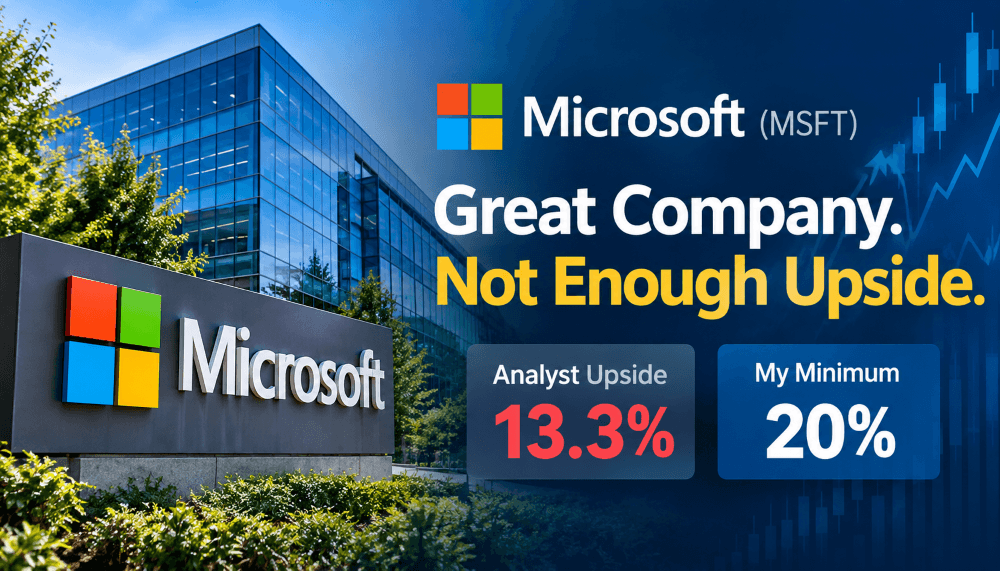
When evaluating a potential investment, I look for companies with strong growth prospects and meaningful upside. One of my requirements is that the average Wall Street analyst’s 12-month price target should suggest at least 20% appreciation from the current share price.
Microsoft (NASDAQ: MSFT) is an excellent business. Unfortunately, at its current valuation, it doesn’t meet that requirement.
What Does Microsoft Do?
Founded in 1975 by Bill Gates and Paul Allen, Microsoft began by developing software for personal computers. Its Windows operating system and Office productivity suite helped make it one of the world’s most valuable companies.
Today, Microsoft is much more than a software company.
Its business revolves around several powerful divisions:
1. Productivity and Business Software
Microsoft 365, which includes Word, Excel, PowerPoint, Outlook, and Teams, is deeply embedded in businesses worldwide. These products generate recurring subscription revenue and are difficult for many organizations to replace.
Microsoft also owns LinkedIn, the professional networking platform, and Dynamics 365, its enterprise business applications.
2. Cloud Computing
Microsoft Azure is one of the world’s leading cloud computing platforms, competing primarily with Amazon Web Services and Google Cloud.
Businesses use Azure to store information, run applications, manage databases, and increasingly deploy artificial intelligence.
Cloud computing has become one of Microsoft’s most important growth engines.
3. Artificial Intelligence
Microsoft has positioned itself at the center of the AI revolution.
Through its relationship with OpenAI and its own research and infrastructure investments, Microsoft is integrating AI into products ranging from Office applications to software development tools.
Its Copilot products aim to turn artificial intelligence into a recurring revenue source by helping businesses automate tasks and improve productivity.
The opportunity is enormous, although so are the investments required to build and operate AI infrastructure.
4. Gaming and Consumer Technology
Microsoft owns Xbox, Minecraft, and Activision Blizzard, giving it a substantial presence in video games.
It also operates the Bing search engine and sells Surface computers.
These businesses diversify Microsoft’s revenue, although enterprise software and cloud computing remain central to its investment story.
Why Microsoft Is Such a Great Business
There are several reasons investors admire Microsoft.
First, it enjoys powerful competitive advantages. Businesses depend on Microsoft products for daily operations, and switching to alternatives can be expensive and disruptive.
Second, its subscription-based business model generates recurring revenue. Customers regularly pay for Microsoft 365, Azure services, and other enterprise products.
Third, Microsoft has enormous financial resources. Its profitability and cash generation allow it to invest billions of dollars in research, acquisitions, and infrastructure.
Finally, Microsoft has demonstrated an impressive ability to reinvent itself. It evolved from desktop software to cloud computing and is now positioning itself for an AI-driven future.
Few companies have successfully navigated so many technological transitions.
But none of these strengths automatically tells us whether the stock is attractively priced.
The Problem: Microsoft’s Stock Price Already Reflects High Expectations
As of October 17, 2026, Microsoft’s latest reported share price is approximately $529.05.
The average Wall Street analyst’s 12-month price target is approximately $599.24.
That implies:
Expected upside = ($599.24 − $529.05) ÷ $529.05 = 13.3%
A potential return of 13.3% is certainly respectable. However, my investment screening process requires at least 20% expected upside.
For Microsoft to qualify at today’s price, the average analyst target would need to reach approximately $634.86.
It currently falls short.
Of course, analyst price targets are estimates, not guarantees. They can change after earnings reports, major announcements, or shifts in market sentiment.
Nevertheless, they provide a useful starting point for evaluating how much potential appreciation Wall Street sees in a stock.
Microsoft’s Growth Outlook
Microsoft continues to deliver impressive growth, especially considering its enormous size.
Current analyst projections suggest:
| Metric | Fiscal 2027 | Fiscal 2028 |
|---|---|---|
| Expected earnings per share | $19.78 | $23.72 |
| Expected EPS growth | 14.5% | 19.9% |
| Expected revenue | $391.35 billion | $468.3 billion |
| Expected revenue growth | 17.9% | 19.7% |
These are impressive numbers for a mature technology company.
However, another of my investment criteria is expected earnings-per-share growth of at least 20%.
Microsoft’s projected EPS growth of 14.5% for fiscal 2027 falls short. Its projected 19.9% growth for fiscal 2028 comes very close.
Revenue growth is strong enough to meet my minimum 15% requirement, although it remains slightly below 20%.
Microsoft is growing rapidly, but not quite rapidly enough to satisfy all my screening criteria.
Is Microsoft Too Expensive? Looking at the PEG Ratio
One valuation metric I find useful is the price/earnings-to-growth ratio, commonly known as the PEG ratio.
The PEG ratio compares a company’s price-to-earnings multiple with its expected earnings growth.
A PEG ratio around 1.0 or below can suggest that investors are paying a reasonable price relative to expected growth, although it does not guarantee that a stock is undervalued.
Microsoft currently has a reported PEG ratio of approximately 1.70.
That means the stock is trading at a relatively high valuation compared with the earnings growth assumed in that calculation.
Investors are willing to pay a premium for Microsoft’s market position, recurring revenue, financial strength, and AI opportunities.
That premium may be justified.
But from my perspective, a PEG ratio of 1.70 does not offer the valuation cushion I prefer when searching for investments with substantial upside.
A Great Company Is Not Always a Great Investment
This distinction is one of the most important lessons in investing.
A company can have excellent management, outstanding products, loyal customers, strong profits, and a promising future.
Yet its stock can still be too expensive to offer the return an investor is seeking.
Imagine buying a wonderful business at a price that already assumes years of extraordinary success.
Even if the company performs well, the stock might produce disappointing returns if investors become less willing to pay a premium valuation.
Conversely, a less celebrated company purchased at a sufficiently attractive price might generate better returns.
The quality of a business matters. But the price we pay matters just as much.
What Would Make Me Reconsider Microsoft?
Microsoft remains a company worth watching.
I would reconsider it if one or more of the following occurred:
- Its share price declined enough to create at least 20% upside relative to the analyst consensus target.
- Analysts increased their earnings forecasts following stronger-than-expected cloud or AI results.
- The consensus price target rose substantially.
- Its valuation became more attractive relative to expected earnings growth.
Microsoft’s upcoming quarterly earnings announcement on October 28, 2026, could provide new information about Azure, AI demand, profitability, and future spending.
A strong report might change analysts’ forecasts. A disappointing report could create a more attractive entry price—or reveal new risks.
Either way, I prefer to evaluate the numbers rather than buy simply because I admire the company.
My Verdict: Microsoft Goes on the Watchlist
Here is how Microsoft measures against my investment criteria:
| Investment criterion | Microsoft | Result |
|---|---|---|
| Analyst 12-month upside ≥20% | 13.3% | Does not qualify |
| Forward EPS growth ≥20% | 14.5% for FY2027 | Does not qualify |
| Revenue growth >15% | 17.9% for FY2027 | Qualifies |
| PEG ratio near or below 1.0 | 1.70 | Does not qualify |
Microsoft is an outstanding company, but at approximately $529 per share, it doesn’t meet my requirements for a new investment.
This is not a prediction that Microsoft shares will decline, nor is it a recommendation to sell existing holdings.
It simply means that, based on my investment criteria and current analyst expectations, I don’t see enough potential upside to justify adding it to my portfolio today.
I would rather miss an opportunity than abandon my investment discipline.
Microsoft stays on my watchlist.
Disclaimer: This article reflects my personal investment research and opinions. It is not personalized financial advice. Analyst forecasts and market valuations can change, and investing in stocks involves the risk of losing money.
Other speculative posts
Leave a Reply