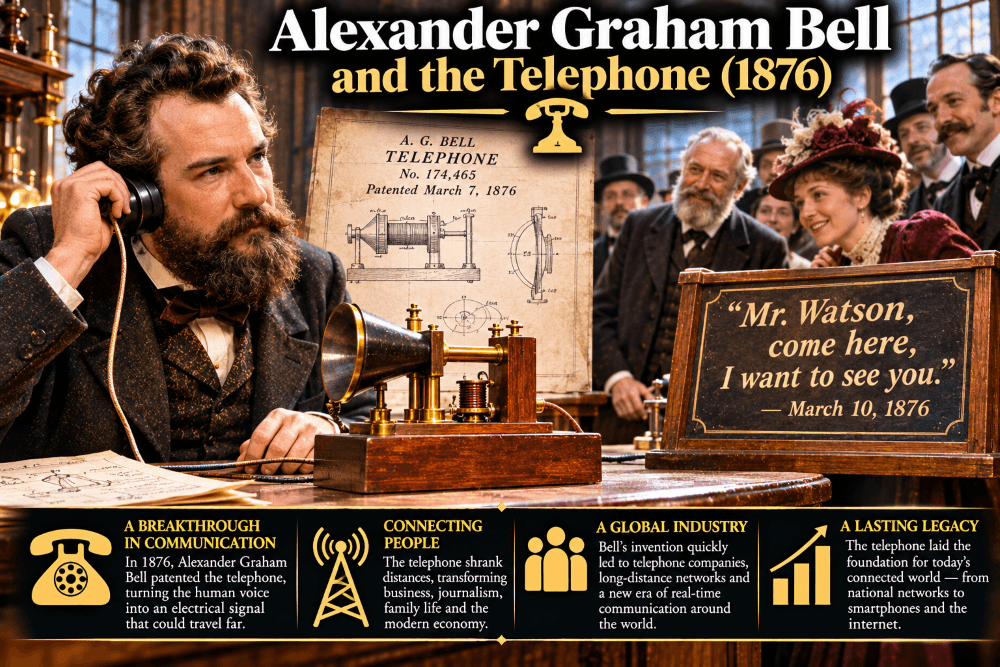
Alexander Graham Bell is remembered as the inventor of the telephone, but the full story is as much about patents, financing, and business strategy as it is about invention. In 1876, Bell won a razor-thin race to the patent office, then turned a fragile, contested idea into one of the most powerful corporations of the 20th century. His story shows how timing, partnerships, and business model choices can matter as much as the technology itself.
Who Was Alexander Graham Bell?
Bell was born in Edinburgh, Scotland, in 1847 into a family deeply involved in the study of speech and elocution.
- His father, Alexander Melville Bell, developed a system called Visible Speech, which aimed to represent the sounds of speech through written symbols.
- Bell moved to North America in 1870, eventually settling in Boston, where he taught deaf students and experimented with sound and communication.
- His work with the deaf, along with his fascination with the mechanics of sound, shaped the experiments that led to the telephone.
Bell was a teacher and tinkerer by background, not a businessman. That made the partnerships he formed along the way especially important.
The Backers Behind the Invention
Financing an Unproven Idea
Developing the telephone required time and money, and Bell relied on supporters who believed in the concept before it worked.
- Gardiner Greene Hubbard, a Boston lawyer and businessman, became a key financial backer. His daughter Mabel, who was deaf, was Bell’s student and later became his wife.
- Thomas Sanders, a leather merchant whose son Bell taught, also provided funding.
- Thomas Watson, a skilled machinist, served as Bell’s assistant and helped build the experimental devices.
These partners supplied money, legal expertise, and technical skill, each filling a gap Bell could not fill alone.
The 1876 Patent Race
A Photo Finish at the Patent Office
The telephone’s patent history is one of the most famous and contested in American business.
- Bell’s lawyers filed his patent application on February 14, 1876.
- Another inventor, Elisha Gray, reportedly filed a related caveat, a notice of intent to patent, at the patent office on the very same day.
- Bell’s patent was granted on March 7, 1876, and it proved to be one of the most valuable patents in American history.
The First Words
Just days after the patent was granted, Bell and Watson achieved a working demonstration.
- On March 10, 1876, Bell reportedly spoke the now-famous words summoning Watson from the next room.
- Later that year, Bell demonstrated the device at the Centennial Exhibition in Philadelphia, drawing public attention and praise from prominent visitors.
- These demonstrations helped turn a laboratory curiosity into a commercial prospect.
A Contested Legacy
It is worth noting that the question of who truly invented the telephone remains debated.
- Elisha Gray and others were working on similar ideas at the same time.
- Antonio Meucci, an Italian inventor, had experimented with voice communication devices earlier, and the U.S. House of Representatives passed a resolution in 2002 honoring his contributions.
- Historians generally agree that Bell won the legal and commercial battle, even if the question of sole invention is more complicated.
Building Bell Telephone
A Famous Miss at Western Union
Bell and his backers initially tried to sell the patent rights to Western Union, then the dominant telegraph company.
- According to the commonly told story, Western Union declined an offer to buy the patents for around $100,000, viewing the telephone as a novelty rather than a serious business.
- Western Union later reversed course and entered the telephone business with competing technology, including improvements from Thomas Edison.
- Bell’s company sued, and in a settlement around 1879, Western Union reportedly agreed to leave the telephone business in exchange for a share of royalties.
The episode became a classic example of an incumbent failing to recognize a disruptive technology.
The Leasing Model
Bell Telephone made an important business model choice that helped it control the market.
- Rather than selling telephones outright, the company generally leased them to customers.
- This kept ownership of the equipment in the company’s hands and created a steady revenue stream.
- It also allowed the company to maintain quality and eventually control the network as a whole.
Theodore Vail and the Network Vision
Theodore Vail, who became the company’s general manager in 1878, shaped Bell Telephone into a national enterprise.
- He pushed to build long-distance lines connecting cities, recognizing that a telephone becomes more valuable as more people can be reached.
- He promoted the idea of a unified, universal telephone service, which supported the company’s push for a regulated monopoly.
- Under his leadership, the company eventually evolved into AT&T, which dominated American telecommunications for much of the 20th century.
Patent Defense and Monopoly
Bell’s patents were enormously valuable, and the company defended them aggressively.
- The company reportedly faced hundreds of legal challenges to its patents and won the key cases.
- The patents gave Bell Telephone a legal monopoly for roughly two decades.
- When the key patents expired in the 1890s, hundreds of independent telephone companies sprang up, showing how much demand had been held back.
AT&T later regained dominance and operated as a regulated monopoly until the U.S. government forced its breakup in 1984.
Lessons from Alexander Graham Bell
- Timing and legal protection matter. Bell’s win in the patent race gave his company a lasting advantage over equally capable competitors.
- Incumbents often underestimate disruption. Western Union‘s decision to pass on the telephone cost it a major opportunity.
- Networks gain value as they grow. Vail’s push for long-distance and universal service reflected an early understanding of network effects.
- Business model choices shape control. Leasing instead of selling helped Bell Telephone maintain quality and market power.
Frequently Asked Questions
Did Alexander Graham Bell really invent the telephone? Bell won the patent and built the first commercially successful telephone business, but others, including Elisha Gray and Antonio Meucci, also worked on similar ideas, so historians view the invention as more contested than the popular story suggests.
Why did Western Union pass on buying Bell’s patents? According to the commonly told story, Western Union saw the telephone as a novelty rather than a serious business, then later entered the field itself and ended up settling a patent dispute with Bell’s company.
Why did Bell Telephone lease telephones instead of selling them? Leasing let the company keep ownership of the equipment, generate steady revenue, and maintain control over quality and the growing network.
What happened when Bell’s patents expired? Independent telephone companies grew rapidly in the 1890s, though AT&T later regained dominance and remained a regulated monopoly until its breakup in 1984.
Related Articles
- Sears and Montgomery Ward: The Catalog Revolution
- Erie War: Vanderbilt’s Battle With Gould and Fisk
- Wall Street and the Ticker: Speed Becomes the Edge
- The Atlantic Cable: Cyrus Field’s Costly Persistence
- The Department Store: Retail’s Quiet Revolution
- The Birth of Modern Management: Railroads Invent the Org Chart
- Early Advertising: How Hype Became a Business Tool
About The History of Entrepreneurship
This article is part of The History of Entrepreneurship, an ongoing series exploring how entrepreneurs, civilizations, technologies, financial institutions, and business innovations gradually created the modern economy.
Leave a Reply