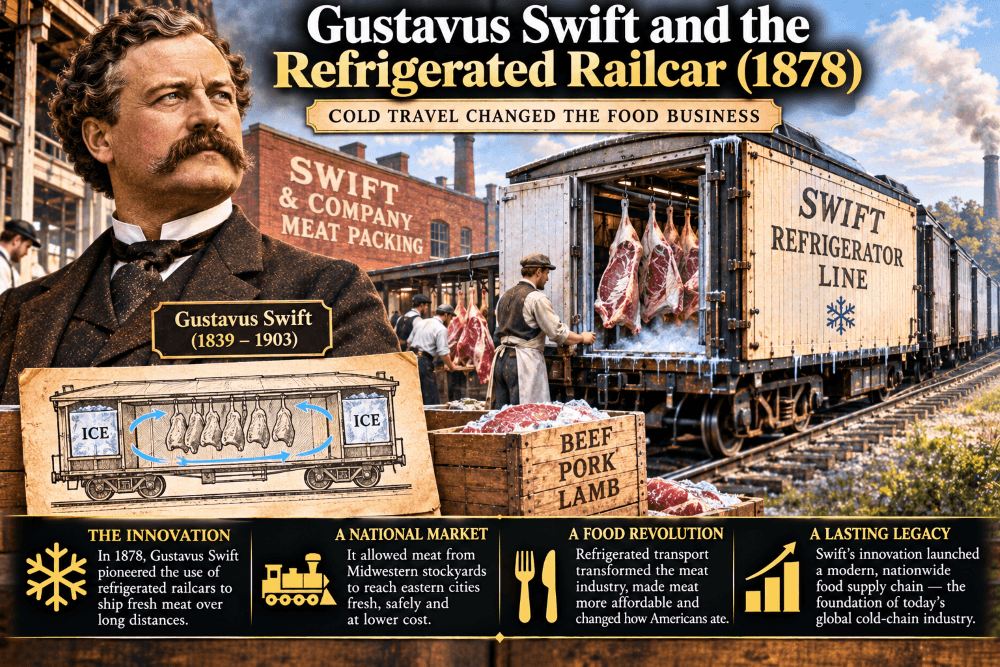
Gustavus Swift did not invent meat, railroads, or refrigeration. His genius was in combining them into a system that moved fresh beef from Chicago to Eastern dinner tables at a lower cost than anyone thought possible. In doing so, he built one of the first truly national food companies and helped create the modern cold chain. His story is a case study in how rethinking a supply chain can unlock an entire industry, and it also reminds us of the human costs that often accompany industrial scale.
The Problem: Moving Beef the Hard Way
By the 1870s, Chicago had become the center of America’s cattle trade, but getting beef to Eastern consumers was surprisingly inefficient.
- Cattle were raised on the Western plains and shipped by rail to Chicago, then shipped alive to Eastern cities for slaughter.
- Transporting live animals meant paying to move heavy, inedible weight, including bone, hide, and waste.
- Animals lost weight or died in transit, adding further cost and waste.
- Eastern butchers and stockyard interests, along with the railroads that carried livestock, had an investment in keeping the system as it was.
Swift saw an obvious inefficiency: why ship the whole animal when customers only wanted the meat?
Who Was Gustavus Swift?
Gustavus Franklin Swift was born in 1839 in Massachusetts and started out as a butcher, building his business through practical knowledge of meat and cattle.
- He built a small beef business in the Northeast and later moved to Chicago in 1875 to be closer to the source of cattle.
- There he began to wonder whether processing the animals in Chicago and shipping dressed beef east could be cheaper and better.
- This simple idea ran into a surprisingly stubborn set of obstacles.
The Refrigerated Railcar Breakthrough
The Technical Problem
Shipping fresh meat over long distances had been tried before, but it kept spoiling.
- Meat needed to stay cold during a journey of many days, in all kinds of weather.
- Earlier attempts with ice-cooled cars often failed because cold air did not circulate properly, causing uneven cooling and spoilage.
- Cars needed to be designed so that ice, air flow, and insulation worked together.
Working With Andrew Chase
Swift worked with an engineer named Andrew Chase to develop a practical solution in the late 1870s.
- The resulting design used ice stored at the top of the car, with ventilation and insulation that allowed cold air to circulate over the meat.
- Chase’s design is widely credited as the first practical refrigerated railcar for fresh meat.
- After several experiments and refinements, Swift began shipping dressed beef east in these cars.
The Railroad Resistance
Getting the idea to market was as much a business problem as an engineering one.
- Many major railroads had invested heavily in livestock cars and stockyard facilities, and they were reluctant to support a system that would reduce live cattle shipments.
- According to the commonly told story, Swift found a willing partner in the Grand Trunk Railway, a Canadian line without a major stake in the livestock trade.
- Swift eventually built his own fleet of refrigerated cars, giving him control over the equipment.
Building a Vertically Integrated System
More Than a Railcar
Swift understood that a refrigerated car alone would not be enough. To succeed, he needed to control the whole chain.
- He built large meatpacking plants in Chicago to slaughter and process cattle at scale.
- He built icing stations along rail routes so cars could be re-iced during the journey.
- He set up a network of branch houses in Eastern cities where meat could be stored and sold to local butchers and retailers.
This approach is often described as vertical integration, meaning one company controlling many steps from raw materials to the customer.
Overcoming Local Resistance
Local butchers in Eastern cities did not welcome the new competition.
- Many butchers and their associations resisted dressed beef from Chicago, in some cases arguing that it was inferior to locally slaughtered meat.
- Swift answered with lower prices and, where needed, by opening his own distribution outlets.
- As customers realized the meat was fresh and cheaper, resistance faded.
Using Every Part of the Animal
Swift and his competitors also made money from by-products that were previously treated as waste.
- Parts of the animal that were not sold as fresh meat were turned into products such as soap, glue, and fertilizer.
- This helped them keep costs low and profits high, and it gave rise to the saying that the packers used “everything but the squeal.”
Impact on American Business
Fresh Meat, Lower Prices, National Markets
The refrigerated railcar and the system around it changed how Americans ate.
- Fresh beef became available year-round in cities far from cattle country.
- Prices fell, making meat more accessible to many households.
- Chicago became the center of a national meatpacking industry dominated by a handful of large firms.
A Template for the Cold Chain
Swift’s system became an early model for the temperature-controlled supply chains that later carried fruit, vegetables, dairy, and frozen foods across the country.
- The idea of controlling temperature throughout the journey paved the way for broader refrigerated distribution.
- It reshaped agriculture by allowing producers to reach distant markets.
- Some accounts also suggest that the overhead disassembly lines in Chicago’s packing plants inspired later ideas about assembly-line manufacturing.
The Costs and Controversies
Concentrated Power
The meatpacking industry became highly concentrated, and its biggest firms drew antitrust scrutiny.
- A small group of major packers, including Swift and Company, was accused of coordinating to control prices and limit competition.
- Swift and Company was involved in a notable antitrust case in the early 1900s that reached the U.S. Supreme Court.
Working and Safety Conditions
The packing plants were also known for dangerous, grueling, and low-paid work, often performed by immigrants.
- Upton Sinclair’s 1906 novel The Jungle exposed unsanitary conditions and harsh labor practices in the industry.
- Public outrage helped push passage of federal meat inspection and food safety laws that same year.
Gustavus Swift died in 1903, so he did not live to see these reforms, but his company and its competitors were at the center of them.
Lessons from Gustavus Swift
- Rethink the whole supply chain. Swift saw that moving meat, not whole animals, was the better solution.
- Control the critical links. Building his own cars, icing stations, and branch houses let him overcome resistance from entrenched players.
- Efficiency can create concentration. The same scale that lowered prices also raised concerns about market power.
- Growth carries responsibility. The industry’s labor and safety problems show the human costs that can accompany industrial scale.
Self Made
Gustavus Franklin Swift is widely considered a classic American “rags to riches” story. He transformed a modest, small-town beginning into one of the largest industrial and meatpacking empires in the world.
Early Beginnings (The “Rags”)
- Starting Small: Born in 1839 on a farm in Cape Cod, Massachusetts, Swift was raised in a modest rural family.
- Early Labor: He left school around the age of 14 to work as a butcher’s helper for one dollar a week.
- First Venture: Demonstrating early entrepreneurial initiative, he borrowed $20 from his father at age 16 to buy a single heifer, butchered it, and sold the meat door-to-door out of a wagon to local neighbors for a small profit.
Rise and Industry Revolution (The “Riches”)
- Moving to Chicago: Recognizing the inefficiencies of transporting live, heavy livestock from western farms to eastern markets by train, Swift moved to Chicago in 1875.
- Innovations in Refrigeration: He pioneered the practical use of the refrigerated railcar to ship dressed beef directly across the country. This allowed year-round meat processing and significantly lowered costs for consumers.
- Efficiency & By-Products: He built an end-to-end industrial model famed for using “everything but the squeal”—turning animal remnants into side products like soap, glue, fertilizer, and margarine to maximize profit margins.
Legacy and Fortune
By the time of his death in 1903, his company, Swift & Company, grossed over $160 million to $200 million in annual sales and employed tens of thousands of people. He accumulated a personal net worth estimated between $7 million and $10 million (equivalent to hundreds of millions of dollars today).
Frequently Asked Questions
Did Gustavus Swift invent the refrigerated railcar? Swift worked with engineer Andrew Chase, whose design is widely credited as the first practical refrigerated railcar for shipping fresh meat. Swift’s contribution was commercializing it and building the surrounding system.
Why did railroads resist the refrigerated railcar? Many railroads had invested heavily in livestock cars and stockyards, so shipping dressed beef instead of live cattle threatened their existing business.
What is vertical integration, and how did Swift use it? Vertical integration means controlling multiple stages of production and distribution. Swift controlled the packing plants, refrigerated cars, icing stations, and Eastern branch houses that delivered his meat to customers.
What problems did the meatpacking industry face? The industry drew antitrust scrutiny for concentrated power and criticism for unsafe working conditions and unsanitary practices, as exposed in Upton Sinclair’s The Jungle in 1906.
Related Articles
- Alexander Graham Bell: The Telephone and a Patent Race
- Sears and Montgomery Ward: The Catalog Revolution
- Erie War: Vanderbilt’s Battle With Gould and Fisk
- Wall Street and the Ticker: Speed Becomes the Edge
- The Atlantic Cable: Cyrus Field’s Costly Persistence
- The Department Store: Retail’s Quiet Revolution
- The Birth of Modern Management: Railroads Invent the Org Chart
About The History of Entrepreneurship
This article is part of The History of Entrepreneurship, an ongoing series exploring how entrepreneurs, civilizations, technologies, financial institutions, and business innovations gradually created the modern economy.
Leave a Reply