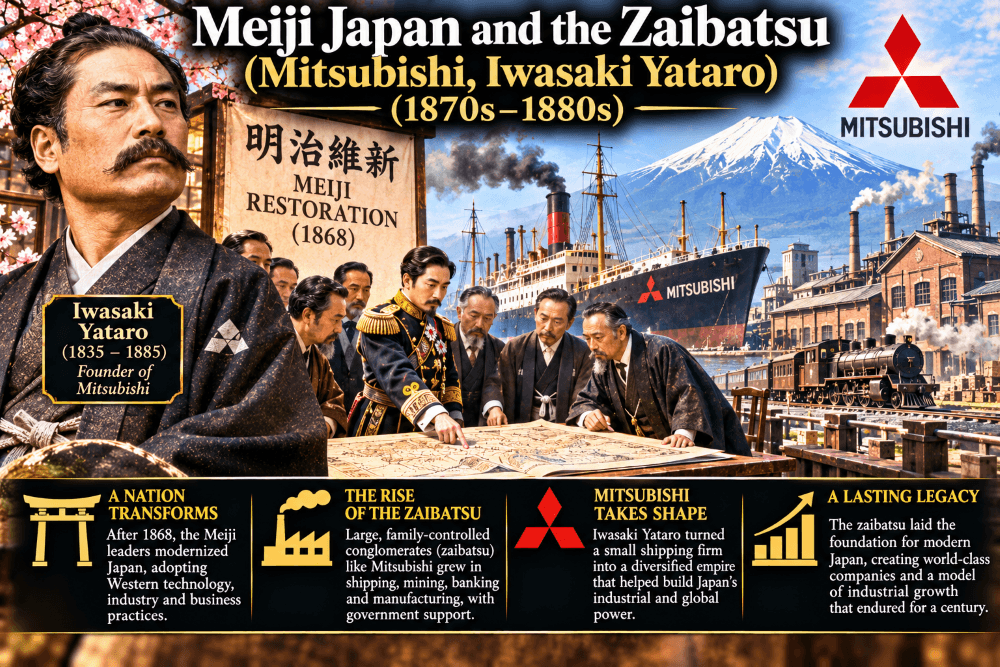
When Japan opened its doors to the modern world in the 1860s, few expected it to become an industrial power within a generation. The Zaibatsu, powerful family-controlled business conglomerates, became one of the engines of that transformation. Among them, Mitsubishi stands out, built from a small shipping business by a determined former samurai named Iwasaki Yataro. His story shows how entrepreneurship, government partnership, and ambition combined during the Meiji era, with results that were both transformative and troubling.
Japan Remakes Itself
The Meiji Restoration
In 1868, the Tokugawa shogunate, which had ruled Japan for over two centuries, fell, and imperial rule was restored under Emperor Meiji.
- The new government set out to modernize quickly, guided by the slogan “enrich the country, strengthen the military.”
- Feudal domains were abolished in 1871, and the old samurai class lost its traditional privileges and stipends.
- The state built factories, shipyards, mines, and railways, importing technology and foreign experts.
A Shortage of Private Capital
Japan lacked a deep base of private industrial capital, so the government often took the lead.
- It financed and operated model enterprises to jump-start industry.
- In the 1880s, it began selling many of these enterprises to private buyers, often on favorable terms.
- Entrepreneurs with political connections and financial skill were in a position to take advantage.
What Is a Zaibatsu?
The word Zaibatsu is often translated as “financial clique.” It describes a large, family-controlled group of companies spanning many industries.
- A holding company, controlled by a founding family, owned shares in a range of businesses.
- Groups typically combined banking, trading, mining, shipping, and manufacturing.
- Close ties to the government were common, and the most successful founders were sometimes called “political merchants.”
The best-known groups were Mitsui, Mitsubishi, Sumitomo, and Yasuda, often called the “Big Four.”
Iwasaki Yataro: From Samurai Family to Shipping Magnate
A Humble Start
Iwasaki Yataro was born in 1835 in the Tosa domain, into a family of low-ranking samurai status.
- He rose through the Tosa domain’s trading operations, learning how commerce and shipping worked.
- When the domains were abolished in 1871, he took over the business and ships associated with Tosa’s trading enterprise.
- By 1873, his firm was operating under the name Mitsubishi, which means “three diamonds,” a reference to the design of his family and domain crests.
Government Partnership as a Growth Engine
Iwasaki’s rise depended heavily on close cooperation with the government.
- Taiwan Expedition (1874): When foreign shipping companies declined to help transport Japan’s military expedition, Mitsubishi took on the job, and the government reportedly rewarded it with a fleet of ships and subsidies.
- Satsuma Rebellion (1877): Mitsubishi carried troops and supplies during the rebellion against the government, bringing large profits.
- Challenging foreign shipping: Backed by the government, Mitsubishi competed aggressively against foreign lines such as the Pacific Mail Steamship Company, which withdrew from key Japanese routes in the 1870s.
By the late 1870s, Mitsubishi dominated Japanese coastal and international shipping.
The Shipping War and a Merger
A Rival Emerges
Mitsubishi’s dominance drew criticism and resistance.
- Rivals and some government officials worried about one firm holding so much power.
- A competing company, the Kyodo Unyu, was formed in 1882 with government and business backing, including from Shibusawa Eiichi, often called the father of Japanese capitalism.
- A fierce price war followed, hurting both sides.
Resolution Through Merger
The conflict ended in 1885, when Mitsubishi’s shipping business and Kyodo Unyu merged to form Nippon Yusen Kaisha (NYK), which became one of Japan’s leading shipping lines. Iwasaki Yataro died that same year.
Diversification and Growth
Even as shipping consolidated, Mitsubishi was already expanding into other businesses.
- It acquired the Takashima coal mine in the early 1880s.
- It took over the Nagasaki Shipyard, leasing it in 1884 and later buying it, which became a base for shipbuilding.
- It also moved into finance and other ventures, laying the groundwork for a diversified conglomerate.
Under Iwasaki’s brother and later his son, Mitsubishi expanded across mining, shipbuilding, banking, and more.
Two Models of Capitalism
The rivalry between Iwasaki and Shibusawa Eiichi highlights two philosophies.
- Iwasaki: Favored concentrated family control and strong centralized management.
- Shibusawa: Promoted joint-stock companies with broader shareholder participation and a more public-minded approach to business.
Japan’s economy eventually blended both approaches, but the family-controlled Zaibatsu became a defining feature of its industrial landscape.
The Legacy and the Costs
Powerful Engines of Industrialization
The Zaibatsu helped Japan build infrastructure, industry, and technology quickly, supported by access to capital and long-term planning.
A Darker Side
Their power also came with serious problems.
- By the 20th century, the Zaibatsu had enormous influence over the economy and politics.
- During World War II, major Zaibatsu, including Mitsubishi, supported Japan’s war effort, and their mines and factories used forced labor, including Korean and Chinese workers and Allied prisoners of war. Mitsubishi companies have faced legal and public pressure over these issues, and one later apologized to some former prisoners of war.
- After the war, the Allied occupation dissolved the Zaibatsu in the late 1940s, though looser industrial groups called keiretsu later emerged.
Lessons from the Zaibatsu
- Government partnership can accelerate growth. Mitsubishi’s rise was inseparable from state support.
- Seize openings created by disruption. Iwasaki took advantage of the abolition of the domains and the government’s need for shipping.
- Diversify beyond the first success. Shipping profits funded mining, shipbuilding, and finance.
- Concentrated power carries risks. The same structures that built industry also created political influence and abuses.
Frequently Asked Questions
What was a Zaibatsu? A Zaibatsu was a large, family-controlled business conglomerate in Japan, typically owning companies in banking, shipping, mining, and manufacturing through a holding company.
Who was Iwasaki Yataro? Iwasaki Yataro was a former low-ranking samurai who founded Mitsubishi in the early Meiji era and built it into Japan’s dominant shipping company with strong government support.
What does the name Mitsubishi mean? Mitsubishi means “three diamonds,” a reference to the design of the founder’s family and domain crests.
What happened to the Zaibatsu after World War II? The Allied occupation dissolved them in the late 1940s, though looser industrial groups known as keiretsu later developed.
Related Articles
- Goldman Sachs and Lehman Brothers: Wall Street’s Rise
- Gustavus Swift: The Refrigerated Railcar That Fed America
- Alexander Graham Bell: The Telephone and a Patent Race
- Sears and Montgomery Ward: The Catalog Revolution
- Erie War: Vanderbilt’s Battle With Gould and Fisk
- Wall Street and the Ticker: Speed Becomes the Edge
- The Atlantic Cable: Cyrus Field’s Costly Persistence
About The History of Entrepreneurship
This article is part of The History of Entrepreneurship, an ongoing series exploring how entrepreneurs, civilizations, technologies, financial institutions, and business innovations gradually created the modern economy.
Leave a Reply