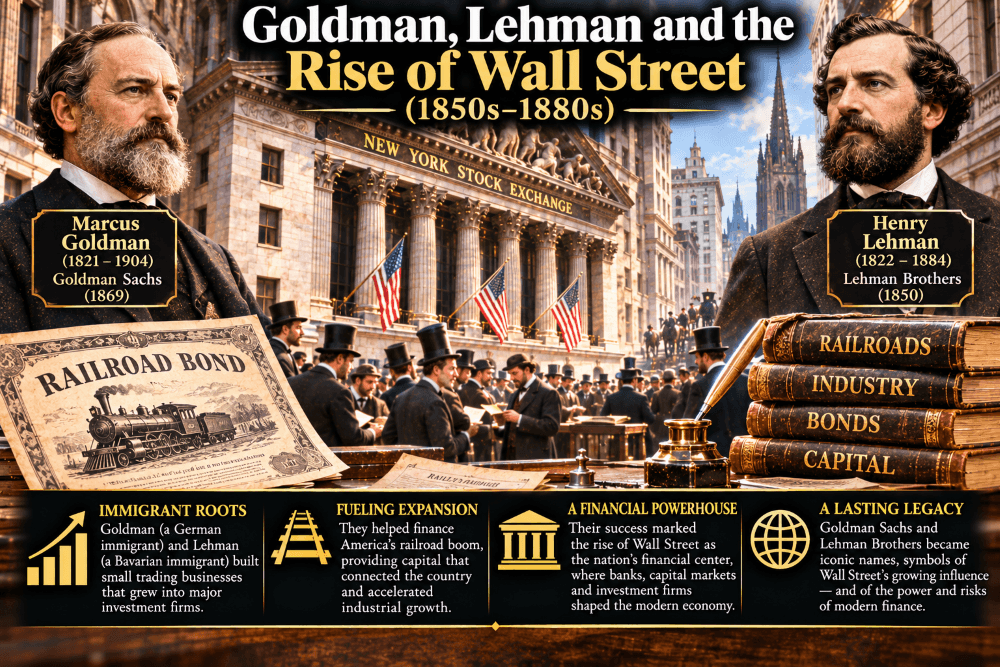
Two of the most famous names in American finance began as small immigrant businesses, not grand banking houses. Goldman Sachs and Lehman Brothers both grew out of modest trade in the mid-19th century, one in Southern cotton and the other in short-term business loans. Their rise between the 1850s and 1880s shows how Wall Street itself evolved from a marketplace for trading into a machine for raising capital.
The Setting: A Booming, Changing Wall Street
The decades after the Civil War were years of explosive economic growth, and the demand for capital was enormous.
- Railroads, factories, and new industries needed far more money than any single investor could provide.
- Securities markets in New York were expanding, and brokers and bankers gained influence.
- The industrial economy was starting to need specialists who could connect businesses that needed money with investors who had it.
This created an opening for a new type of firm, the investment bank, that could do more than simply trade or lend.
Newcomers Outside the Establishment
Immigrant Founders
Both firms were founded by German-Jewish immigrants who arrived with little capital and built their businesses from the ground up.
- In the mid-19th century, old-line financial institutions were often dominated by established, Protestant elites.
- Immigrant entrepreneurs, including many Jewish families, frequently faced social and professional exclusion from those circles.
- They relied instead on trust, family ties, and personal networks, including connections that stretched back to Europe, to build credit and find partners.
This pattern, building financial institutions through networks when the establishment was closed, echoes the story of the Rothschilds earlier in this series.
Lehman Brothers: From Dry Goods to Cotton
A Family Business in Alabama
The Lehman brothers started in the American South, where the cotton economy dominated.
- Henry Lehman emigrated from Bavaria in the 1840s and opened a dry goods store in Montgomery, Alabama.
- His brothers Emanuel and Mayer joined him in the following years.
- Farmers often paid with raw cotton, so the brothers started trading cotton themselves, which grew into a brokerage and commodity business.
The Weight of the Cotton Economy
It is important to be honest about what that business rested on.
- The Southern cotton economy depended on the forced labor of enslaved people.
- According to historical records, members of the Lehman family took part in this system, including through the ownership of enslaved people.
- The firm’s early prosperity was therefore connected to slavery, a fact that is part of any honest account of its origins.
Moving to New York
After the Civil War, the Lehmans shifted their center of gravity to New York, where finance was concentrating.
- The firm opened a New York office and focused on commodities and trading.
- It was among the founders of the New York Cotton Exchange in 1870.
- It later became a member of the New York Stock Exchange and moved increasingly into underwriting securities.
Goldman Sachs: The Commercial Paper Business
A Peddler Becomes a Banker
Marcus Goldman followed a different path to Wall Street.
- He immigrated from Bavaria, worked as a peddler and small merchant, and moved to New York in 1869.
- There he started a business in commercial paper, the short-term promissory notes issued by merchants.
- He bought these notes from merchants at a discount, then sold them to banks, earning a margin for taking on the work and risk.
Samuel Sachs and a New Name
Goldman’s business grew when his family joined the firm.
- His son-in-law, Samuel Sachs, joined in 1882.
- The firm was renamed Goldman, Sachs & Co. in 1885.
- The firm gradually expanded from commercial paper into other banking and securities services.
How Investment Banking Took Shape
Both firms helped transform Wall Street from a place where securities were merely traded into one where companies could raise money in organized ways.
- Underwriting: Banks began buying new securities from companies and reselling them to investors, taking on risk in exchange for fees.
- Syndicates: Firms formed groups to share the risk of larger deals.
- Relationships: Banks built long-term ties with companies, advising them and helping them tap the public markets.
The Partnership That Linked Them
Later, in the early 1900s, the two firms worked together in a famous way.
- In 1906, Goldman Sachs and Lehman Brothers jointly underwrote the public offering of Sears, Roebuck and Co., a company covered earlier in this series.
- This deal is often described as a milestone in bringing industrial companies to public markets.
- It helped establish both firms as leading underwriters.
Different Endings
Lehman Brothers’ Collapse
Lehman Brothers survived for 158 years, through wars, depressions, and panics.
- In September 2008, during the global financial crisis, it filed for bankruptcy after heavy losses tied to the mortgage market.
- It was the largest bankruptcy filing in American history and became a symbol of the crisis.
Goldman Sachs’ Survival
Goldman Sachs took a different path.
- It weathered the 2008 crisis, in part by converting to a bank holding company, which gave it access to federal support programs.
- It remains one of the most influential financial institutions in the world.
Lessons from Goldman Sachs and Lehman Brothers
- Exclusion can drive innovation. Outsiders built new institutions when the establishment was closed to them.
- Start where you are and move up the value chain. Both firms grew from small trading and lending businesses into major banks.
- Origins matter. Lehman’s early cotton trade shows that wealth can be bound up with moral wrongs.
- Longevity is not immunity. Even a firm with a century and a half of history can fail when risk management breaks down.
Frequently Asked Questions
How did Goldman Sachs start? Marcus Goldman, a German immigrant, began in New York in 1869 buying commercial paper from merchants at a discount and selling it to banks, and the firm later became Goldman, Sachs & Co. after Samuel Sachs joined.
How did Lehman Brothers begin? The Lehman brothers started with a dry goods store in Montgomery, Alabama, and became cotton traders and brokers before moving to New York and growing into a major financial firm.
What was commercial paper? It is a short-term promissory note issued by a business. Dealers buy these notes at a discount and sell them to banks or investors, profiting on the difference.
Why did Lehman Brothers collapse? Lehman filed for bankruptcy in September 2008 after heavy losses tied to the mortgage market during the global financial crisis.
Related Articles
- Gustavus Swift: The Refrigerated Railcar That Fed America
- Alexander Graham Bell: The Telephone and a Patent Race
- Sears and Montgomery Ward: The Catalog Revolution
- Erie War: Vanderbilt’s Battle With Gould and Fisk
- Wall Street and the Ticker: Speed Becomes the Edge
- The Atlantic Cable: Cyrus Field’s Costly Persistence
- The Department Store: Retail’s Quiet Revolution
About The History of Entrepreneurship
This article is part of The History of Entrepreneurship, an ongoing series exploring how entrepreneurs, civilizations, technologies, financial institutions, and business innovations gradually created the modern economy.
Leave a Reply