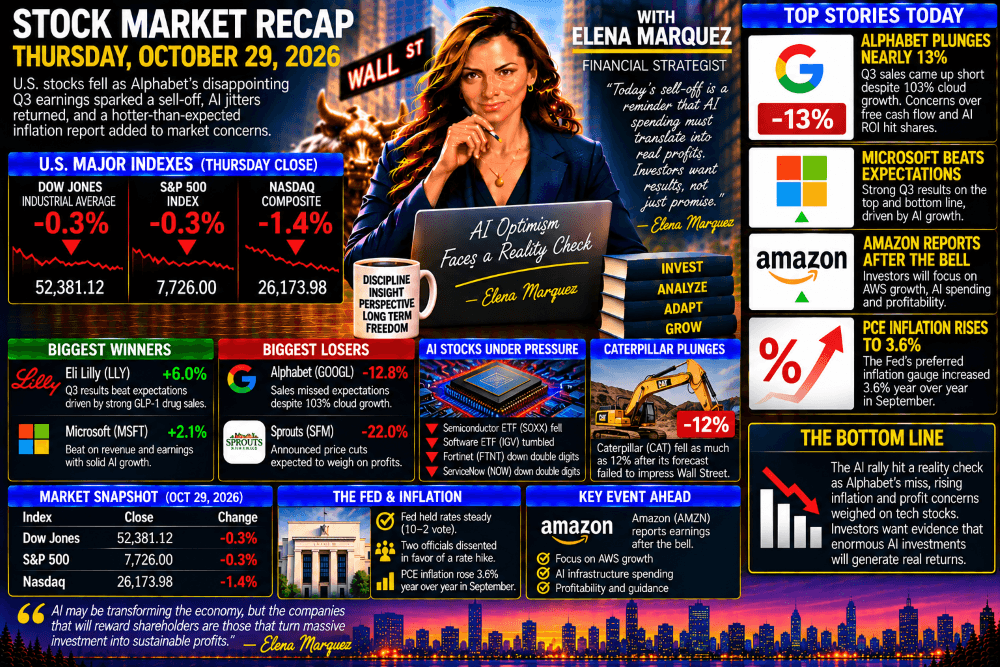
Thursday | Nasdaq slides 1.4%, Alphabet plunges nearly 13%, and inflation worries return to Wall Street
Wall Street’s technology rally came to an abrupt halt Thursday, October 29, as disappointing earnings from Alphabet reignited concerns about the enormous cost of artificial intelligence.
The Nasdaq Composite fell approximately 1.4%, significantly underperforming the broader market. The S&P 500 and Dow Jones Industrial Average each declined roughly 0.3%.
The biggest shock came from Alphabet, Google’s parent company. Despite reporting extraordinary cloud revenue growth of 103%, the company’s overall sales disappointed investors, and concerns about free cash flow and the financial returns from AI investments sent its shares tumbling nearly 13%.
Selling spread across semiconductor, software and cybersecurity stocks.
Meanwhile, a fresh inflation report added to the uncertainty. The Federal Reserve’s preferred inflation measure, the Personal Consumption Expenditures (PCE) price index, rose 3.6% year over year in September.
That reading came just one day after the Federal Reserve voted to keep interest rates unchanged.
The market’s central concern: Artificial intelligence may be transforming the economy, but investors are increasingly questioning whether the companies spending billions on it will earn satisfactory returns.
1. How the major indexes performed
How the Major Indexes Performed
Thursday, October 29, 2026
Thursday’s decline interrupted the recovery that had lifted technology stocks earlier in the week.
Investors had become more optimistic following Anthropic’s IPO filing and strong semiconductor earnings.
But Alphabet’s disappointing results reminded Wall Street that rapid AI growth doesn’t necessarily guarantee attractive shareholder returns.
The Nasdaq’s sharper decline reflects the technology sector’s sensitivity to concerns about spending, profitability and valuations.
2. Alphabet Plunges Nearly 13% Despite Explosive Cloud Growth
Alphabet, Google’s parent company, suffered one of Thursday’s largest technology selloffs after its third-quarter earnings disappointed investors.
The company reported overall sales below Wall Street expectations.
Yet one figure stood out: cloud revenue reportedly increased 103%.
That extraordinary growth suggests demand for AI computing and enterprise cloud services remains substantial.
So why did the stock plunge?
Because investors are increasingly looking beyond revenue growth.
They want to know whether the billions being invested in data centers, specialized processors and AI systems will generate enough profits and free cash flow to justify the spending.
The problem with enormous AI investments
Building AI infrastructure requires substantial capital.
Companies must purchase expensive processors, construct data centers, secure electricity and cooling capacity, and develop increasingly sophisticated software.
These investments may eventually create significant economic value.
But they also reduce the cash available for shareholders today.
If revenue growth fails to produce sufficient returns, investors may reassess what they’re willing to pay for the company’s shares.
Alphabet’s selloff illustrates that even extraordinary growth in one business segment may not be enough to overcome concerns about overall financial performance.
Investors aren’t necessarily rejecting artificial intelligence. They’re questioning its economics.
3. Microsoft Beats Expectations, but AI Spending Remains Under Scrutiny
Microsoft reported quarterly results that exceeded Wall Street expectations for both revenue and earnings.
The performance demonstrated continued strength in the company’s business, including demand for AI-related services.
Microsoft has become one of the leading suppliers of enterprise artificial intelligence.
Its Azure cloud platform provides computing infrastructure for businesses developing and deploying AI applications.
The company also offers AI-powered productivity tools and enterprise software.
However, Microsoft faces the same financial challenge confronting other technology giants.
AI infrastructure is expensive.
Investors want to see that the company’s spending translates into sustainable revenue growth, operating profits and free cash flow.
Microsoft’s earnings beat provided a more encouraging signal than Alphabet’s results.
But the broader technology selloff suggests investors remain cautious about the sector’s valuations and spending commitments.
4. Semiconductor and Software Stocks Join the Selloff
Thursday’s weakness extended well beyond Alphabet.
Semiconductor stocks declined, with the iShares Semiconductor ETF (SOXX) falling as investors reassessed the outlook for AI infrastructure demand.
Software stocks also came under pressure, including companies represented by the iShares Expanded Tech-Software Sector ETF (IGV).
Semiconductor companies have benefited enormously from demand for AI computing equipment.
But their performance depends partly on the willingness of large technology companies to continue investing.
If major cloud providers slow their infrastructure expansion, semiconductor suppliers could eventually experience weaker demand.
Software companies face a different set of challenges.
Some are investing heavily to incorporate AI into their products.
Others face concerns that AI could disrupt existing business models.
These uncertainties have made investors more selective about technology valuations.
Fortinet and ServiceNow suffer double-digit declines
Two software-related companies experienced particularly sharp losses Thursday.
Fortinet (FTNT) fell by double digits after its service-revenue outlook disappointed analysts.
ServiceNow (NOW) also declined by double digits following its earnings report.
Their losses highlight how sensitive technology stocks have become to earnings guidance.
When valuations assume strong future growth, even modest disappointments can trigger substantial selling.
5. Eli Lilly Jumps 6% on Strong Weight-Loss Drug Sales
While technology stocks struggled, pharmaceutical giant Eli Lilly delivered a strong performance.
Its shares jumped approximately 6% following better-than-expected third-quarter results.
The company’s performance was supported by strong demand for its GLP-1 medications, used in diabetes and weight management.
These treatments have become one of the fastest-growing areas of the pharmaceutical industry.
Rising demand has created significant revenue opportunities for manufacturers.
However, the long-term outlook also depends on manufacturing capacity, competition, pricing and regulatory developments.
Eli Lilly’s strong performance demonstrates that investors can still find growth opportunities outside the technology sector.
It also highlights the importance of diversification.
6. Caterpillar Falls as Its Outlook Disappoints
Industrial equipment manufacturer Caterpillar experienced a sharp selloff after its outlook failed to impress Wall Street.
Caterpillar is an important supplier of machinery used in construction, mining, energy and infrastructure projects.
Its performance can offer insight into global industrial activity.
When businesses and governments invest heavily in construction and infrastructure, demand for Caterpillar equipment often improves.
When economic uncertainty increases, customers may delay expensive purchases.
The company’s disappointing forecast raised concerns about future demand and profitability.
Its stock fell as much as 12% during Thursday’s trading.
That figure represents an intraday decline rather than a confirmed closing return.
7. Sprouts Farmers Market Plunges 22%
Grocery chain Sprouts Farmers Market suffered one of Thursday’s largest declines after announcing a pricing strategy that could reduce profitability.
The company plans to lower prices to attract customers and remain competitive.
Lower prices can help increase store traffic and sales volume.
But they can also reduce profit margins.
If a retailer sells more products while earning less profit on each sale, total profitability may suffer.
Sprouts indicated that its strategy could weigh on earnings into next year.
Investors reacted negatively, sending shares down approximately 22%.
The selloff illustrates how sensitive markets are to profit-margin expectations, even in relatively defensive industries such as grocery retailing.
8. Inflation Rises to 3.6%, Complicating the Fed’s Outlook
Inflation Rises to 3.6%
September 2026 | PCE Price Index, Year over Year
The reported PCE inflation rate remains above the Federal Reserve’s 2% longer-run inflation target.
Thursday’s economic data added another concern for investors.
The Personal Consumption Expenditures price index, the Federal Reserve’s preferred inflation measure, increased 3.6% year over year in September.
That reading suggests inflation remains stubbornly elevated.
The report came just one day after the Fed voted 10–2 to keep interest rates unchanged.
Two policymakers favored an increase.
Why inflation matters for stock prices
Persistent inflation can force the Federal Reserve to maintain higher interest rates for longer.
Higher borrowing costs can slow economic growth and reduce corporate profitability.
They also make future earnings less valuable in today’s dollars.
That effect can be particularly significant for high-growth technology companies.
Thursday’s combination of disappointing technology earnings and elevated inflation created an unfavorable environment for the Nasdaq.
Investors now face the possibility that monetary policy could remain restrictive even as some companies struggle to justify their valuations.
9. Amazon Earnings: The Next Big Test for AI Spending
Amazon was scheduled to report quarterly earnings after Thursday’s closing bell.
Its results could provide another important indication of whether demand for cloud computing and AI infrastructure remains strong.
Amazon Web Services is one of the world’s largest cloud computing platforms.
The company has invested heavily in expanding its computing capacity and developing AI-related services.
Investors will focus on AWS revenue growth, capital expenditures, operating margins and free cash flow.
Amazon’s retail business will also provide insight into consumer spending.
Strong earnings could help stabilize sentiment toward technology stocks.
But disappointing guidance or unexpectedly high infrastructure spending could intensify concerns about the AI investment cycle.
10. The Day’s Biggest Winners and Losers
The Day’s Biggest Winners & Losers
Thursday, October 29, 2026
The contrast between Eli Lilly’s strong performance and the sharp declines in Alphabet, Caterpillar and Sprouts highlights the importance of company-specific earnings and expectations.
Even when the overall market falls, individual companies can perform well.
Likewise, a strong industry doesn’t guarantee that every company will deliver attractive shareholder returns.
11. What I’m Watching Next
Several developments could influence market direction over the coming sessions.
Amazon’s earnings: Investors will evaluate AWS growth, AI infrastructure spending and profitability.
Alphabet’s selloff: The market will be watching whether the sharp decline creates buying interest or leads to further selling across technology stocks.
Inflation and the Federal Reserve: The 3.6% PCE reading raises questions about whether interest rates could remain elevated.
Semiconductor and software stocks: Investors will look for signs that Thursday’s selling pressure is stabilizing.
Corporate profit margins: Earnings from Caterpillar, Sprouts and other companies demonstrate that profitability concerns extend beyond artificial intelligence.
The Bottom Line
Thursday’s trading session demonstrated how quickly investor sentiment can change.
Earlier in the week, Anthropic’s IPO filing and strong semiconductor earnings had renewed confidence in artificial intelligence.
But Alphabet’s disappointing results reignited concerns about the enormous financial commitments required to compete in AI.
Microsoft delivered stronger earnings, yet the broader technology sector still came under pressure.
Meanwhile, elevated inflation reduced hopes that the Federal Reserve would soon adopt a more accommodative monetary policy.
The result was a difficult session for the Nasdaq and several major technology companies.
My takeaway: The AI revolution may create enormous economic value, but shareholders should never confuse rapid technological progress with guaranteed investment returns. Ultimately, earnings, free cash flow and the price paid for a stock determine long-term investment success.
Other Stock Market blog posts
Leave a Reply