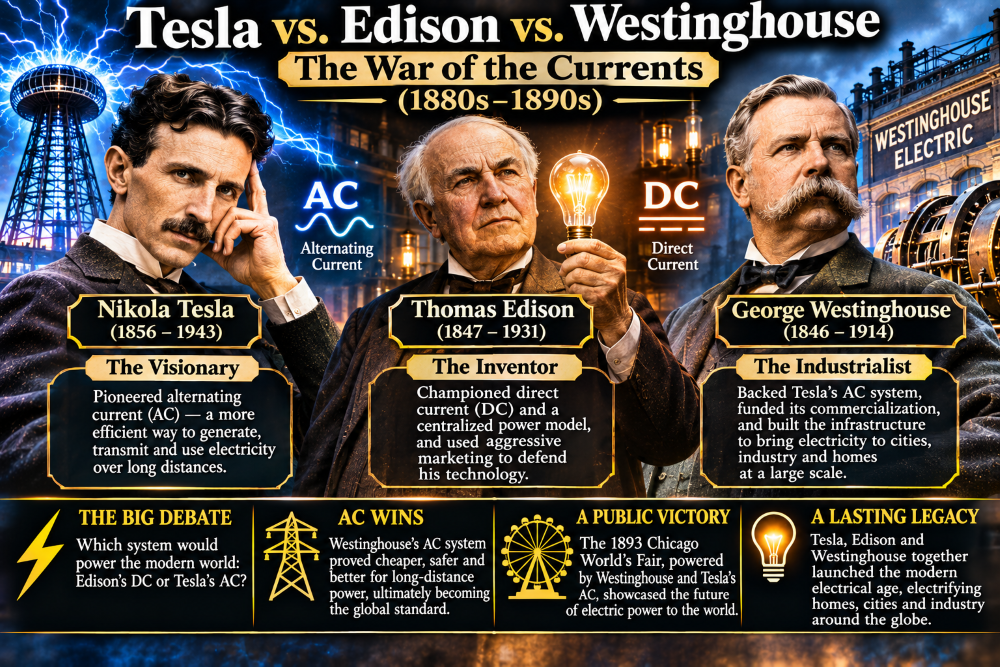
In the 1880s and 1890s, a bitter fight broke out over how electricity should be delivered to homes and factories. The War of the Currents pitted Thomas Edison‘s direct current (DC) against the alternating current (AC) championed by George Westinghouse and powered by Nikola Tesla’s inventions. It was a battle of technology, but also of marketing, patents, financing, and public fear, and its outcome shaped the electrical grid we still use.
The Setup: Edison’s Direct Current
Thomas Edison was already famous for the practical incandescent light bulb, and he wanted to build the system that powered it.
- In 1882, his company opened the Pearl Street Station in Manhattan, one of the first commercial central power stations.
- It supplied direct current, which flows in one direction, to nearby customers.
- Edison built a business around selling generators, wiring, lamps, and the whole system.
DC worked well, but it had a major weakness.
The Problem With DC
Direct current could not travel far at useful voltages without large energy losses.
- Power plants had to be located close to customers, often within about a mile.
- Covering a city or region would require many stations.
- Rural and long-distance delivery was expensive or impractical.
This limit created an opening for a competing technology.
The Challenger: Alternating Current
Alternating current changes direction many times per second. Its great advantage is that its voltage can be changed easily with transformers.
- Power can be sent at high voltage over long distances with lower losses.
- The voltage is then reduced for safe use in homes and businesses.
- This allows large central power plants to serve wide areas.
The Three Players
- Thomas Edison: The famous inventor and entrepreneur, committed to DC and invested in its success.
- George Westinghouse: A Pittsburgh industrialist, already successful with his railway air brake invention, who saw AC’s potential and founded Westinghouse Electric in 1886.
- Nikola Tesla: A Serbian-born engineer who arrived in the United States in 1884, briefly worked for Edison, and developed an AC induction motor and polyphase systems.
In 1888, Westinghouse licensed Tesla’s patents. This gave Westinghouse a practical AC motor, a key piece of the puzzle.
The Fight Gets Ugly
A Public Relations War
Edison and his allies tried to turn public opinion against AC by emphasizing its dangers.
- Edison associates, including Harold Brown, staged public demonstrations in which animals were electrocuted with AC.
- The campaign aimed to portray AC as deadly and DC as safer.
- Critics have described these demonstrations as gruesome stunts designed to scare the public and regulators.
The Electric Chair
The fight also involved the electric chair.
- New York State adopted electrocution as a method of execution, and AC was used.
- Edison’s side was linked to promoting AC for this purpose, partly to associate it with death.
- The first execution, of William Kemmler in 1890, was badly botched.
Westinghouse was reportedly dismayed at the use of his technology in this way. These episodes remain one of the darkest parts of the business rivalry.
The Turning Points
Westinghouse Gains Ground
Several developments tilted the contest toward AC.
- Financing and mergers: In 1892, Edison’s company merged with a rival to form General Electric, backed by financier J.P. Morgan. Edison lost control, and the new company moved toward AC as well.
- The 1893 World’s Columbian Exposition in Chicago: Westinghouse won the contract to light the fair, reportedly by submitting a lower bid, and used Tesla’s AC system. Millions of visitors saw it in action.
- Niagara Falls: Westinghouse’s AC system was chosen to harness the power of Niagara Falls. Power was transmitted to Buffalo, roughly 26 miles away, in 1896, a dramatic demonstration of long-distance transmission.
Why AC Won
AC prevailed for practical economic reasons.
- It could be generated at large, efficient plants and sent over long distances.
- It made electricity cheaper and more widely available.
- It scaled to cities, factories, and eventually entire nations.
The Human Side
Westinghouse’s Strain
Westinghouse’s company faced severe financial pressure in the early 1890s, and he reportedly asked Tesla to release him from a costly royalty arrangement. According to popular accounts, Tesla agreed, a decision that cost him potential riches.
Tesla’s Later Years
Tesla became famous for his inventions, but he struggled financially in later life and died in 1943 with little money, even though his work became foundational to modern power systems. Edison, meanwhile, remained one of America’s best-known inventors.
Legacy
- AC became the standard for power grids around the world.
- DC did not disappear. It remains important for batteries, electronics, and modern high-voltage direct current transmission lines.
- The episode is often cited as an example of a standards battle, in which technology, marketing, and finance all matter.
Lessons from the War of the Currents
- Better technology does not win automatically. Marketing, financing, and public perception shaped the outcome.
- Scale and network effects matter. AC’s ability to serve large areas gave it a decisive advantage.
- Be willing to adapt. Edison’s company eventually adopted AC through the General Electric merger.
- Ethics matter. Fear campaigns and harmful demonstrations damaged reputations.
Frequently Asked Questions
What was the War of the Currents? It was a late 19th-century competition over whether direct current (DC) or alternating current (AC) would become the standard for electric power, involving Edison, Westinghouse, and Tesla.
Why did AC win over DC? AC could be transmitted over long distances at high voltage and then reduced for safe use, allowing large central power plants to serve wide areas more cheaply than DC.
What role did Nikola Tesla play? Tesla developed the AC induction motor and polyphase systems, which Westinghouse licensed in 1888 and used to build practical AC power systems.
Did Edison really support the electric chair? Edison and his associates were linked to efforts to associate AC with execution, and electrocution using AC was adopted in New York, though historians debate the exact extent of Edison’s personal role.
Related Articles
- Standard Oil Trust: How a Legal Device Built a Monopoly
- Cecil Rhodes and De Beers: Building a Diamond Monopoly
- Krupp and Siemens: Steel, Electricity and Empire
- German Chemical Industry: The Birth of Corporate R&D
- Zaibatsu: Iwasaki Yataro and Meiji Japan’s Mitsubishi
- Goldman Sachs and Lehman Brothers: Wall Street’s Rise
- Gustavus Swift: The Refrigerated Railcar That Fed America
About The History of Entrepreneurship
This article is part of The History of Entrepreneurship, an ongoing series exploring how entrepreneurs, civilizations, technologies, financial institutions, and business innovations gradually created the modern economy.
Leave a Reply