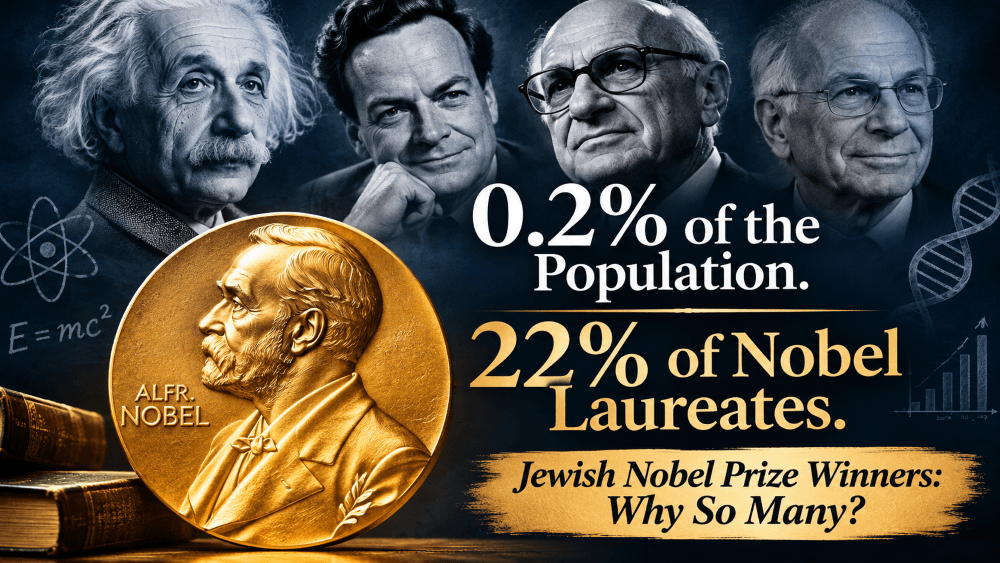
Imagine a group representing just 0.2% of the world’s population producing more than 22% of all individual Nobel Prize laureates. This is the remarkable story of Jewish Nobel Prize winners, one of the most striking examples of intellectual overrepresentation in modern history.
How did such a small population produce so many of the world’s most celebrated scientists, economists, writers, and thinkers?
The answer takes us through centuries of Jewish history, educational traditions, religious scholarship, persecution, migration, and the rise of modern universities.
It also raises a fascinating question: What can the rest of the world learn from the educational and intellectual traditions that helped produce these achievements?
Jewish Nobel Prize Winners: The Extraordinary Numbers
The Nobel Prizes were first awarded in 1901, recognizing outstanding achievements in physics, chemistry, medicine, literature, and peace. The Nobel Memorial Prize in Economic Sciences was added in 1969.
According to a historical compilation covering 1901–2025, 223 of 990 individual Nobel laureates were Jewish or had Jewish ancestry under the compilation’s definition.
That represents approximately 22.5% of individual laureates, even though Jewish people account for roughly 0.2% of the world’s population today.
Put differently, the Jewish share of Nobel laureates is approximately 110 times the community’s current share of the global population.
This comparison is striking, although it is not a precise measure of historical opportunity. The Jewish share of the world population has changed over time, and Nobel-winning institutions have been concentrated in particular countries.
Nevertheless, the pattern of Jewish achievement across multiple disciplines is unmistakable.
How Many Nobel Prizes Have Jewish People Won?
The following table breaks down Jewish Nobel laureates by category, using one consistent historical compilation through 2025.
| Nobel Prize Category | Jewish Laureates | Share of Category |
|---|---|---|
| Physics | 60 | 26% |
| Chemistry | 37 | 19% |
| Physiology or Medicine | 60 | 26% |
| Economic Sciences | 40 | 40% |
| Literature | 17 | 14% |
| Peace | 9 | 8% |
| Total | 223 | Approximately 22.5% overall |
Source: Nobel Jews, using Nobel Foundation prize records and a documented ancestry-based classification. These figures count individuals, not the number of entire prizes awarded.
Different compilations produce slightly different totals because Jewish identity can be defined through religion, self-identification, upbringing, or ancestry.
Economics: An Especially Remarkable Achievement
Perhaps the most surprising figure is in economics.
Approximately 40% of Nobel Memorial Prize laureates in Economic Sciences through 2025 were Jewish or of Jewish ancestry under this classification.
Jewish economists have profoundly influenced how we understand markets, incentives, human behavior, financial systems, and public policy.
Among them are Milton Friedman, Paul Samuelson, Kenneth Arrow, and Daniel Kahneman.
The concentration in economics invites further investigation into academic networks, mathematical education, intellectual debate, and the development of economics departments in American universities.
Why Have Jewish People Won So Many Nobel Prizes?
There is no single explanation for this extraordinary record.
Instead, historians and social scientists point to several overlapping influences.
1. A Centuries-Old Tradition of Education
Jewish culture has long placed considerable importance on literacy, scholarship, and the interpretation of written texts.
In traditional Jewish communities, religious education involved studying the Torah, analyzing the Talmud, and debating different interpretations.
Students were encouraged to examine arguments, identify contradictions, and defend their reasoning.
These practices developed long before modern universities existed.
The economists Maristella Botticini and Zvi Eckstein, in their book The Chosen Few: How Education Shaped Jewish History, 70–1492, examine how historical investments in literacy and education influenced Jewish economic and occupational development.
Their work offers an important perspective on how educational institutions can influence the economic trajectory of a community over many generations.
2. A Culture That Values Questions and Debate
One distinctive feature of traditional Talmudic scholarship is its emphasis on competing interpretations.
Rather than simply memorizing conclusions, students learn to examine why different authorities disagree.
Scientific research also depends on questioning assumptions, evaluating evidence, and testing explanations.
The parallel is intriguing, although it would be an oversimplification to suggest that Talmudic education directly caused modern scientific achievement.
The broader lesson is that communities that value intellectual engagement can create environments supportive of scholarship.
3. Historical Restrictions Encouraged Certain Professions
For centuries, Jewish communities in parts of Europe experienced restrictions on land ownership, membership in professional guilds, and access to certain occupations.
These restrictions varied considerably by country and historical period.
In some places, Jewish families became concentrated in commerce, finance, medicine, and other occupations where education and transferable skills were valuable.
Knowledge could be carried across borders even when property could not.
Over generations, some communities developed professional traditions and networks that helped later generations pursue higher education and specialized careers.
However, persecution also caused enormous losses of life, wealth, opportunity, and intellectual potential.
4. The Transformation of European Universities
During the nineteenth and early twentieth centuries, European science underwent a remarkable transformation.
Universities in Germany, Austria-Hungary, France, Britain, and elsewhere became centers of research in physics, chemistry, mathematics, and medicine.
As legal restrictions were relaxed in parts of Europe, increasing numbers of Jewish students entered secular universities.
Many were attracted to emerging scientific disciplines, where new discoveries could challenge established ideas.
This historical timing matters.
The Nobel Prizes began in 1901, during a period when Jewish intellectuals were increasingly participating in some of the world’s most influential research institutions.
5. Jewish Immigration Strengthened American Science
The rise of Nazism in Germany and the persecution of European Jews forced many scholars to flee their homes.
Some found refuge in the United States, where universities and research institutions offered opportunities to continue their work.
Albert Einstein, Hans Bethe, and numerous other scientists contributed to the development of American research.
The United States benefited enormously from this migration of intellectual talent.
One historical compilation identifies 50 refugees or exiles among 223 Jewish Nobel laureates through 2025.
This history illustrates both the destructive consequences of persecution and the importance of societies that welcome talented immigrants.
6. Education as a Form of Family and Social Capital
In many Jewish families, education has historically represented more than a pathway to employment.
It has also been associated with social respect, intellectual achievement, and opportunities for future generations.
Parents who emphasize education may encourage children to pursue demanding academic careers.
Professional networks, mentorship, and access to universities can reinforce these opportunities.
Such advantages can accumulate over generations, particularly when combined with supportive institutions and research funding.
These patterns are not universal among Jewish families, nor are they exclusive to Jewish communities.
Is Jewish Nobel Prize Success Explained by Genetics?
Whenever one population achieves unusually high representation in a particular field, questions about intelligence and heredity sometimes arise.
Intelligence-related traits are influenced by both genetic and environmental factors.
However, there is no convincing evidence demonstrating that genetic differences explain Jewish overrepresentation among Nobel Prize winners.
Nobel Prizes do not measure intelligence directly. They recognize specific achievements that depend on education, opportunity, collaboration, resources, and historical circumstances.
Furthermore, Jewish populations are genetically, culturally, geographically, and religiously diverse.
The available evidence supports investigating educational, institutional, and historical explanations rather than assuming an inherent biological advantage.
What Can We Learn From This History?
The story of Jewish Nobel Prize winners provides several lessons that extend beyond any particular religion or community.
- Education has long-term consequences. Investments in literacy and advanced learning can influence opportunities across generations.
- Intellectual debate matters. Encouraging people to question ideas can strengthen critical thinking.
- Institutions create opportunities. Universities, laboratories, mentorship, and research funding help talented individuals achieve their potential.
- Migration can enrich societies. Countries that welcome scholars and researchers may benefit from their knowledge and discoveries.
- Cultural priorities can shape outcomes. Families and communities influence which achievements are encouraged and celebrated.
None of these lessons guarantees a Nobel Prize.
But together, they offer a useful framework for understanding how societies can cultivate intellectual achievement.
Conclusion: A Small Population With an Extraordinary Intellectual Legacy
Jewish Nobel Prize winners have made extraordinary contributions to physics, chemistry, medicine, economics, literature, and peace.
Their achievements are especially striking when compared with the relatively small size of the global Jewish population.
Yet the most meaningful explanation is not found in a single cultural characteristic or a simple statistical comparison.
It emerges from the interaction of educational traditions, historical occupational patterns, migration, institutional opportunities, and exceptional individual accomplishments.
Perhaps the most valuable lesson is that human potential flourishes when education, intellectual curiosity, and opportunity reinforce one another.
That is a lesson worth studying far beyond the history of the Nobel Prizes.
Top 10 most famous Jewish Nobel Prize winners
A selection based on broad public recognition and historical influence, rather than an objective ranking of importance.
1. Albert Einstein Physics · 1921
Revolutionized modern physics through relativity and quantum theory. His Nobel Prize recognized his explanation of the photoelectric effect.
2. Niels Bohr Physics · 1922
A pioneer of atomic structure and quantum mechanics, born to a Jewish mother and a Lutheran father.
3. Richard Feynman Physics · 1965
Helped develop quantum electrodynamics and became one of the most celebrated science communicators of the twentieth century.
4. Milton Friedman Economic Sciences · 1976
Influential economist known for his research on monetary policy, consumption, and economic freedom.
5. Daniel Kahneman Economic Sciences · 2002
Transformed behavioral economics through research on judgment, decision-making, and cognitive biases. Author of Thinking, Fast and Slow.
6. Jonas Salk — Not a Nobel Prize winner
Jonas Salk, who developed the first successful polio vaccine, was Jewish and internationally renowned, but never received a Nobel Prize.
7. Bob Dylan Literature · 2016
The legendary American singer-songwriter was honored for his poetic contributions to the American musical tradition. nobelprize.org
8. Elie Wiesel Peace · 1986
Holocaust survivor, author of Night, and advocate for human rights and remembrance. nobelprize.org
9. Henry Kissinger Peace · 1973
American diplomat and secretary of state recognized for Vietnam ceasefire negotiations. His award was highly controversial. nobelprize.org+1
10. Steven Weinberg Physics · 1979
Helped develop the theory unifying electromagnetic and weak nuclear interactions, a cornerstone of modern particle physics.
Frequently asked questions
1. What percentage of Nobel Prize winners are Jewish?
Approximately 22%–23% of individual Nobel laureates through 2025 were Jewish or had Jewish ancestry, depending on the classification used.
2. Which Nobel Prize category has the highest Jewish representation?
Economic Sciences, at approximately 40% of individual laureates through 2025.
3. Who was the first Jewish Nobel Prize winner?
Adolf von Baeyer, who had Jewish ancestry through his mother, received the 1905 Nobel Prize in Chemistry. Wikipedia
4. Why are Jewish people so successful in Nobel Prize research?
Historians point to educational traditions, occupational history, access to European and American research institutions, migration, and professional networks. The relative importance of these influences remains a subject of research.
Sources and further reading
- NobelPrize.org — Official Nobel Prize facts
- Nobel Jews — Category statistics through 2025
- Nobel Jews — Classification methodology
- JINFO — Jewish Nobel Prize winners
- The Chosen Few: How Education Shaped Jewish History, 70–1492
Leave a Reply