Daily Market Review | Wednesday, November 4, 2026 | AlainGuillot.com
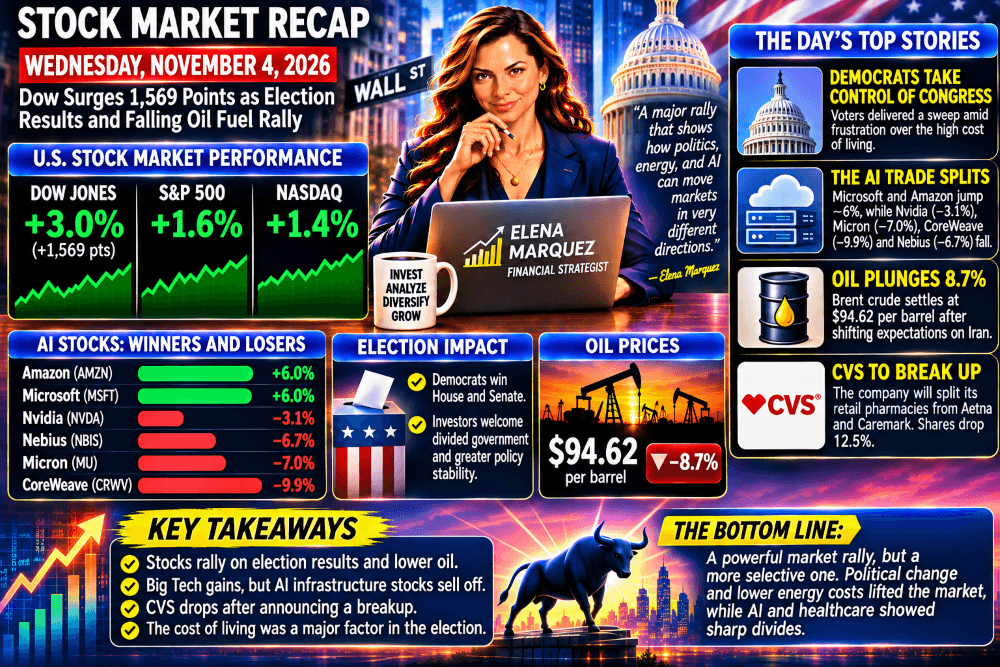
Wall Street staged a powerful rally Wednesday as investors reacted to a sweeping Democratic victory in the U.S. midterm elections, a dramatic collapse in oil prices, and major changes in expectations for the artificial intelligence industry.
The Dow Jones Industrial Average jumped 1,569 points, or approximately 3.0%, while the S&P 500 gained 1.6% and the Nasdaq Composite advanced 1.4%.
Investors appeared to welcome the prospect of divided government, which could limit abrupt policy changes on tariffs, federal spending, and foreign affairs.
But the day’s gains concealed significant differences between industries.
Microsoft and Amazon surged approximately 6%, while Nvidia, Micron, and several AI data center operators declined sharply.
Brent crude oil plunged 8.7% to $94.62 per barrel, while CVS Health dropped 12.5% after announcing plans to separate its retail pharmacy business from its insurance and pharmacy-benefit operations.
The central theme of November 4 was a major reassessment of political risk, energy prices, and the economics of artificial intelligence.
1. How the Major Indexes Performed
U.S. Stock Market Performance
Wednesday, November 4, 2026 | Daily Change
Approximate closing performance based on the supplied November 4 market report.
The Dow led Wednesday’s advance, gaining more than 1,500 points in one session.
The S&P 500 and Nasdaq also recorded substantial gains, although technology stocks showed very different reactions depending on their exposure to AI infrastructure.
The rally suggested that investors were reassessing the economic and regulatory environment following the elections.
However, a broad index rally does not necessarily mean that every industry is becoming more attractive.
2. Midterm Elections: Democrats Take Congress
The biggest political story was the Democratic Party’s victory in both chambers of Congress.
After two years of rising prices, housing affordability problems, and frustration over energy costs, voters delivered a significant change in Washington’s political balance.
According to the Associated Press voter survey cited in the supplied report, approximately 39% of respondents identified the economy as the country’s most important issue.
Nearly 90% considered the cost of living either a crucial or major factor in their voting decision.
These findings highlight how deeply inflation and affordability concerns have affected American households.
Why Wall Street welcomed the results
Investors often view divided government as a potential source of stability.
When the presidency and Congress are controlled by opposing parties, major legislative changes may become more difficult to implement.
This can reduce the likelihood of sudden shifts in taxation, regulation, and government spending.
However, divided government can also create uncertainty through legislative gridlock, budget disputes, and difficulties addressing economic challenges.
Wednesday’s rally reflected investors’ immediate interpretation of the election results rather than proof that any particular political arrangement guarantees stronger stock returns.
3. The AI Trade Splits: Hyperscalers Win, Data Center Stocks Lose
One of Wednesday’s most striking developments was the split within the artificial intelligence industry.
Large technology companies such as Microsoft and Amazon rallied strongly.
Meanwhile, smaller cloud infrastructure providers and semiconductor companies suffered substantial declines.
AI Stocks: Winners and Losers
Wednesday, November 4, 2026 | Daily Returns
Why did Microsoft and Amazon rise?
Newly elected Democratic governors in states such as Texas and Ohio could make the approval and construction of new data centers more difficult.
If construction slows, existing data center capacity may become more valuable.
Large technology companies already operate extensive cloud computing infrastructure.
They also possess substantial financial resources and established relationships with governments, utilities, and regulators.
These advantages could help them navigate a more restrictive environment.
Why did CoreWeave and Nebius fall?
Companies such as CoreWeave and Nebius depend heavily on expanding their computing capacity.
Their growth strategies often require significant investments in buildings, electricity, processors, and financing.
If new projects face delays or restrictions, future revenue growth could become less predictable.
CoreWeave fell 9.9%, while Nebius declined 6.7%.
The market appeared to be pricing in the possibility of slower infrastructure expansion.
Why did Nvidia and Micron decline?
Nvidia lost 3.1%, while Micron fell 7.0%.
Both companies supply important components used in computing infrastructure.
If investors expect fewer data centers to be built, they may also anticipate slower growth in demand for processors and memory.
That doesn’t mean AI demand has disappeared.
It means investors are reconsidering the pace at which demand will translate into hardware purchases.
The AI revolution can continue while individual companies experience dramatically different investment outcomes.
4. Oil Prices Plunge 8.7% as Iran War Expectations Shift
Energy markets experienced one of the day’s most dramatic moves.
Brent crude futures fell 8.7%, settling at $94.62 per barrel.
The decline accelerated after Vice President JD Vance attributed Republican election losses partly to the war involving Iran.
Reports also emerged that President Donald Trump was considering replacing Defense Secretary Pete Hegseth, although Trump denied those reports.
Investors interpreted the developments as potentially increasing the likelihood of a change in U.S. policy toward the conflict.
Why oil prices reacted so strongly
Oil prices reflect expectations about future supply disruptions.
When geopolitical tensions threaten production or transportation, traders often demand a higher price for crude oil.
If the perceived risk of conflict decreases, that geopolitical premium can decline quickly.
Wednesday’s 8.7% fall suggests a substantial shift in market expectations.
What lower oil prices mean for the economy
Lower energy costs can benefit households by reducing gasoline and transportation expenses.
Businesses may also benefit from lower shipping, manufacturing, and operating costs.
If the decline persists, it could help ease inflationary pressure.
However, lower crude prices can hurt energy producers by reducing revenue and profit expectations.
The important question is whether the decline reflects a lasting improvement in geopolitical conditions or a temporary change in investor sentiment.
5. CVS Announces a Major Corporate Breakup
CVS Health delivered one of the day’s biggest corporate announcements.
The company said it plans to separate its retail pharmacy operations from its insurance and pharmacy-benefit businesses.
The proposed restructuring would create two companies.
One would contain Aetna, the health insurance business, and Caremark, the pharmacy-benefit manager.
The other would operate approximately 9,000 CVS retail pharmacies.
The decision reverses a major trend toward consolidation in the healthcare industry.
Why CVS wants to separate its businesses
Large corporations sometimes combine businesses to achieve cost savings, expand customer relationships, or gain competitive advantages.
However, combining different operations can also create complexity.
Retail pharmacies, health insurance, and pharmacy-benefit management have different economics, regulatory risks, and capital requirements.
Separating the businesses could allow management teams to focus more closely on their respective operations.
Investors, however, reacted negatively.
CVS shares declined 12.5%.
The sharp fall suggests concerns about the restructuring’s financial consequences, execution risks, or the future profitability of the separated businesses.
A corporate breakup doesn’t automatically create shareholder value.
Its success depends on the financial strength and operating performance of the resulting companies.
6. The Cost of Living Drives Political Change
Beyond the immediate stock-market reaction, the midterm elections highlighted a major economic issue: household affordability.
Voters expressed frustration over rising prices, housing costs, and gasoline expenses.
According to the survey figures cited in the supplied report, nearly nine in ten voters considered the cost of living a major or crucial issue.
This suggests that inflation remains politically important even when the rate of price increases slows.
Lower inflation doesn’t necessarily mean lower prices
One important distinction is that a decline in inflation means prices are rising more slowly.
It doesn’t necessarily mean that prices are falling.
For households struggling with rent, food, insurance, and transportation costs, slower inflation may offer limited immediate relief.
The political consequences can be significant.
For investors, affordability concerns could influence future policies involving housing, healthcare, energy, and consumer spending.
7. The Day’s Biggest Market Movers
| Company or asset | Daily change |
|---|---|
| Amazon | Approximately +6% |
| Microsoft | Approximately +6% |
| Nvidia | −3.1% |
| Nebius | −6.7% |
| Micron | −7.0% |
| CoreWeave | −9.9% |
| CVS Health | −12.5% |
| Brent crude oil | −8.7% |
The contrast between winners and losers was remarkable.
The Dow gained 3%, but several prominent companies suffered substantial losses.
The market rewarded businesses perceived to have strong existing infrastructure and financial resources.
At the same time, investors reduced exposure to companies facing regulatory uncertainty, expensive expansion plans, or major restructuring challenges.
8. What Investors Should Watch Next
Several developments could determine whether Wednesday’s rally continues.
- AI data center regulation: Will newly elected governors introduce restrictions on new construction?
- Technology spending: Will Microsoft, Amazon, and other hyperscalers maintain their planned infrastructure investments?
- Semiconductor demand: Could slower data center construction affect orders for Nvidia and Micron?
- Oil prices: Will Brent remain below $100, or will geopolitical tensions trigger another rebound?
- CVS restructuring: What financial details will emerge about the proposed separation?
- Economic policy: How will the new Congress approach inflation, housing affordability, and healthcare?
- Employment data: Friday’s scheduled jobs report could influence expectations for Federal Reserve interest-rate policy.
The coming weeks could reveal whether Wednesday’s rally reflects a durable improvement in sentiment or a temporary reaction to political developments.
9. The Biggest Investment Lesson of November 4
Wednesday demonstrated why investors should avoid treating entire industries as if every company has the same prospects.
Microsoft and CoreWeave both participate in the artificial intelligence economy.
Yet their business models, financial resources, and exposure to infrastructure expansion are very different.
Microsoft has established revenue streams and extensive existing infrastructure.
CoreWeave is more dependent on continued growth in AI computing capacity.
A slowdown in new construction could affect these companies in very different ways.
The same principle applies to energy and healthcare.
Falling oil prices can benefit consumers while hurting oil producers.
A corporate restructuring can create opportunities but also introduce significant uncertainty.
Successful investing requires understanding not only where an industry is going, but also how individual companies make money and what risks they face.
Conclusion: A Historic Rally Reveals a Changing Market
November 4 was an extraordinary day on Wall Street.
The Dow jumped 1,569 points, the S&P 500 gained 1.6%, and the Nasdaq rose 1.4%.
Investors welcomed the election results and the possibility of greater political stability.
Oil prices plunged as expectations surrounding the Iran conflict shifted.
But the technology sector experienced a sharp divide.
Microsoft and Amazon surged, while Nvidia, Micron, CoreWeave, and Nebius declined.
CVS also suffered a major selloff after announcing plans to split its business.
For long-term investors, the lesson is clear.
A rising market creates opportunities, but it doesn’t eliminate risk. Financial strength, sustainable profitability, competitive advantages, and reasonable valuations remain essential.
Other Stock Market blog posts
Leave a Reply