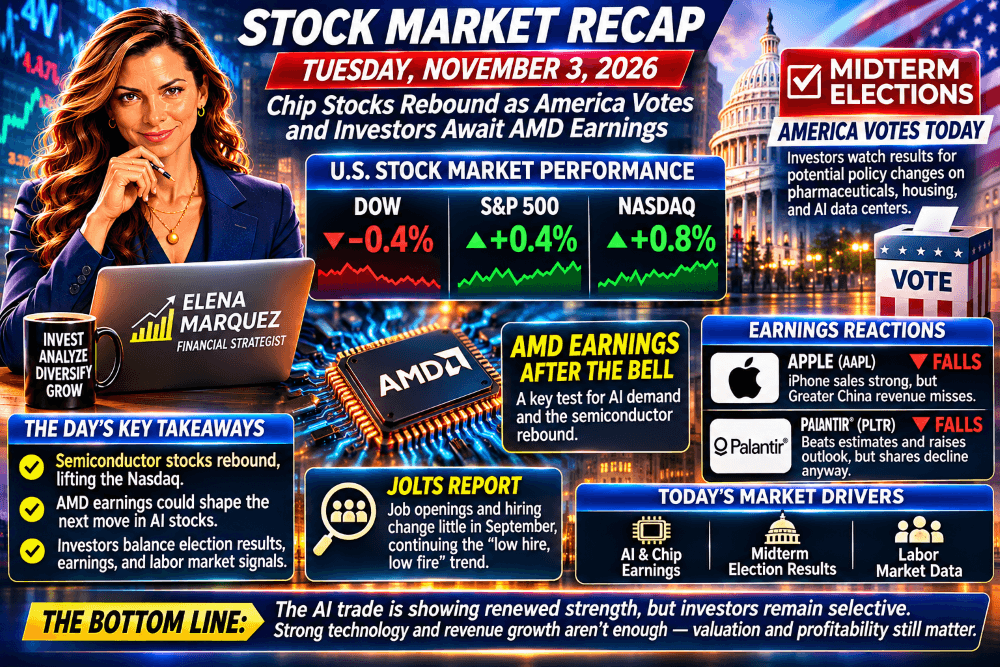
Daily Market Review | Tuesday, November 3, 2026
Wall Street finished Tuesday’s session with mixed results as Americans headed to the polls for the midterm elections and investors prepared for another important round of artificial intelligence earnings.
The Dow Jones Industrial Average declined approximately 0.4%, while the S&P 500 gained 0.4%. The technology-heavy Nasdaq Composite advanced roughly 0.8%, supported by a rebound in semiconductor stocks.
After a difficult October and another round of technology selling on Monday, investors appeared willing to return to selected AI-related companies.
But the recovery remained fragile.
Advanced Micro Devices (AMD) was scheduled to report quarterly earnings after the closing bell, potentially providing fresh evidence about demand for artificial intelligence processors.
Meanwhile, Apple and Palantir declined despite reporting earnings that contained positive developments, and new labor-market data suggested that American employers remain reluctant both to hire and to lay off workers.
The day’s central theme: Investors still believe in artificial intelligence, but they’re becoming much more demanding about earnings, valuations and future profitability.
1. How the Major Indexes Performed
U.S. Stock Market Performance
Tuesday, November 3, 2026 | Daily Change
Tuesday’s performance reversed some of Monday’s pattern.
On Monday, the Dow advanced while technology stocks declined. On Tuesday, the Nasdaq led the market higher while the Dow finished in negative territory.
The shift highlights how quickly investor sentiment can change, particularly during earnings season.
The Nasdaq’s 0.8% advance was encouraging for technology investors, but a single positive session doesn’t necessarily establish a sustained recovery.
The market remains sensitive to corporate earnings, interest rates and expectations for future AI spending.
2. Semiconductor Stocks Rebound After a Difficult October
Semiconductor stocks led Tuesday’s recovery following a turbulent start to November.
Micron Technology, Nvidia and Advanced Micro Devices were among the companies benefiting from renewed interest in chip stocks.
The rebound came after October’s severe selloff in AI-related companies.
The Nasdaq declined approximately 5.2% during October, while the iShares Semiconductor ETF (SOXX) reportedly lost around 17%.
Investors had become increasingly concerned about the enormous amounts of money technology companies were spending on artificial intelligence infrastructure.
But Tuesday’s recovery suggested that some investors saw value after the recent declines.
Is the AI correction over?
It’s too early to tell.
The underlying demand for AI computing remains an important long-term investment theme.
Companies continue building data centers, developing advanced AI models and purchasing specialized processors.
However, strong demand doesn’t automatically guarantee strong shareholder returns.
Valuations matter.
Profit margins matter.
And perhaps most importantly, investors want evidence that the massive capital expenditures associated with AI will eventually generate attractive returns.
Tuesday’s rebound may indicate renewed confidence, but the next round of earnings could quickly change sentiment again.
3. AMD Earnings Could Determine the Next Move in AI Stocks
Advanced Micro Devices was scheduled to report third-quarter earnings after Tuesday’s closing bell.
The announcement comes at a particularly sensitive moment for the semiconductor industry.
AMD is an important competitor in the market for high-performance processors used in data centers and artificial intelligence applications.
Investors will be watching for evidence that demand for AMD’s AI products remains strong.
But the company’s earnings announcement isn’t just about the most recent quarter.
What investors want to know
The most important questions concern data center revenue, AI processor demand, profit margins and management’s outlook for the fourth quarter.
The company’s guidance may prove more important than whether it beats current-quarter earnings estimates.
Intel’s recent experience demonstrated why.
Despite some positive aspects of its third-quarter results, Intel’s disappointing outlook triggered a severe stock-market reaction.
Investors are increasingly focused on what comes next rather than simply celebrating past results.
For AMD, the challenge will be demonstrating that AI demand can support continued growth and profitability.
The market wants more than an exciting AI story. It wants numbers that justify the stock price.
4. Apple Declines Despite Strong iPhone Sales
Apple shares declined Tuesday following the company’s quarterly earnings announcement Monday evening.
Apple’s results contained several encouraging developments, particularly strong iPhone sales.
However, the company also disappointed investors in some areas, including revenue from Greater China.
China remains an important market for Apple, both as a source of consumer demand and as a major part of its global business.
Weaker-than-expected revenue in the region can raise concerns about competition, consumer spending and future growth.
Why a company can beat earnings and still fall
Investors sometimes assume that strong earnings should automatically lead to higher stock prices.
But the market is forward-looking.
A company can report excellent results and still see its stock decline if investors expected even better performance.
Apple’s results illustrate the importance of evaluating a business against market expectations rather than looking only at its reported profits.
The company’s future growth prospects, regional performance and management guidance can matter as much as the headline earnings numbers.
5. Palantir Falls Despite Beating Expectations
Palantir Technologies also declined following its earnings report, even though the company exceeded analysts’ expectations.
Palantir reported strong third-quarter results and raised its full-year revenue outlook.
One notable development was that U.S. commercial revenue exceeded U.S. government revenue for the first time, according to the supplied report.
This suggests that Palantir’s software is gaining traction among private-sector customers.
The company has attracted substantial investor interest because of its artificial intelligence and data analytics platforms.
But its stock remains sensitive to expectations about future growth.
The valuation challenge
Palantir’s earnings demonstrate a recurring theme in today’s market.
A company can be growing quickly, winning customers and raising guidance, yet its shares can still decline.
Why?
Because investors may already have priced substantial future success into the stock.
When expectations become extremely high, even strong results may not be enough.
This is one of the most important risks associated with investing in rapidly growing technology companies.
6. Midterm Elections Put Washington in the Spotlight
Americans headed to the polls Tuesday for the 2026 midterm elections.
Investors are watching the results for clues about future government policies affecting the economy and financial markets.
Several industries could be particularly sensitive to changes in Washington.
Pharmaceuticals
Drug pricing, healthcare regulation and government spending could influence the outlook for pharmaceutical companies.
Housing
Housing affordability, construction incentives and mortgage-related policies could affect homebuilders, lenders and real estate companies.
Artificial intelligence infrastructure
The rapid expansion of AI data centers has raised questions about electricity demand, land use, environmental regulation and infrastructure investment.
Policy changes could influence where and how quickly new data centers are built.
Will the election determine the market’s direction?
Elections can create short-term volatility, particularly when the results differ from expectations.
However, the stock market’s long-term direction depends on many factors beyond politics.
Corporate earnings, economic growth, inflation, interest rates and valuations remain central to investment returns.
Investors should be careful about making large portfolio decisions based solely on election predictions.
7. JOLTS Report: The Labor Market Remains in a “Low Hire, Low Fire” Environment
The U.S. Labor Department released its latest Job Openings and Labor Turnover Survey (JOLTS) on Tuesday.
The report showed that job openings and hiring changed little in September.
Economists have described the current environment as a “low hire, low fire” labor market.
That means employers aren’t aggressively expanding their workforces, but they also aren’t laying off large numbers of workers.
This can create a relatively stable employment environment while making it more difficult for unemployed workers to find new jobs.
Why this matters for the Federal Reserve
The Federal Reserve closely monitors labor-market conditions when making interest-rate decisions.
A labor market that weakens too much could threaten economic growth.
But a labor market that remains too strong could contribute to wage pressures and inflation.
The latest JOLTS report suggests that employment conditions remain relatively stable, although hiring momentum is limited.
Investors will be watching additional labor-market indicators for evidence of whether this balance is changing.
8. The Day’s Biggest Market Stories
November 3 — Market Snapshot
| Market / Company | Development |
| Dow Jones | −0.4% |
| S&P 500 | +0.4% |
| Nasdaq | +0.8% |
| AMD | Quarterly earnings due after the bell |
| Apple | Shares decline after earnings |
| Palantir | Shares decline despite earnings beat |
| JOLTS | Job openings and hiring little changed |
| Midterm elections | Voting underway; results awaited |
Index changes are approximate. No individual share-price percentages were provided for today’s AMD, Apple or Palantir moves.
The day’s most important market development was the rebound in semiconductor stocks.
Investors returned to selected technology companies after October’s sharp correction.
But earnings reactions at Apple and Palantir demonstrated that expectations remain demanding.
Meanwhile, the midterm elections and labor-market data added to the uncertainty surrounding economic policy.
9. What Investors Should Watch Next
Several developments could influence trading over the remainder of the week.
- AMD earnings: Management’s fourth-quarter guidance and commentary about AI processor demand could affect semiconductor stocks.
- Election results: Investors will assess potential changes in policy toward healthcare, housing and AI infrastructure.
- Technology valuations: Markets will continue evaluating whether earnings growth justifies current stock prices.
- Employment data: Friday’s October jobs report could influence expectations for Federal Reserve policy.
- Market breadth: Investors will watch whether the semiconductor rebound spreads to other industries or remains concentrated in technology.
A sustained market recovery would be more convincing if it were supported by improving earnings expectations and broader participation across sectors.
The Bottom Line: AI Stocks Rebound, but Investors Remain Selective
Tuesday’s market action offered some encouragement to technology investors.
The Nasdaq gained approximately 0.8%, supported by a recovery in semiconductor stocks.
But the Dow declined 0.4%, while Apple and Palantir fell following their earnings announcements.
Meanwhile, investors awaited AMD’s results and the outcome of the U.S. midterm elections.
The JOLTS report showed a labor market that remains relatively stable but lacks strong hiring momentum.
The broader lesson is that investors are becoming increasingly selective.
Artificial intelligence remains a powerful long-term investment theme.
But companies must demonstrate that technological innovation can translate into sustainable profits.
The best investments won’t necessarily be the companies with the most exciting technology. They’ll be the companies that deliver the strongest financial returns relative to the price investors pay.
Other Stock Market blog posts
Leave a Reply