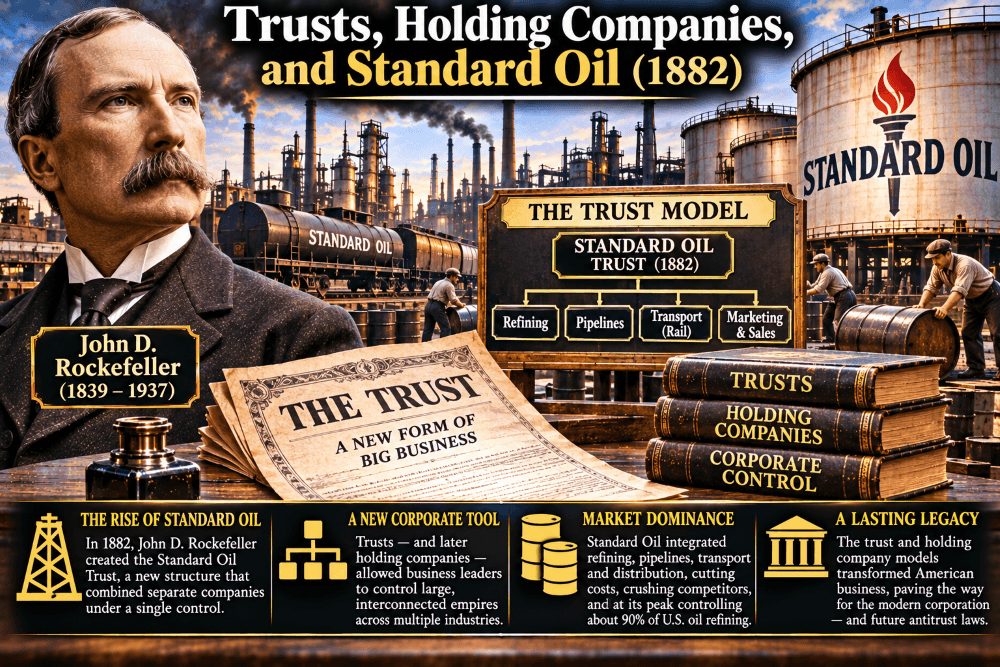
Some of the most important innovations in business history are not machines but legal structures. The Standard Oil Trust, created in 1882, was one of them. It was a clever legal arrangement that let John D. Rockefeller‘s oil empire operate as a single enterprise across state lines, and it gave rise to the word “trust” as a symbol of corporate power. It also set off a public backlash that led to America’s first antitrust laws.
The Problem: A Chaotic Oil Industry
The American oil industry in the 1860s and 1870s was a roller coaster.
- Oil was discovered in Pennsylvania in 1859, and a gold-rush atmosphere followed.
- Prices swung wildly, with booms and busts that ruined many producers and refiners.
- Refining was crowded with small competitors, and oversupply drove profits down.
John D. Rockefeller, who entered refining in Cleveland in the 1860s, saw an opportunity. He believed that bringing order to the industry through consolidation would make it more stable and profitable.
Rockefeller Builds Standard Oil
Consolidating Cleveland
Standard Oil was founded in 1870 in Ohio by Rockefeller and several partners, including Henry Flagler and Samuel Andrews.
- The company focused on efficiency, cost control, and scale.
- It bought out competitors, and in a burst of acquisitions in 1872, sometimes called the “Cleveland Massacre,” it absorbed most of Cleveland’s refineries.
- By the late 1870s, Standard Oil controlled roughly 90 percent of American refining.
Secret Deals and Hard Tactics
Standard Oil’s rise was not only about efficiency. It also relied on aggressive and controversial methods.
- It negotiated secret rebates from railroads in exchange for large, guaranteed shipping volume, giving it a cost advantage over rivals.
- It was accused of using predatory pricing and pressure tactics to squeeze out competitors.
- At the same time, it did lower the cost of kerosene and standardized quality, benefiting consumers.
This combination of real efficiency and ruthless competition is central to the debate about Rockefeller’s legacy.
The 1882 Trust Agreement
A Legal Puzzle
By the early 1880s, Standard Oil had a legal problem. It was a collection of companies in different states, and state laws limited how corporations could own and control businesses elsewhere.
- Corporations were chartered by individual states, with differing rules.
- A company chartered in one state generally could not hold stock in a company in another state.
- Rockefeller needed a way to manage the whole network as one.
The Trust Solution
Standard Oil’s lawyers, including Samuel Dodd, devised an arrangement in 1882 known as the Standard Oil Trust.
- Shareholders of the various Standard Oil companies transferred their shares to a small group of trustees, led by Rockefeller.
- In return, they received trust certificates that gave them a share of the profits.
- The trustees controlled all the companies and could manage them centrally.
The trust allowed coordinated control of refineries, pipelines, and distribution across state lines. It was a legal workaround that turned a collection of companies into a single powerful organization.
Public Backlash and the First Antitrust Law
A Symbol of Corporate Power
The Standard Oil Trust became shorthand for monopoly power. Soon, any large combination was called a “trust.”
- Farmers, small businesses, and reformers worried that these giants could control prices and crush competition.
- Journalists exposed the company’s practices. Ida Tarbell’s investigative series on Standard Oil, published in the early 1900s, shaped public opinion.
Law Catches Up
Governments began to respond.
- In 1890, Congress passed the Sherman Antitrust Act, the first federal law aimed at restraining monopolies and trusts.
- In 1892, the Ohio Supreme Court ordered the Standard Oil Trust dissolved.
- The company reorganized, but the underlying control remained.
From Trust to Holding Company
A New Legal Tool
After the trust was dissolved, a different legal structure emerged.
- In 1889, New Jersey passed a law allowing corporations to own stock in other corporations, creating the modern holding company.
- A holding company is a parent company that owns controlling shares in other companies, called subsidiaries.
- In 1899, Standard Oil reorganized around Standard Oil Company of New Jersey as a holding company.
This approach allowed centralized control in a legal form that lasted, and it spread widely across American business.
The Breakup in 1911
The government pursued Standard Oil in court.
- In 1911, the U.S. Supreme Court ruled that Standard Oil was an unlawful monopoly and ordered it broken into dozens of separate companies.
- The successors included companies that later grew into major oil firms, such as those that became ExxonMobil and Chevron.
- Rockefeller remained enormously wealthy, since he held shares in the successor companies.
Why It Still Matters
Holding Companies Today
The holding company structure Standard Oil helped popularize remains common.
- Many modern conglomerates, including Berkshire Hathaway and Alphabet, use holding-company structures.
- Such structures allow ownership and control of many businesses under a single parent.
The Ongoing Debate
The questions raised by Standard Oil remain current.
- When does scale create efficiency, and when does it harm competition?
- How should governments regulate dominant firms?
- These debates continue in today’s discussions about technology and other industries.
Lessons from the Standard Oil Trust
- Legal structure can be a competitive weapon. The trust solved a legal problem and enabled centralized control.
- Efficiency and monopoly can coexist. Standard Oil lowered costs and also crushed rivals.
- Success invites regulation. Public backlash led to antitrust laws and the company’s breakup.
- Structures evolve. The trust gave way to the holding company, which endures.
Frequently Asked Questions
What was the Standard Oil Trust? It was a 1882 legal arrangement in which shareholders of various Standard Oil companies transferred their shares to a group of trustees, letting Rockefeller manage the companies as one enterprise.
What is a holding company? A holding company is a parent company that owns controlling shares in other companies, allowing it to control them without necessarily running day-to-day operations.
What was the Sherman Antitrust Act? Passed in 1890, it was the first federal law aimed at restraining monopolies and trusts, though it was weakly enforced at first.
How did Standard Oil end? In 1911, the U.S. Supreme Court ordered Standard Oil broken into dozens of separate companies.
Related Articles
- Cecil Rhodes and De Beers: Building a Diamond Monopoly
- Krupp and Siemens: Steel, Electricity and Empire
- German Chemical Industry: The Birth of Corporate R&D
- Zaibatsu: Iwasaki Yataro and Meiji Japan’s Mitsubishi
- Goldman Sachs and Lehman Brothers: Wall Street’s Rise
- Gustavus Swift: The Refrigerated Railcar That Fed America
- Alexander Graham Bell: The Telephone and a Patent Race
About The History of Entrepreneurship
This article is part of The History of Entrepreneurship, an ongoing series exploring how entrepreneurs, civilizations, technologies, financial institutions, and business innovations gradually created the modern economy.
Leave a Reply